
The Birch and Swinnerton-Dyer conjecture
Introduction and Historical Context
The Birch and Swinnerton-Dyer (BSD) conjecture represents one of the most profound and technically demanding open problems in modern arithmetic geometry and number theory. Recognized globally as one of the seven Millennium Prize Problems by the Clay Mathematics Institute, the conjecture postulates a deep, structural relationship between the discrete algebraic properties of an elliptic curve and the continuous, complex analytic properties of its associated L-function 12.
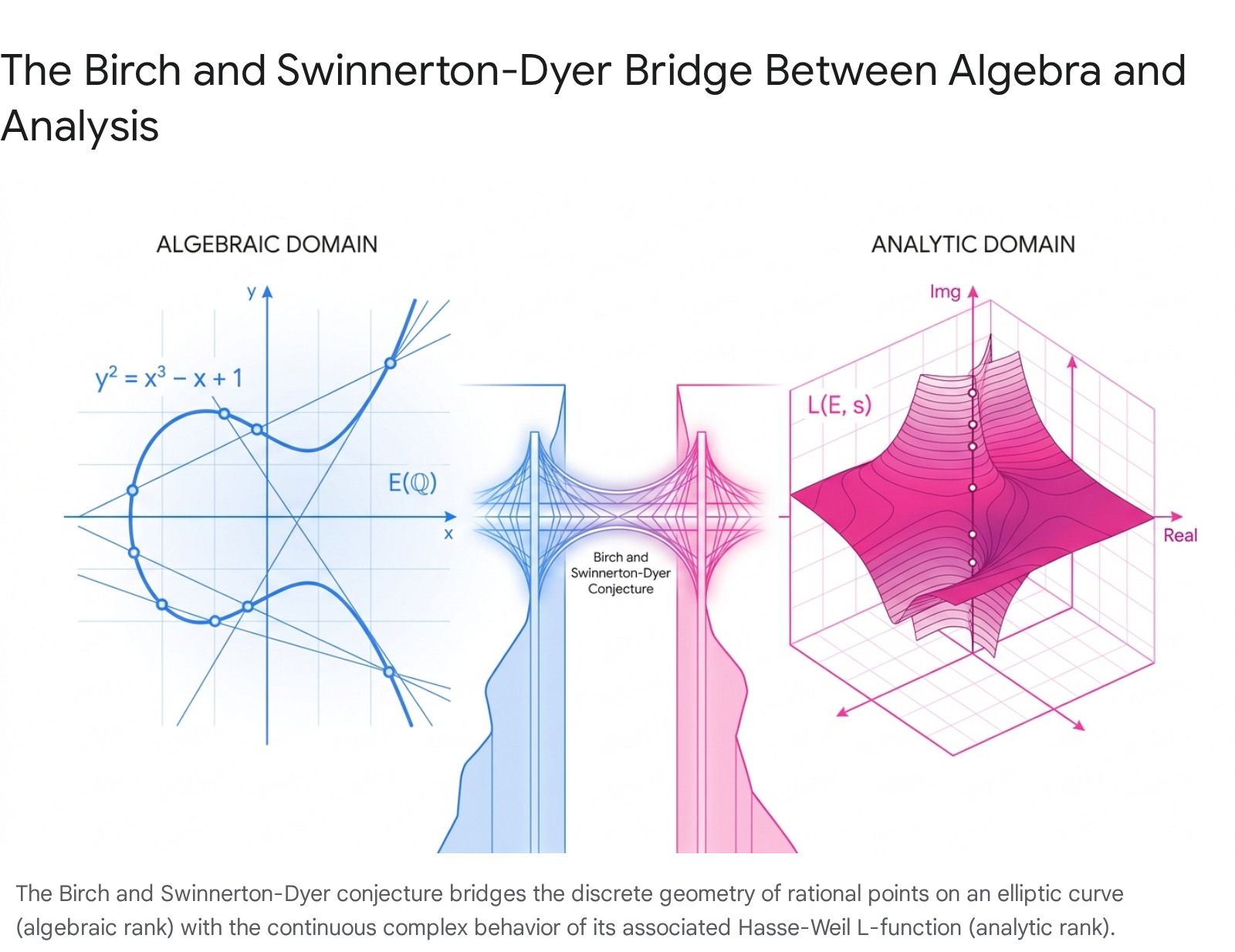
The conjecture traces its origins to the early 1960s at the University of Cambridge, where mathematicians Bryan Birch and Peter Swinnerton-Dyer leveraged the EDSAC-2 computer to perform pioneering numerical experiments 234. The researchers sought to understand the distribution of rational points on elliptic curves by calculating the number of solutions to these equations modulo various prime numbers 2. They observed an unexpected and striking asymptotic pattern: the growth rate of the number of points over finite fields appeared directly correlated with the number of independent rational points of infinite order on the curve 34.
This empirical observation laid the groundwork for a formal conjecture that bridges two historically disparate domains: the algebraic geometry governing Diophantine equations and the analytic number theory governing complex power series 46. An unconditional proof of the conjecture would not only provide a systematic mechanism for classifying the rational solutions to cubic equations but would also vindicate the overarching mathematical philosophy that global algebraic phenomena are intrinsically governed by local analytic data 35.
Algebraic Foundations of Elliptic Curves
To rigorously articulate the conjecture, it is necessary to establish the algebraic objects under investigation. An elliptic curve $E$ defined over a field $K$ (typically the field of rational numbers $\mathbb{Q}$) is a smooth, projective algebraic curve of genus one, equipped with a distinguished rational base point $\mathcal{O}$ functioning as the point at infinity 67.
Assuming the characteristic of the underlying field is not 2 or 3, any such curve can be represented by an affine Weierstrass equation of the form:
$$y^2 = x^3 + ax + b$$
where the coefficients $a, b \in \mathbb{Q}$ 468. The requirement that the curve is smooth (lacking cusps or self-intersections) is algebraically equivalent to the condition that its discriminant, $\Delta = -16(4a^3 + 27b^2)$, is non-zero 7910.
The Mordell-Weil Group and Algebraic Rank
The fundamental algebraic property of an elliptic curve is that its set of rational points, denoted $E(\mathbb{Q})$, possesses the structure of an abelian group 3411. The group operation is defined geometrically via the "chord and tangent" method: a line intersecting the curve at two rational points will necessarily intersect the curve at a third rational point. Reflecting this third point across the horizontal axis produces the geometric sum of the original two points 349.
In 1922, Louis Mordell established that the group of rational points $E(\mathbb{Q})$ is finitely generated 29. This result, later extended to abelian varieties over number fields by André Weil, dictates that the group decomposes into a direct sum:
$$E(\mathbb{Q}) \cong \mathbb{Z}^r \oplus E(\mathbb{Q})_{\text{tors}}$$
The component $E(\mathbb{Q})_{\text{tors}}$ represents the torsion subgroup, consisting of all points of finite order 5612. The structure of this torsion subgroup is highly constrained. According to a landmark theorem proven by Barry Mazur, the torsion subgroup of any elliptic curve defined over the rational numbers must be isomorphic to one of exactly 15 specific finite abelian groups 513.
| Torsion Subgroup Structure | Permitted Values |
|---|---|
| $\mathbb{Z}/n\mathbb{Z}$ | $1 \le n \le 10$, or $n = 12$ |
| $\mathbb{Z}/2\mathbb{Z} \oplus \mathbb{Z}/2n\mathbb{Z}$ | $1 \le n \le 4$ |
Because the torsion subgroup is universally bounded and algorithmically computable (via the Nagell-Lutz theorem), the primary difficulty in understanding the arithmetic of an elliptic curve lies in the non-torsion component 5. The non-negative integer $r$ is defined as the algebraic rank (or Mordell-Weil rank) of the curve 613. It signifies the number of independent basis points of infinite order 12. An elliptic curve possesses a finite number of rational points if and only if $r = 0$, and an infinite number of rational points if and only if $r > 0$ 12.
Despite Mordell's proof that the rank $r$ is finite, the proof is fundamentally non-constructive. There is currently no known, guaranteed algorithm to unconditionally compute the algebraic rank for an arbitrary elliptic curve over $\mathbb{Q}$ 214.
Analytic Foundations and the L-Function
While the algebraic rank $r$ is a global invariant defined over the rational numbers, the Birch and Swinnerton-Dyer conjecture relates it to an analytic object constructed from local data across all prime numbers 1516.
Local Reduction and Traces of Frobenius
For any prime number $p$, the coefficients of the minimal Weierstrass equation of the elliptic curve can be reduced modulo $p$. For all primes $p$ that do not divide the discriminant $\Delta$ (known as primes of good reduction), the reduced equation defines a non-singular elliptic curve over the finite field $\mathbb{F}_p$ 617.
The number of points on this reduced curve over the finite field is denoted as $N_p$. The trace of the Frobenius endomorphism, $a_p$, is defined as the deviation of the point count from the expected baseline $p+1$:
$$a_p = p + 1 - N_p$$
A foundational theorem by Helmut Hasse establishes a strict bound on this deviation, proving that $|a_p| \le 2\sqrt{p}$ 6. This bound limits the error between the number of points on the curve and the number of elements in the underlying finite field, confirming that $N_p$ scales linearly with $p$.
Construction of the Euler Product
The global analytic object at the center of the conjecture is the Hasse-Weil L-function, $L(E, s)$, a complex variable function $s \in \mathbb{C}$ that aggregates the local point counts $a_p$ 2315. It is formally defined as an Euler product over all prime numbers 616:
$$L(E, s) = \prod_{p \nmid \Delta} \left(1 - a_p p^{-s} + p^{1-2s}\right)^{-1} \prod_{p \mid \Delta} L_p(E, s)^{-1}$$
The first product ranges over all primes of good reduction. The second product handles the finite set of "bad" primes dividing the discriminant, where the reduced curve acquires a singularity 17. At these bad primes, the local factor $L_p(E, s)$ takes a simplified form $(1 - a_p p^{-s})^{-1}$, where $a_p \in {0, 1, -1}$ depending on whether the singularity constitutes additive, split multiplicative, or non-split multiplicative reduction 4918.
Due to the Hasse bound, the infinite Euler product converges absolutely to define a holomorphic function in the complex right half-plane where the real part $\Re(s) > 3/2$ 2617.
Analytic Continuation and the Modularity Theorem
The fundamental obstacle in the mid-20th century was that the Birch and Swinnerton-Dyer conjecture concerns the behavior of the L-function at the specific critical point $s = 1$, which resides strictly outside the region of absolute convergence 25. Evaluating the conjecture required proving that the L-function could be analytically continued across the entire complex plane.
This massive theoretical hurdle was resolved through the proof of the Modularity Theorem. Building on the groundbreaking work of Andrew Wiles and Richard Taylor (who proved modularity for semistable curves in 1995 to resolve Fermat's Last Theorem), the theorem was fully generalized to all elliptic curves over $\mathbb{Q}$ by Breuil, Conrad, Diamond, and Taylor in 2001 2819. The Modularity Theorem establishes that every rational elliptic curve corresponds to a specific type of modular form - a highly symmetric analytic function living on the upper half-plane 319.
Because modular forms possess inherent functional equations and analytic continuations, the L-function of the elliptic curve inherits these properties 28. The L-function $L(E,s)$ is thus analytically continued to an entire function on the complex plane, and it satisfies a functional equation relating its value at $s$ to its value at $2-s$ 618. With this analytic continuation secured, the value and derivatives of $L(E, s)$ at the central point $s = 1$ are rigorously mathematically defined.
The Weak Conjecture: Rank Equality and Parity
The most fundamental formulation of the problem, frequently termed the Weak Birch and Swinnerton-Dyer Conjecture or the Rank Conjecture, posits a strict equality between the geometric and analytic dimensions of the curve 1416.
The analytic rank of the curve, denoted $r_{\text{an}}$, is defined as the order of vanishing of the Taylor expansion of $L(E, s)$ at $s = 1$ 1319. If $L(E, 1) \neq 0$, the analytic rank is $0$. If $L(E, 1) = 0$ but the first derivative $L'(E, 1) \neq 0$, the analytic rank is $1$, and so forth 420. The Weak BSD conjecture asserts that the algebraic rank precisely matches the analytic rank:
$$\text{rank}(E(\mathbb{Q})) = \text{ord}_{s=1} L(E, s)$$
This implies that the L-function evaluates to zero at $s=1$ if and only if the elliptic curve possesses an infinite number of rational points 19.
The Parity Conjecture and Root Numbers
An immediate and highly studied consequence of the Rank Conjecture is the Parity Conjecture. The functional equation for $L(E, s)$ takes the general form:
$$\Lambda(E, s) = w \cdot \Lambda(E, 2-s)$$
where $\Lambda(E,s)$ is the completed L-function multiplied by appropriate gamma factors, and $w$ is the global root number of the elliptic curve 1821. The root number can only take the values $+1$ or $-1$, and it can be computed unconditionally as a product of local root numbers across all primes $w = \prod w_v$ 221.
If $w = +1$, the function is symmetric around $s=1$, meaning its derivatives of odd order vanish, and the analytic rank must be an even integer 2122. Conversely, if $w = -1$, the function is antisymmetric around $s=1$, its derivatives of even order vanish, and the analytic rank must be an odd integer 2122. The Parity Conjecture, derived directly from BSD, posits that the parity of the algebraic rank is entirely dictated by this analytic sign:
$$(-1)^{\text{rank}(E(\mathbb{Q}))} = w$$
While the full Rank Conjecture remains unproven for high ranks, the Parity Conjecture has seen substantial independent progress, serving as a vital consistency check for the broader BSD hypothesis 221.
The Strong Conjecture: The Exact Leading Coefficient
The Weak BSD conjecture provides a binary condition for the existence of infinitely many solutions. However, the Strong (or Refined) Birch and Swinnerton-Dyer Conjecture elevates the problem by making an exact, highly structured claim regarding the leading non-zero coefficient in the Taylor expansion of $L(E, s)$ 1416.
Assuming $r$ is the algebraic rank, the conjecture asserts that the limit of the L-function divided by $(s-1)^r$ evaluates exactly to a formula comprised of six independent arithmetic invariants of the curve 141618:
$$\lim_{s \to 1} \frac{L(E,s)}{(s-1)^r} = \frac{L^{(r)}(E, 1)}{r!} = \frac{|\text{Ш}(E/\mathbb{Q})| \cdot \Omega_E \cdot R_E \cdot \prod_{p} c_p}{|E(\mathbb{Q})_{\text{tors}}|^2}$$
This identity is considered one of the most astonishing formulas in modern mathematics, as it flawlessly equates an analytic limit - derived purely from point counts over finite fields - to a product of global geometric, topological, and cohomological variables 615. A rigorous examination of the Strong BSD conjecture requires defining each of the parameters in this formula.
| Formula Component | Symbol | Mathematical Origin | Computability Status |
|---|---|---|---|
| Leading Coefficient | $\frac{L^{(r)}(E, 1)}{r!}$ | The $r$-th derivative of the L-function evaluated at $s=1$. | Computable to high precision (via modularity algorithms) |
| Real Period | $\Omega_E$ | Integration of the invariant Néron differential over the real locus $E(\mathbb{R})$. | Readily computable to arbitrary precision |
| Regulator | $R_E$ | Determinant of the Gram matrix formed by the Néron-Tate canonical height pairing. | Computable (if a full basis of infinite order points is known) |
| Tamagawa Product | $\prod c_p$ | Index of the connected component of the identity in the Néron model at bad primes. | Computable locally via Tate's algorithm |
| Torsion Squared | $|E(\mathbb{Q})_{\text{tors}}|^2$ | The square of the number of finite-order points on the curve. | Easily computable via the Nagell-Lutz theorem |
| Tate-Shafarevich Group | $|\text{Ш}(E/\mathbb{Q})|$ | Obstructions to the local-global Hasse principle; parameterizes principal homogeneous spaces. | Uncomputable in general; not known to be finite for arbitrary curves |
The Real Period ($\Omega_E$)
The parameter $\Omega_E$ represents the real period of the elliptic curve 1416. Topologically, the complex points of an elliptic curve $E(\mathbb{C})$ form a torus, constructed by quotienting the complex plane by a period lattice $\Lambda$ 7. The real period is calculated by integrating the canonical, translation-invariant Néron differential $\omega = \frac{dx}{2y + a_1 x + a_3}$ over the real locus of the curve, $E(\mathbb{R})$ 2324. If the discriminant is positive, the real locus contains two connected components, and the period calculation incorporates this geometry; if negative, there is only one component 723. The period is a transcendental number but can be computed to arbitrary precision using the arithmetic-geometric mean.
The Elliptic Regulator ($R_E$)
The regulator $R_E$ functions as a measure of the geometric "volume" or "density" of the free part of the Mordell-Weil group 71416. Its definition relies on the Néron-Tate canonical height, $\hat{h}(P)$, a quadratic form that quantifies the arithmetic complexity of a rational point $P$ (essentially, the logarithmic scale of the numerator and denominator coordinates as the point undergoes addition) 7.
The canonical height induces a non-degenerate, symmetric bilinear pairing on the quotient space $E(\mathbb{Q})/E(\mathbb{Q})_{\text{tors}}$ 7. Given a basis of independent points $P_1, P_2, \dots, P_r$ that generate the free part of the Mordell-Weil group, the regulator is defined as the determinant of the $r \times r$ Gram matrix formed by their height pairings: $R_E = \det(\langle P_i, P_j \rangle)$ 7918. In the case where the algebraic rank is zero, the regulator is conventionally defined as $R_E = 1$ 1618.
Tamagawa Numbers ($c_p$)
The terms $c_p$ in the product $\prod c_p$ are local factors known as Tamagawa numbers, which capture the arithmetic behavior of the curve at primes of bad reduction 142325. Historically, these were originally viewed by Birch and Swinnerton-Dyer as empirical "fudge factors" needed to balance the formula, but were later rigorously interpreted by John Tate as volumes of $p$-adic integrals 2526.
Formally, if $\mathcal{E}$ represents the globally minimal Néron model of the elliptic curve over the integers $\mathbb{Z}$, the special fiber over the finite field $\mathbb{F}_p$ may contain multiple connected components at bad primes. The Tamagawa number $c_p$ is defined as the finite index of the connected component of the identity: $c_p = [E(\mathbb{Q}_p) : E_0(\mathbb{Q}_p)]$ 726. These numbers are invariant, well-defined integers that can be explicitly computed for any curve using Tate's algorithm 27.
The Torsion Subgroup ($|E(\mathbb{Q})_{\text{tors}}|^2$)
The denominator of the formula is the square of the order of the torsion subgroup 1416. Because this parameter is bounded by Mazur's theorem (maxing out at 16 points), it is easily computed and verified for any rational elliptic curve 513.
The Tate-Shafarevich Group ($\text{Ш}(E/\mathbb{Q})$)
The most mathematically impenetrable component of the Strong BSD formula is the order of the Tate-Shafarevich group, denoted by the Cyrillic letter Sha ($\text{Ш}$) 51416. This group is intimately related to the local-global principle (the Hasse principle) in Diophantine geometry 619.
The Hasse principle states that a Diophantine equation should have a rational solution if and only if it has a solution over the real numbers and over all $p$-adic fields 919. While this principle holds universally for quadratic equations, it frequently fails for cubic equations such as elliptic curves 619. The Tate-Shafarevich group rigorously measures the exact extent to which this local-global principle fails 619. Its elements correspond to equivalence classes of principal homogeneous spaces (torsors) over $E$ that contain points in every local completion but fail to possess a global rational point 9.
The formulation of the BSD conjecture implicitly assumes that the Tate-Shafarevich group is finite 141619. If it is finite, the existence of a non-degenerate, alternating bilinear pairing on the group (known as the Cassels-Tate pairing) ensures that its order $|\text{Ш}|$ must be a perfect square 142427. Despite decades of effort, there is no known general algorithm or theoretical mechanism to unconditionally compute the order of $\text{Ш}$, and proving its finiteness for arbitrary elliptic curves remains one of the greatest prevailing obstacles in algebraic number theory 2514.
Historical Milestones and Partial Proofs
While a comprehensive proof covering all elliptic curves across all ranks eludes the mathematical community, monumental theoretical breakthroughs have secured the validity of the conjecture for specific sub-classes of curves.
Coates-Wiles and Complex Multiplication
The first major advancement occurred in 1977, when John Coates and his student Andrew Wiles proved a partial case of the conjecture for a highly symmetric subset of elliptic curves known as curves with Complex Multiplication (CM) 25. An elliptic curve has complex multiplication if its endomorphism ring is strictly larger than the integers, possessing extra symmetries typically arising from an imaginary quadratic field 2.
Coates and Wiles proved that if a CM curve defined over $\mathbb{Q}$ possesses a non-vanishing L-function at $s=1$ (i.e., an analytic rank of $0$), then the curve possesses only finitely many rational points (an algebraic rank of $0$) 228. This was the first rigorous demonstration linking analytic non-vanishing to geometric finiteness. Subsequent work by Karl Rubin in the late 1980s proved that the Tate-Shafarevich group for these specific CM curves is finite, verifying elements of the Strong BSD formula in this domain 529.
The Gross-Zagier Theorem
The landscape for general, non-CM elliptic curves was revolutionized in 1986 by Benedict Gross and Don Zagier 2520. Their theorem addressed curves with an analytic rank of exactly 1 ($L(E, 1) = 0$ but $L'(E, 1) \neq 0$) 21820. By leveraging the modularity of elliptic curves, they constructed specific geometric points on modular curves known as Heegner points.
Gross and Zagier established an exact formula relating the height of these Heegner points to the first derivative of the L-function 820. Consequently, they proved that if the analytic rank is 1, the Heegner point has infinite order, guaranteeing that the algebraic rank is at least 1 220.
Kolyvagin's Euler Systems
The definitive triumph for low-rank curves was completed in 1989 by Victor Kolyvagin 2520. By utilizing the arithmetic properties of the Heegner points discovered by Gross and Zagier, Kolyvagin developed a powerful new theoretical framework known as Euler systems 5820. Kolyvagin utilized these systems to bound the size of Selmer groups, which act as a computationally accessible upper bound for both the Mordell-Weil group and the Tate-Shafarevich group 810.
Kolyvagin's theorems proved that: 1. If an elliptic curve has analytic rank 0, its algebraic rank is exactly 0, and its Tate-Shafarevich group is finite 220. 2. If an elliptic curve has analytic rank 1, its algebraic rank is exactly 1, and its Tate-Shafarevich group is finite 220.
Together, the work of Gross-Zagier and Kolyvagin unconditionally resolves the Weak BSD conjecture for all elliptic curves over the rational numbers with analytic ranks of 0 or 1 2527. However, for curves with analytic rank 2 or greater, it has not been definitively proven in any individual case that the algebraic rank equals the analytic rank, nor is it proven that the Tate-Shafarevich group is finite 52024.
| Analytic Rank Status | Weak BSD (Rank Equality) | Strong BSD (Formula Validity) | Finiteness of $\text{Ш}$ |
|---|---|---|---|
| Analytic Rank 0 | Proven (Kolyvagin, Gross-Zagier) | Verified for many subfamilies | Proven |
| Analytic Rank 1 | Proven (Kolyvagin, Gross-Zagier) | Verified for many subfamilies | Proven |
| Analytic Rank $\ge 2$ | Unproven | Unproven | Unproven |
Statistical Distributions and Average Ranks
In the absence of point-wise proofs for high-rank curves, the modern frontier of arithmetic geometry has heavily incorporated statistical methodologies to determine how frequently the BSD conjecture holds across the vast landscape of all elliptic curves.
Between 2013 and 2021, a series of monumental breakthroughs by Manjul Bhargava and Arul Shankar revolutionized the study of average ranks 103031. By applying advanced techniques from the geometry of numbers, invariant theory, and analytic number theory, Bhargava and Shankar studied the orbits of integral binary quartic forms to establish precise asymptotic bounds on the average size of 2-Selmer and 3-Selmer groups of elliptic curves over $\mathbb{Q}$ 101231.
Because the Selmer group serves as an upper bound for the Mordell-Weil group, these statistical methods permitted the researchers to prove unconditionally that the average algebraic rank of all elliptic curves over $\mathbb{Q}$ (when ordered by naive height) is bounded strictly above by 1.5 113132.
This boundedness is a profound result. When combined with the parity distributions established by Dokchitser and others, the Bhargava-Shankar bound dictates that a strictly positive proportion of all rational elliptic curves - at least 66% - must possess an algebraic rank of either 0 or 1 102935. Because Kolyvagin's theorems secure the conjecture for ranks 0 and 1, it is now a mathematical certainty that the exact Birch and Swinnerton-Dyer conjecture holds for the vast majority of all elliptic curves over the rational numbers 1029.
Recent Breakthroughs in Strong Verification (2024 - 2026)
While statistical methods guarantee that the conjecture is usually true, verifying the exact Strong BSD formula for precise, non-CM curves remained deeply challenging due to the uncomputable nature of the Tate-Shafarevich group 2427. However, the period between 2024 and 2026 witnessed a surge in theoretical and algorithmic advancements validating the full strong conjecture.
Infinite Families of Non-CM Twists
In 2024, an extensive theoretical paper by Ashay Burungale, Christopher Skinner, Ye Tian, and Xin Wan provided a mechanism to circumvent previous limitations regarding supersingular primes 2936. By deploying explicit reciprocity laws to encode $p$-adic L-functions into zeta elements, they successfully proved the $p$-part of the BSD formula for specific classes of ordinary and supersingular primes 2936.
This theoretical machinery yielded the first unconditional proof of the Strong BSD conjecture for infinite families of quadratic twists of non-CM elliptic curves 2936. Building directly on this framework, mathematicians Barinder Banwait and Xiaoyu Huang published an algorithm in 2026 that translated the Burungale-Skinner-Tian-Wan constraints into executable code 2935. Applying this algorithm against global databases, they successfully identified thousands of specific elliptic curves with conductors up to 500,000 that definitively satisfy the complete Strong BSD conjecture unconditionally 2935. This provides researchers with the first large-scale, unconditional dataset where the order of the Tate-Shafarevich group is proven geometrically rather than merely inferred analytically 29.
Generalizations and Equivariant Refinements
Simultaneous to advancements over the rational numbers, mathematicians have pushed to finalize the formalization of BSD over complex characters and alternative fields. The Equivariant Tamagawa Number Conjecture (ETNC) is a vast generalization of BSD that analyzes the Hasse-Weil-Artin L-series attached to finite-dimensional complex representations of Galois groups 3733. In 2024, researchers David Burns and Daniel Macias Castillo published definitive, refined conjectures of BSD-type that effectively subsume the classical BSD equations into the broader ETNC framework, successfully proving their formulations for specific families of characters relying on modular symbols 33. Corresponding function-field analogues for algebraic curves over finite fields of characteristic $p > 0$ have similarly been established in late 2024 37.
Computational Frontiers and Record Ranks
The legacy of the BSD conjecture is deeply intertwined with machine computation 23. This tradition is sustained today through massive distributed computing projects that map the arithmetic landscape.
The LMFDB Project
The primary repository for this data is the L-functions and Modular Forms Database (LMFDB) 213435. As of 2025 updates, the LMFDB catalogs over 3.82 million distinct elliptic curves over $\mathbb{Q}$, covering all isogeny classes up to a conductor norm of nearly 300 million 35. The database provides pre-computed values for the invariants in the Strong BSD formula. For curves of rank 0 or 1, the analytic order of $\text{Ш}$ is isolated algorithmically by evaluating Dokchitser's approximations of $L(E,1)$ alongside the regulator and periods 51424. Universally, the analytic order of $\text{Ш}$ evaluates to perfect squares (e.g., $1.000$, $4.000$, $9.000$), providing empirical certainty of Cassels' pairing theorem even where unconditional proof is lacking 1424.
The Bounded Rank Debate and the 2024 Record
A compelling secondary mystery surrounding elliptic curves is whether the algebraic rank is uniformly bounded across all curves, or if it can be arbitrarily large 123642. Various heuristics propose differing answers; models analyzing Selmer group bounds suggest that high-rank curves may be statistically sparse enough to cap at a finite upper limit (perhaps around rank 21) 1236.
For 18 years, the record for the highest known rank of an elliptic curve stood at 28, a curve discovered by Noam Elkies in 2006 123642. The lack of a new record for nearly two decades bolstered the argument that a ceiling might exist 36. However, this hypothesis was challenged in August 2024 when Elkies and Zev Klagsbrun announced the discovery of a curve possessing a rank of at least 29 4237.
The rank 29 curve was identified through intensive computational sieving of a rank-17 elliptic fibration upon a specialized K3 surface, the identical geometry used to discover the 2006 record 3738. The resulting Weierstrass equation features coefficients extending to 60 digits 3637. Assuming the Generalized Riemann Hypothesis (GRH), analytical bounds confirm the rank is exactly 29, representing the current absolute limit of known Diophantine solutions 1237. While a single point of data does not resolve the boundedness debate, it exemplifies the extreme computational demands required to probe the outer boundaries of the BSD conjecture 36.
Broad Implications of a Final Proof
Should the Birch and Swinnerton-Dyer conjecture be proven completely for all ranks and fields, it would instantly resolve several adjacent, historic problems in mathematics.
The Congruent Number Problem
One of the most immediate casualties of a BSD proof would be the Congruent Number Problem, a puzzle that has evaded resolution since the era of 10th-century Arab mathematicians 59. The problem asks for an algorithmic way to determine which integers can represent the area of a right-angled triangle with purely rational side lengths 29.
The geometry of these triangles can be directly mapped to elliptic curves. An integer $n$ is a congruent number if and only if the elliptic curve defined by $y^2 = x^3 - n^2x$ possesses an infinite number of rational points (an algebraic rank greater than zero) 212. In 1983, Jerrold Tunnell established a theorem demonstrating that if the Weak BSD conjecture holds true, then a simple, highly effective algorithm based on counting integer partitions determines congruent numbers unconditionally 25. Therefore, proving BSD solves the Congruent Number Problem permanently 5.
Motives and the Langlands Program
Beyond specific equations, a resolution to BSD provides the foundational blueprint for understanding how geometric invariants interact with analytic L-functions across all algebraic varieties 639. A proof would invigorate the pursuit of the Bloch-Kato conjecture, the vast generalization of BSD applying to motives over number fields, offering a universal formula for Tamagawa numbers 27. Furthermore, it serves as the ultimate litmus test for the Langlands program, confirming the deep philosophical conviction that the analytic structures derived from harmonic analysis rigidly dictate the algebraic geometry of Diophantine equations 39.
Assessment of Non-Standard Theoretical Proposals
Given the intense prestige and financial reward surrounding Millennium Prize Problems, the BSD conjecture frequently attracts highly speculative preprint claims aiming to provide complete, elementary resolutions across all ranks. Throughout 2025, several such manuscripts surfaced in non-peer-reviewed archives.
One prominent preprint proposes "Resonance Stability Theory," attempting to reinterpret the complex L-function $L(E, s)$ as a standing wave expansion, arguing that the order of vanishing represents a "resonance collapse order" that cleanly maps to the Mordell-Weil rank 8. Another unvetted manuscript introduces the so-called "Iran Formula," attempting to unify analytic and arithmetic components through an alternative analysis of the logarithmic derivative $L'(E, s)/L(E, s)$ 18. A third paper claims to prove the conjecture by abandoning continuous analysis entirely, grounding the proof in physical arguments regarding a "3D discrete orthogonal grid of the universe" 46.
These proposals are treated with a high degree of calibrated uncertainty by arithmetic geometry experts, as they lack formal peer-review and broad consensus 1839. The prevailing sentiment within the community is that overcoming the barrier at analytic rank 2 will not result from simple functional reinterpretations or physics metaphors, but will require unprecedented breakthroughs in Iwasawa theory, motivic cohomology, and the explicit construction of Euler systems for higher-rank spaces 2439.
In conclusion, the Birch and Swinnerton-Dyer conjecture remains the ultimate touchstone for modern algebraic number theory. It asserts that mathematics does not separate the discrete from the continuous; the geometric infinity of rational points on a curve is perfectly and inexorably encoded in the analytic vanishing of a complex wave. While spectacular partial triumphs have conquered the lowest ranks and established statistical certainties, the deep architecture governing higher-rank curves continues to elude definitive proof, ensuring that BSD will command the attention of mathematicians for decades to come.