
Biological basis of disgust sensitivity and political orientation
Introduction
For much of modern history, political science and sociology conceptualized ideological orientation strictly as a product of environmental socialization. Under this classical framework, an individual's placement on the political spectrum was assumed to be the cumulative result of familial upbringing, cultural embeddedness, socioeconomic status, and conscious rational deliberation. Over the past two decades, an interdisciplinary paradigm shift spanning political psychology, behavioral genetics, evolutionary anthropology, and cognitive neuroscience has fundamentally challenged this assumption. Accumulating evidence indicates that political orientation - particularly the continuum ranging from social conservatism to liberalism - is deeply intertwined with heritable biological traits, neuroanatomical structures, and basic physiological reflexes [6, 36, 110].
Central to this biological framework is the study of disgust sensitivity and the behavioral immune system. Disgust, an ancient and visceral emotion, evolved primarily to protect organisms from the ingestion of toxins and exposure to pathogens. However, in human populations, this localized physiological response has been co-opted by higher-order cognitive networks to evaluate social behaviors, moral transgressions, and political policies [20, 26, 103]. The degree to which an individual's behavioral immune system reacts to potential contamination is now recognized as a significant predictor of their adherence to traditional cultural norms, their perception of outgroups, and their overarching political ideology [5, 27, 30].
The initial emergence of "political physiology" produced striking, heavily publicized claims, often suggesting that deterministic biological traits sharply divided conservative and liberal brains. Early studies reported robust physiological hyper-reactivity to threat among conservatives and distinct morphological differences in key neuroanatomical structures [55, 72, 114]. However, the scientific consensus has matured rapidly. A recent wave of high-powered, preregistered replications and advanced longitudinal modeling has introduced critical constraints to these early theories [31, 32, 105]. The contemporary scientific understanding explicitly rejects biological determinism. Instead, it frames political ideology as a highly multidimensional phenotype shaped by intricate gene-environment interactions, neurochemical modulation, and culturally calibrated physiological sensitivities.
Evolutionary Paradigms and the Behavioral Immune System
Pathogen Prevalence and Cultural Organization
The evolutionary foundation for the biological divergence in political orientation is most commonly articulated through the "parasite stress hypothesis." This theory posits that human social structures and cultural norms evolved, in part, as complex defense mechanisms against infectious diseases. In geographic regions characterized by a historically high prevalence of disease-causing pathogens, societies face persistent existential threats that necessitate stringent behavioral regulation [1, 4].
To mitigate the risk of contagion, these societies are statistically more likely to develop authoritarian governance structures, collectivist values, and strict enforcement of social conformity. Cross-national empirical analyses substantiate this evolutionary mechanism. Research utilizing the Standard Cross-Cultural Sample (SCCS) - a diverse database of small-scale traditional societies - reveals that ecological parasite prevalence strongly predicts measures of authoritarian governance [1]. This predictive power remains robust even when statistically controlling for other severe threats to human welfare, though historical famine also serves as a unique predictor of authoritarianism [1].
The logic underlying this adaptation is structural: rigid adherence to established traditions, dietary restrictions, and stringent ingroup boundaries actively limit exposure to unknown, potentially contaminated outgroups and novel, risky behaviors [5, 30]. The parasite stress hypothesis suggests that ideological conservatism, at its core, functions as a societal-level behavioral immune system.
Intergroup Hostility Versus Intragroup Adherence
While the correlation between historical pathogen stress and authoritarian or conservative cultural norms is well-documented, the precise psychological mechanism driving this relationship has been the subject of intensive academic debate. Theoretical models have generally divided into two competing accounts.
The intergroup account suggests that pathogen avoidance directly motivates hostility toward outgroups. Because foreign populations historically carried novel pathogens to which local populations had no acquired immunity, the behavioral immune system allegedly tags outgroup members as implicit disease vectors. If this model were the primary driver of political ideology, ecological pathogen stress should correlate most strongly with social dominance orientation, a psychological metric assessing an individual's support for intergroup hierarchies, barriers, and dominance over marginalized groups [5, 27].
Conversely, the intragroup account argues that pathogen avoidance primarily motivates adherence to local, traditional norms. Throughout history, cultural traditions regarding hygiene, food preparation, and sexual practices have frequently possessed latent pathogen-neutralizing properties. Under this model, pathogen stress should correlate primarily with traditionalism and conformity rather than overt intergroup dominance [5].
Large-scale global data overwhelmingly supports the intragroup account. Analyses comprising over 11,000 participants across 30 nations demonstrate that national parasite stress and individual disgust sensitivity relate strongly and consistently to traditionalism [5]. Traditionalism, in this context, is defined as the facet of social conservatism emphasizing norm adherence, respect for authority, and group cohesion. In contrast, researchers found no significant relationship between pathogen stress and social dominance orientation within these populations [5]. This indicates that the biological foundation of this political alignment is fundamentally geared toward preserving ingroup cohesion and enforcing behavioral compliance, rather than executing offensive outgroup hostility [5].
Cross-Cultural Mediations of Disgust and Collectivism
The downstream effects of the behavioral immune system extend deeply into the sociological classification of cultures as individualistic or collectivistic. Across multiple indices and datasets, worldwide variation in historical pathogen prevalence substantially predicts societal tendencies toward collectivism [4]. Within ecological regions facing higher infectious disease threats, human cultures are reliably characterized by greater collectivism, lower dispositional openness to novel experiences, and a heightened likelihood to conform to majority opinion [1, 4].
The magnitude of this effect is substantial. Analyses controlling for potential confounding variables - such as regional GDP per capita, GINI coefficients, education levels, and life expectancy - demonstrate that historical pathogen prevalence remains an especially strong predictor of both individualism (negatively correlated) and collectivism (positively correlated) [1, 4]. These correlations range from 0.63 to 0.73 in absolute magnitude, providing robust, empirically independent evidence that cultural differences in ideological tendencies are deeply tethered to epidemiological history [4].
Disgust Sensitivity in Political Contexts
At the level of individual psychology, the primary operational manifestation of the behavioral immune system is disgust sensitivity. While disgust originated as an automatic physiological reflex to expel toxic or contaminated substances, human cognitive architecture has expanded the scope of this emotion. Disgust now serves as a primary emotional mechanism for evaluating social norms, sexual behaviors, and moral transgressions [20, 26, 103].
The Three Domains of Disgust
Psychometric evaluations of disgust sensitivity frequently utilize the Three Domain Disgust Scale (TDDS), which disaggregates the emotion into three distinct evolutionary categories: pathogen disgust, sexual disgust, and moral disgust [28, 102].
Pathogen disgust, which measures aversive reactions to disease-conveying vectors such as bodily fluids, mold, or rotting organic matter, is the most consistent predictor of political ideology. A comprehensive meta-analysis of cross-cultural data demonstrated that elevated pathogen disgust sensitivity significantly predicts increased social conservatism [101]. The effect size is generally moderate, typically clustered around an r value of 0.14 to 0.25 [101]. This robust association suggests that individuals whose autonomic nervous systems are highly calibrated to detect and reject physical contamination are simultaneously predisposed to endorse socially conservative policies, which inherently function to protect societal boundaries and maintain order.
The other domains of disgust exhibit differential relationships depending on the precise behavioral outcome measured. For instance, in the context of sociosexual orientation (the willingness to engage in uncommitted sexual relationships), higher levels of pathogen and moral disgust are generally associated with more restricted sociosexuality. Conversely, studies accounting for shared variance across all three domains have occasionally found that individuals with lower sexual disgust but higher pathogen and moral disgust exhibit more favorable attitudes toward uncommitted sex, highlighting the complex internal dynamics of the disgust response [28].
| Disgust Domain | Primary Elicitor | Evolutionary Function | General Political Correlates |
|---|---|---|---|
| Pathogen Disgust | Bodily fluids, mold, rot, disease vectors. | Avoidance of infectious diseases and physical contamination. | Strongly predicts social conservatism, traditionalism, and anti-immigration attitudes [27, 101]. |
| Sexual Disgust | Non-procreative or risky sexual behaviors. | Optimization of mate selection and avoidance of sexually transmitted infections. | Correlates with restricted sociosexuality; variable links to specific moral ideologies [28]. |
| Moral Disgust | Cheating, stealing, social norm violations. | Maintenance of social cohesion and reciprocal altruism. | Associated with binding moral foundations and punishment of ingroup defectors [26, 28]. |
Ecological Calibration and Occupational Variance
The expression of disgust sensitivity is not an immutable genetic constant; rather, it is highly responsive to immediate environmental contexts, resource scarcity, and individual lifestyle. Anthropological field studies vividly illustrate this ecological calibration.
Research conducted among the indigenous Shuar people in the Ecuadorian Amazon examined disgust behaviors across communities with varying degrees of market integration [29]. Individuals residing in the most market-integrated households demonstrated the highest levels of disgust sensitivity, whereas those in isolated, traditional foraging communities exhibited lower sensitivity [29]. Crucially, the researchers found that household disgust levels correlated strongly with broader community disgust levels. Because community members frequently share food, drinking vessels, water sources, and exposure to soil pathogens, disgust acts as a socially regulated behavior [29]. The emotional response is continuously calibrated to account for the relative costs and benefits of pathogen avoidance within a specific environment.
Occupational exposure further alters the baseline of disgust sensitivity. A study examining healthcare professionals during periods of heightened pathogen threat found that medical workers reported significantly lower overall levels of pathogen disgust compared to the general population [102]. Habitual exposure to bodily fluids and disease vectors effectively desensitizes the basic physiological reflex. However, despite this lowered baseline, the functional relationship between pathogen disgust and intergroup bias remained intact. Regardless of profession, higher pathogen disgust relative to one's baseline was still associated with viewing fictitious immigrant groups as unclean and with a greater endorsement of binding moral values [102]. This indicates that while the absolute threshold for physical disgust can be habituated, its structural link to social cognition and ideological preference remains preserved.
Immigration Attitudes and Outgroup Derogation
The political implications of the behavioral immune system are most starkly visible in the context of immigration policy. Recent cross-national research suggests that anti-immigration attitudes possess deep psychological roots in implicit disease avoidance motivations.
Because outgroup members are historically associated with novel pathogens, individuals with high pathogen disgust sensitivity often implicitly tag members of racial, ethnic, and cultural outgroups as potential disease threats [30]. This tagging occurs independently of rational assessments of actual epidemiological risk. Extensive studies utilizing nationally representative samples from Norway, Sweden, Turkey, Mexico, and the United States provide robust evidence for this disease avoidance hypothesis [27, 30].
Across these highly diverse cultural and political contexts, disgust sensitivity is consistently associated with anti-immigration attitudes. Notably, the magnitude of this relationship is comparable to the effect of formal education on immigration stances [27, 30]. Furthermore, the relationship cannot be explained away as a mere byproduct of general social conservatism. When statistical models control for broad social policy attitudes (such as views on sexuality, gay rights, and abortion), the specific effect of pathogen disgust on opposition to immigration remains positive and highly significant [27]. This suggests that the behavioral immune system drives specific protectionist policy preferences directly, operating partially independently of abstract ideological self-identification [27, 103].
Temporal Dynamics and Cohort Effects
The intersection of pathogen prevalence and political ideology also exhibits significant temporal variation. Longitudinal analyses of the United States over a 60-year period reveal that the correlation between ecological infection levels and conservative ideology is not uniform across time [2, 3].
Data from the 1960s and 1970s demonstrate a strong positive association between state-level pathogen prevalence and the aggregate conservatism of the population. However, from the 1980s onward, as medical advancements and public health infrastructure significantly reduced objective pathogen stress, this correlation began to diminish [2, 3]. Demographic analyses, including the assessment of self-reported political affiliations of tens of thousands of social media users, suggest that this phenomenon is primarily a cohort effect. The ecological influence of infectious diseases on political ideology is significantly larger for older demographics (individuals over 40) who grew up - or whose parents grew up - during eras characterized by higher objective pathogen threat [2, 3]. Consequently, as overall environmental pathogen stress declines, its baseline influence on the formation of political ideology in younger generations appears to wane.
Autonomic Physiology and Threat Reactivity
To isolate the biological mechanisms underlying these ideological differences, researchers have increasingly relied on psychophysiological measurements. This approach bypasses conscious self-reporting, aiming to capture the autonomic nervous system's implicit, pre-cognitive responses to environmental stimuli. The two most common metrics in this domain are electrodermal activity (EDA), commonly analyzed via skin conductance level (SCL), and cardiovascular indices such as heart rate (HR) [59, 89, 90].
Skin conductance is governed exclusively by the sympathetic branch of the autonomic nervous system. It measures minute changes in the electrical conductance of the skin caused by eccrine sweat gland activity, serving as a pure index of sympathetic arousal in response to emotionally salient, threatening, or cognitively demanding stimuli [89, 90]. Heart rate, conversely, is antagonistically controlled by both the sympathetic and parasympathetic nervous systems, providing insight into emotional engagement, stress regulation, and executive cognitive function [61, 90].
The Motivated Social Cognition Model
The theoretical framework underpinning political psychophysiology is the concept of conservatism as "motivated social cognition." Synthesized in a landmark 2003 meta-analysis by Jost et al., this model integrates theories of personality, epistemic needs, and existential psychology [38, 39, 40].
The meta-analysis, encompassing 88 samples across 12 countries, confirmed that political conservatism is strongly predicted by several psychological variables, most notably death anxiety (weighted mean r = 0.50), system instability (r = 0.47), dogmatism and intolerance of ambiguity (r = 0.34), and personal needs for order, structure, and cognitive closure (r = 0.26) [39, 40]. The model posits that the core ideology of conservatism - which emphasizes resistance to change and the justification of existing hierarchies - functions as an epistemic defense mechanism [39]. It is motivated by innate psychological needs to manage uncertainty, mitigate fear, and establish stability in the face of perceived systemic threats [39, 42].
Initial Physiological Paradigms
Building directly upon the motivated social cognition model, early physiological studies sought to prove that conservative threat management was deeply embedded in the autonomic nervous system. A pioneering 2008 study by Oxley et al. measured the skin conductance responses of participants exposed to sudden, aversive stimuli, such as loud noises or images of spiders and open wounds [55, 91, 107].
The researchers reported that individuals who exhibited highly reactive sympathetic nervous systems - indicated by sharp spikes in skin conductance - were significantly more likely to endorse socially conservative policies, including support for capital punishment, increased defense spending, and patriotism [55, 91]. The implication was profound: conservatism was proposed to be closely tied to a distinct, latent "physiological trait" characterized by generalized hyper-reactivity to threat.
Subsequent research expanded on this paradigm. A 2012 study by Dodd et al. utilized eye-tracking technology combined with SCL to measure attentional biases [53, 55, 91]. The findings suggested that right-leaning individuals exhibited a significantly greater physiological and attentional orientation toward aversive stimuli (such as images of maggots or physical violence). In contrast, left-leaning individuals demonstrated a greater physiological orientation toward appetitive, pleasing stimuli [53, 91]. Additional studies indicated that liberals were more responsive to abstract "gaze cues" - a tendency to shift attention in the direction of another person's eye movements - suggesting a heightened biological responsivity to social and communal signals compared to conservatives, who exhibited greater autonomous visual behavior [55, 56].
Methodological Scrutiny and Replication Failures
While these early findings generated widespread academic and media attention, the foundation of the physiological threat sensitivity hypothesis has been severely destabilized by subsequent methodological scrutiny and the broader replication crisis in the social sciences.
In 2020, Bakker et al. published a definitive, high-powered preregistered replication of the original Oxley et al. study in Nature Human Behaviour [31, 105]. Conducting both direct and conceptual replications across diverse populations in the United States and the Netherlands, the researchers sought to validate the existence of the physiological threat trait. The results were unequivocally contradictory to the original claims [31].
The replication analyses found zero statistically significant associations between skin conductance responses to threatening or disgusting images and either social or economic conservatism [31, 105]. The standardized coefficients observed were up to 37 times smaller than the effects reported in 2008 [31]. Crucially, the study also found weak and occasionally negative correlations between an individual's physiological responses to different types of aversive images, dismantling the core premise that there is an overarching, generalizable "physiological trait" for threat sensitivity embedded in the autonomic nervous system [31]. Bayesian analyses applied across all samples provided moderate to strong evidence in favor of the null hypothesis, confirming that the initial findings were almost certainly false positives driven by the statistical noise of extremely small sample sizes (the 2008 study relied on merely 46 participants) [31, 107].
Attempts to replicate the attentional bias findings of Dodd et al. have met similar fates. High-powered studies utilizing modern eye-tracking hardware have failed to reproduce the claim that conservatives possess a distinct visual bias toward social threats or aversive imagery [53, 54, 105]. Systematic reviews of the literature now emphasize a critical distinction: while self-reported threat perception and cognitive threat appraisal reliably correlate with conservatism, raw, lower-order autonomic physiological reactivity does not cleanly or reliably map onto political ideology [105]. The relationship between physiology and politics is demonstrably fragile, context-dependent, and highly heterogeneous [60, 88, 105].
Neuroanatomical and Functional Correlates of Ideology
If raw autonomic reflexes fail to predict ideology reliably, researchers must look to the structural anatomy and functional processing networks of the central nervous system. The field of political neuroscience has undergone a similar trajectory to psychophysiology, moving from bold, deterministic claims based on small samples to highly nuanced, complex understandings derived from modern replication standards.
Brain Morphology and the Amygdala Replications
A highly publicized 2011 study by Kanai et al. established the early narrative in political neuroanatomy. Based on MRI scans of 90 university students, the study reported stark morphological differences between partisans: political conservatism was positively correlated with the gray matter volume of the right amygdala, and negatively correlated with the volume of the anterior cingulate cortex (ACC) [12, 32]. Because the amygdala is integral to threat detection and emotional processing, and the ACC is involved in error detection and cognitive conflict monitoring, the anatomical findings seemingly provided a perfect biological substrate for the behavioral differences observed between conservatives and liberals.
In 2024, an exhaustive preregistered replication by Petropoulos Petalas et al., published in iScience, tested these neuroanatomical claims. The researchers utilized a highly representative Dutch sample of 928 participants, making it ten times larger and vastly more socioeconomically diverse than the original cohort [32, 72, 74]. The replication yielded highly nuanced results that forced a re-evaluation of the field:
- The Amygdala Finding Replicated, but is Minute: The researchers successfully replicated the positive relationship between right amygdala volume and political conservatism [32, 74]. However, the effect size was approximately one-third the magnitude of the original 2011 study (Pearson's r = 0.068 compared to the original r = 0.23) [32, 73].
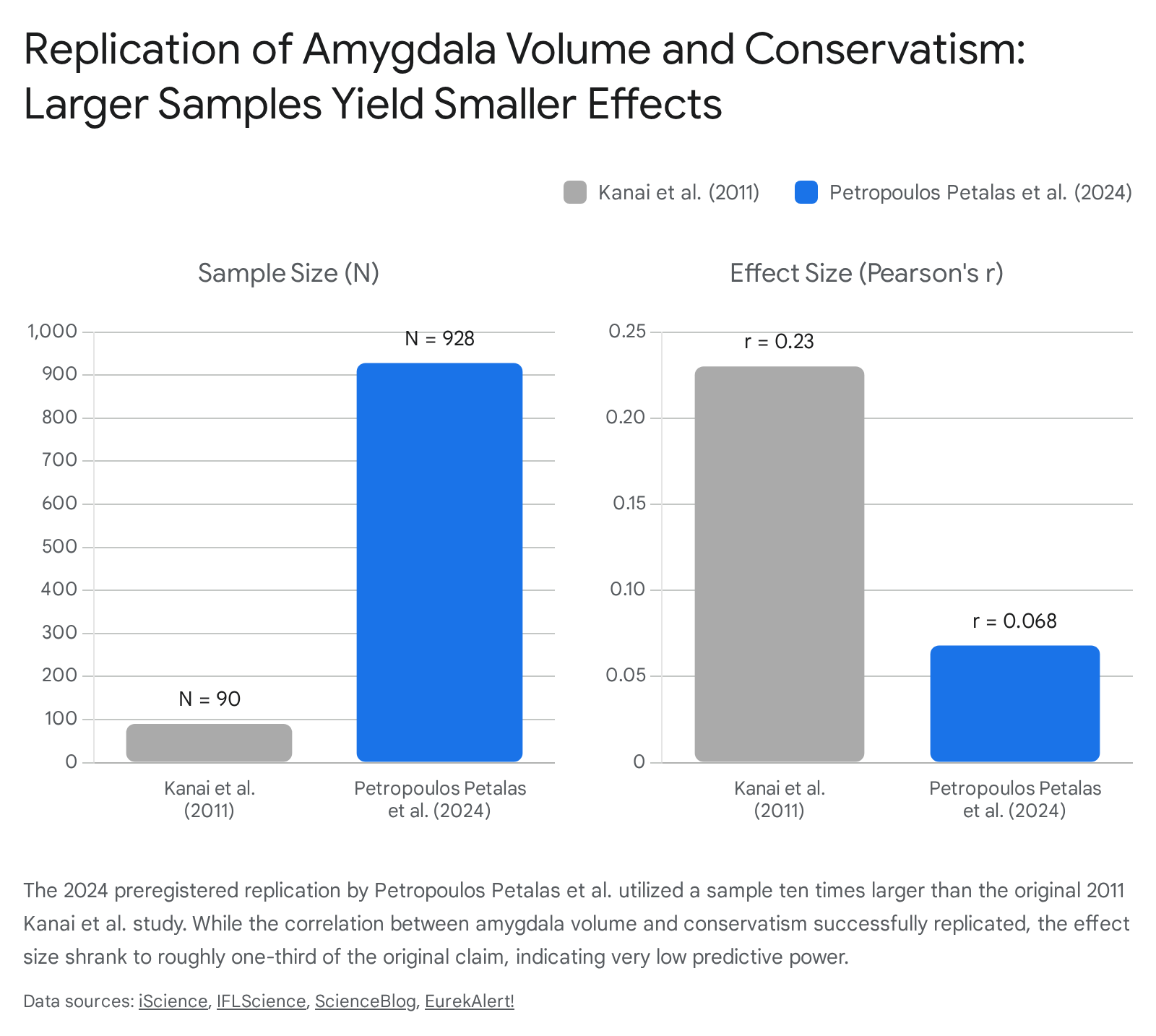
Translated into physical dimensions, the average volumetric difference in the amygdala between a progressive and a conservative voter is roughly 10 cubic millimeters - an anatomical difference roughly equivalent to the size of a single sesame seed [72, 73, 75]. 2. The ACC Finding Failed to Replicate: The study found no consistent evidence to support the link between political ideology and the volume of the anterior cingulate cortex, firmly rejecting the prior hypothesis regardless of how the data was split or analyzed [32, 72, 74]. 3. Discovery of the Fusiform Gyrus Link: Extensive confirmatory tests revealed a weak, newly identified positive association between conservatism and gray matter volume in the right fusiform gyrus, a region traditionally associated with facial recognition and higher-level visual processing [32, 72, 94]. This correlation extended to both the economic and social dimensions of conservative ideology [32].
The ultimate conclusion drawn from contemporary neuroanatomical research is one of extreme caution. While subtle, statistically significant differences in brain structure exist across the ideological spectrum, these anatomical features possess remarkably low predictive power for determining an individual's political affiliation [32, 72].
Brain Lesions and Political Involvement
Further contextualizing the role of neuroanatomy are studies evaluating patients with localized brain lesions. These studies reveal that focal damage to specific neural networks drastically alters the intensity of a person's political involvement, independent of their ideological orientation.
Research indicates that increased political involvement - measured by interest in politics, media consumption, and frequency of political discussion - is associated with lesions connected to the left dorsolateral prefrontal cortex (DLPFC), posterior precuneus, and left superior parietal lobule [92, 93]. Conversely, a significant decrease in political involvement is observed following lesions connected to the bilateral amygdala, the anterior temporal lobe, and the superior temporal sulcus [92]. This data reinforces the notion that the amygdala is essential for driving emotional engagement with socio-political stimuli, even if its sheer volume cannot reliably predict whether that engagement will manifest as conservative or liberal.
Functional Connectivity and Predictive Modeling
While static structural anatomy yields only tiny ideological effect sizes, dynamic functional neuroimaging provides a much richer, predictive understanding. By analyzing resting-state and task-based functional magnetic resonance imaging (fMRI) data, researchers can observe how different regions of the brain communicate and synchronize.
Recent studies utilizing convolutional neural networks (CNNs) to analyze the functional connectivity (FC) of healthy adults demonstrate that liberals and conservatives exhibit noticeable, discriminative differences in how their brain networks interface [95]. The application of artificial intelligence models to FC data allows researchers to predict an individual's political ideology with high accuracy, suggesting that ideological divergence is fundamentally rooted in specific neural processing pathways and network integration rather than the raw size of isolated brain regions [95].
Moral Foundations Theory and Neural Processing
The functional neurological pathways underlying ideology are heavily guided by Moral Foundations Theory (MFT). MFT is an evolutionary functionalist approach to moral psychology, postulating that the human mind relies on several innate, modular psychological foundations to navigate the social world.
The Taxonomy of Moral Foundations
The core formulation of MFT originally identified five domains of moral concern: Care/Harm, Fairness/Cheating, Loyalty/Betrayal, Authority/Subversion, and Sanctity/Purity [21, 23, 24]. In response to the unique ideological perspectives of libertarians and further empirical data, a sixth foundation - Liberty/Oppression - was subsequently integrated into the theoretical framework [23, 24, 68, 71]. To measure an individual's reliance on these specific dimensions, researchers utilize the Moral Foundations Questionnaire (MFQ), which has recently been updated to the MFQ-2 to improve psychometric properties and cross-cultural validity, ensuring the theory operates reliably outside of WEIRD (Western, Educated, Industrialized, Rich, and Democratic) populations [82, 83, 84, 85].
Extensive behavioral research demonstrates a pronounced ideological divide in the prioritization of these foundations. Political liberals rely predominantly on the "individualizing" foundations (Care and Fairness), which are concerned with protecting individual rights, welfare, and equality. Conversely, political conservatives rely on a broader, more evenly distributed array that heavily weighs the "binding" foundations (Loyalty, Authority, and Purity), which operate at the group level to enforce social order, deference to tradition, and institutional cohesion [23, 25, 98].
Functional Neuroimaging of Moral Judgments
Spatiotemporal partial least squares correlation (PLSC) analyses of fMRI data provide crucial neurobiological validation for MFT's claims of cognitive modularity [11, 48, 69, 70, 96]. When subjects are tasked with evaluating vignettes that violate different moral foundations, the brain exhibits distinct, identifiable topographical activation patterns.
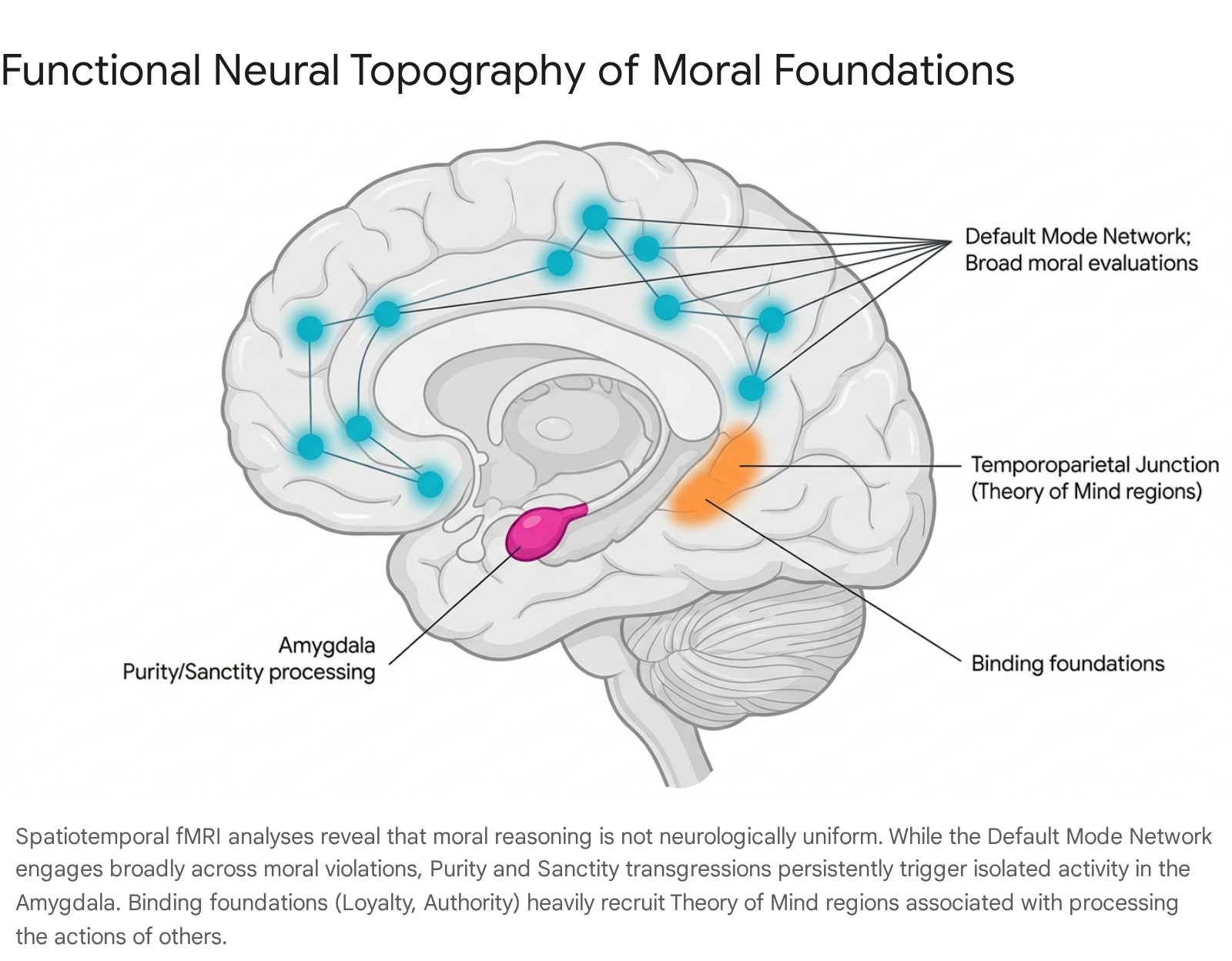
- Purity and the Amygdala: Transgressions of the Purity/Sanctity foundation - often linked to pathogen exposure, dietary restrictions, or sexual taboos - persistently and specifically elicit activity in the amygdala. This firmly differentiates purity violations from other moral judgments, biologically tying moral disgust to the brain's ancient threat-detection architecture [11, 69, 70].
- Default Mode Network (DMN): General moral foundation violations heavily engage the default network, a distributed brain system associated with self-referential thought, memory retrieval, and internal moral reasoning [11, 69].
- Theory of Mind Integration: Violations of binding foundations (Loyalty, Authority, Sanctity) prompt significantly greater activity in regions associated with processing other people's actions and mental states - specifically, the temporoparietal junction and regions dedicated to Theory of Mind - rather than self-oriented processing [50, 98].
A machine-learning decoding model applied to fMRI data successfully predicted which specific moral foundation an individual was judging based purely on fine-grained neural activity patterns across the brain [50, 98]. This substantiates a pluralist view of moral reasoning: humans do not process all moral wrongs through a single, centralized "harm" center. Instead, different categories of moral violations travel along distinct neural pathways, and because liberals and conservatives prioritize these foundations differently, they exhibit fundamentally different neural activations when encountering identical moral stimuli [50, 98].
Genetic Architecture and Gene-Environment Interplay
If gross anatomy and autonomic reflexes are comparatively weak predictors of ideology, behavioral genetics provides a much more robust - albeit complex - mechanism for the biological transmission of political attitudes.
Heritability Across the Lifespan
Classical Twin Studies consistently demonstrate that political orientation possesses substantial genetic variance, often estimating the heritability of political conservatism and party affiliation at between 30% and 60% [36, 63, 66]. However, these genetic influences are highly dynamic and shift significantly throughout an individual's lifespan.
Advanced methodologies, such as the cross-sectional Nuclear Twin Family Design utilized by the German TwinLife project (which includes data from twins, biological parents, and non-twin full siblings to correct for the restrictive assumptions of classical twin models), reveal distinct developmental trajectories [6, 9]. During childhood and early adolescence (ages 16 - 18), individual differences in political orientation are primarily driven by the shared "family" environment, direct parental socialization, and passive gene-environment correlations [6, 7].
However, as individuals transition into emerging adulthood (ages 21 - 25) and establish independence outside the parental home, the influence of the shared familial environment rapidly diminishes. Concurrently, genetic variance emerges as the significant, stabilizing driver of political orientation [6, 7]. This developmental shift illustrates the principle of active gene-environment correlation: as adults gain autonomy, their initial, subtle genetic predispositions (such as general hierarchy-orientation, an innate need for cognitive closure, or trait openness to experience) drive them to consciously select and embed themselves within specific social, educational, and media environments. These chosen environments then actively reinforce, catalyze, and crystallize their underlying biological proclivities into concrete political ideologies [6, 9, 34].
| Life Stage | Primary Driver of Political Orientation | Mechanism |
|---|---|---|
| Childhood & Early Adolescence | Shared Environment & Socialization | Passive gene-environment correlation; parental influence dictates ideological exposure [6, 7]. |
| Emerging Adulthood & Beyond | Genetic Variance & Disposition | Active gene-environment correlation; autonomous selection of environments reinforces genetic baselines [6, 7, 34]. |
Candidate Genes and Social Context
The modern frontier of behavioral genetics focuses intensely on Gene-Environment Interaction (GxE) - how specific external environments alter the phenotypic expression of underlying genetic propensities [10, 35, 37].
A compelling illustration of GxE in political science is the moderating role of socioeconomic status. Analyses indicate that while 30 - 40% of the variance in political interest among adolescents is attributable to genetics, this heritability is heavily contingent on family wealth. High parental income acts as an "enhancing environment" that provides the resources and stability necessary for genetic dispositions toward political interest to fully express themselves. Conversely, poverty and extreme environmental stress severely suppress the genetic influence on political engagement [9].
Researchers have also attempted to isolate specific candidate genes linked to political ideology, most notably focusing on the dopamine receptor D4 (DRD4) gene and the serotonin transporter gene (5-HTTLPR) [43, 44, 46]. An influential, heavily cited 2010 study suggested that the 7R allele of the DRD4 gene - a variant traditionally associated with novelty-seeking and risk-taking behavior - predicted liberal political ideology in early adulthood. However, this genetic effect was strictly conditional: the gene only predicted liberalism if the individual possessed a large, diverse network of friendships during adolescence [43, 44, 45]. The theoretical model posited that novelty-seeking genes require exposure to diverse viewpoints (facilitated by dense social networks) to manifest as progressive political liberalism.
Despite the conceptual elegance of this finding, candidate gene studies are notoriously susceptible to false positives and replication failures. Subsequent attempts to replicate the specific DRD4-friendship interaction have yielded highly mixed results [47, 64]. A replication study utilizing a population of Singaporean Han Chinese subjects found a main effect of the DRD4 gene on conservatism, but found absolutely no interaction effect with friendship networks [47, 65]. Broadly, specific candidate gene findings regarding complex social behaviors rarely maintain statistical significance when subjected to modern, large-scale genome-wide association studies (GWAS), signaling that researchers must approach single-gene explanations for ideology with profound skepticism [63].
Neuroendocrinology and Social Behavior
To fully understand the biological mechanisms underlying moral and political foundations, researchers also examine neuroendocrinology - specifically the modulatory role of oxytocin. Often simplistically characterized in popular media as the "love hormone," oxytocin is a powerful neuropeptide central to social attachment, empathy regulation, and the execution of moral behaviors [16, 17, 18].
Oxytocin, Trust, and Moral Emotion
Oxytocin functions neurologically by suppressing amygdala threat responses and simultaneously stimulating empathic concern in higher cortical regions. This neurochemical action serves as the foundation for interpersonal trust, which is a critical metric for the stability of both economic markets and democratic political systems [16, 19, 20]. Double-blind, placebo-controlled intranasal administration studies reveal that oxytocin significantly and selectively influences moral emotions and decision-making:
- Deliberate vs. Accidental Harm: Oxytocin administration dramatically increases feelings of guilt, shame, and an unwillingness to endorse utilitarian moral dilemmas that require inflicting deliberate harm on others to achieve a greater good. Crucially, oxytocin does not alter emotional reactions or moral judgments regarding accidental harm, indicating a highly specific neurochemical tuning to intentionality and interpersonal agency [17, 20].
- Political Trust and Partisanship: Experimentally manipulating oxytocin levels reliably increases individuals' baseline interpersonal trust. Interestingly, it also elevates trust in government institutions and specific political figures. However, this effect is heavily conditioned by pre-existing partisanship and baseline levels of social trust; oxytocin tends to elevate political trust primarily in individuals who possess low baseline social trust, suggesting a compensatory neurobiological mechanism [19].
While oxytocin heavily modulates the individualizing moral foundations (Care and Fairness), it cannot be accurately described as a universally "liberal molecule." In specific experimental contexts, elevated oxytocin can actually increase defensive outgroup derogation and promote aggressive in-group preservation if the ingroup is perceived to be under direct threat [20]. This demonstrates that biological modulators of human morality are deeply dependent on contextual framing, and their effects scale dynamically based on perceived environmental security.
Methodological and Ethical Limitations
The ongoing integration of biological sciences into political theory has faced rigorous ethical, conceptual, and methodological critiques. The primary danger of identifying biological correlates of ideology is the descent into biological determinism - the logical fallacy that political differences are innate, unchangeable, and therefore justify existing social hierarchies or invalidate opposing worldviews as biologically defective [110, 112, 113, 114].
The Multidimensionality of Political Ideology
A major methodological limitation in early political physiology was the treatment of "conservatism" and "liberalism" as monolithic, unidimensional traits [32, 105]. In reality, political ideology is highly fractionated and socially constructed. An individual may be deeply conservative regarding social institutions and cultural traditions (driven by high pathogen disgust and a reliance on binding moral foundations) but simultaneously hold highly progressive views regarding economic redistribution or foreign policy [103, 105].
The failure to replicate early findings regarding the amygdala and physiological threat sensitivity largely stems from this oversimplification. When modern researchers decompose ideology into distinct axes - specifically isolating social, economic, and securitarian conservatism - biological correlations behave entirely differently [72, 91, 105]. For instance, economic conservatives often express significantly less overall fear and threat sensitivity compared to social conservatives, confounding models that treat all conservatism identically [91]. Furthermore, attempting to map abstract, historically contingent political philosophies - which shift dramatically across decades, regimes, and cultures - onto raw, static biological mechanisms is inherently problematic and theoretically unsound [56, 77, 114].
The Fallacy of Biological Determinism
As highlighted by the recent replication crises in political psychophysiology, the objective effects of brain anatomy and raw autonomic reactivity on political ideology are exceedingly small [31, 32]. The empirical fact that amygdala volume differs by the size of a single sesame seed between political extremes indicates that while minor biological predispositions exist, they are easily overridden, modified, or entirely suppressed by human cognition, cultural learning, and environmental realities [72, 73, 75].
The history of biological determinism is fraught with episodes where incomplete science was utilized to justify xenophobia, eugenics, and the marginalization of outgroups [111, 113, 114]. Modern biology explicitly frustrates authoritarian preferences for rigid categories and deterministic outcomes [112, 114]. The biological sciences emphatically do not support the idea that humans are deterministically wired to belong to a specific political party, nor do they suggest that moral intuitions are immune to rational interrogation and cultural evolution.
Conclusion
The science of disgust sensitivity and political orientation reveals a profound, symbiotic relationship between human biology and social organization. Evolutionary pressures - particularly historical pathogen prevalence - have deeply shaped the behavioral immune system, predisposing human populations to varying baseline levels of disgust sensitivity and differing preferences for traditional, ingroup-binding norms.
While early research drastically overstated the deterministic power of gross brain anatomy and raw physiological threat reflexes, modern high-powered replications confirm that subtle, highly contextualized biological variances do exist. Genetic predispositions - amplified significantly through active gene-environment interactions as individuals select their cultural surroundings during the transition to adulthood - lay the preliminary groundwork for an individual's psychological landscape. Concurrently, functional neural networks distinctly segregate the processing of moral foundations, illustrating that liberals and conservatives literally utilize different neural pathways when navigating complex moral dilemmas.
Ultimately, biology does not dictate policy. Genetics, neurochemistry, and physiological sensitivities act merely as the raw, emotional scaffolding upon which socialization, intellect, and lived experience construct a fluid political identity.