
Behavioral effects of media violence
Media violence and its influence on real-world human behavior has been the subject of extensive scientific inquiry, institutional policy formation, and public debate for more than four decades. As media ecosystems have evolved from passive television broadcasts and cinematic films to highly interactive video games, immersive virtual reality (VR), and algorithmically amplified social media networks, the psychological mechanisms underpinning these interactions have grown increasingly complex. Decades of research have yielded a massive corpus of experimental, cross-sectional, and longitudinal data. However, interpretations of this data remain highly contested. While a significant body of literature identifies a reliable correlation between media violence and minor aggressive cognitions or behaviors, a vocal faction of the scientific community argues that methodological flaws and publication bias have artificially inflated these concerns, distracting public health initiatives from far more potent socioeconomic and environmental drivers of violent crime.
This analysis synthesizes 40 years of empirical research, meta-analytic evaluations, and longitudinal studies to evaluate the continuum of media violence. It examines foundational theoretical models, the evolution of public health guidelines, the precise magnitude of the "aggressor effect" compared to established sociological risk factors, and the novel behavioral implications of decentralized, algorithmically driven platforms.
Theoretical Foundations of Media Violence Research
The scientific investigation into how media consumption translates into physical action is grounded in several overlapping psychological frameworks. The most prominent among these is the General Aggression Model (GAM), which posits that aggressive behavior is primarily a cognitive process. According to the GAM, exposure to violent media activates and reinforces cognitive schemas associated with aggression, subsequently altering an individual's internal state - comprising physiological arousal, affective responses (feelings of anger or hostility), and cognitive scripts 12. Over time, repeated activation of these aggressive scripts is theorized to normalize violent responses to interpersonal conflict, leading to increased behavioral aggression in non-media contexts 1.
Complementary to the GAM is Social Learning Theory, which suggests that individuals, particularly children, learn social behaviors through observation and imitation. Media platforms provide thousands of simulated aggressive scenarios, often displaying violence as a justified, effective, or rewarded method of problem-solving 23. When media portrays violence without realistic negative consequences, it can foster moral disengagement - a cognitive process where players or viewers justify immoral behavior by detaching it from standard moral frameworks 12.
Conversely, Uses and Gratifications Theory suggests a different temporal sequence, proposing that individuals with pre-existing aggressive traits actively seek out violent media to satisfy psychological needs 34. Under this framework, media consumption is not solely the instigator of aggression but a contextual environment where highly aggressive individuals find validation, an effect increasingly observed in studies regarding social media addiction and appetitive aggression 4.
Evolution of Medical and Psychological Guidelines
The medical community's response to media violence has historically mirrored the precautionary principle, though recent decades have forced a transition from blanket warnings toward calibrated, context-specific guidance.
Pediatric Health Recommendations
Public health monitoring of media violence accelerated in 1982 when the National Institute of Mental Health issued a comprehensive review linking television violence to behavioral issues in children 6. This concern was solidified in 2000 through a joint statement by the American Academy of Pediatrics (AAP), the American Medical Association, and the American Psychological Association (APA), which framed entertainment violence as a distinct risk factor for children 58. In a 2001 policy statement, the AAP described the negative health effects of television viewing - including aggressive behavior, desensitization, and fear of victimization - and recommended strict limitations on total media time, alongside the removal of televisions from children's bedrooms 67.
In 2009, the AAP published an updated statement declaring that exposure to violence across television, movies, music, and video games represented a significant risk to adolescent health 58. However, the ubiquity of mobile internet access necessitated a shift in clinical advice. Acknowledging that strict time limits were no longer practical, the AAP revised its policy in 2016. The updated guidelines moved away from a one-size-fits-all restriction paradigm, instead encouraging pediatricians to help families develop personalized media use plans that balance digital consumption with adequate sleep, physical activity, and active parental coviewing 910.
The American Psychological Association Resolutions
The APA has been a central authority in synthesizing media violence research, though its institutional stance has faced significant internal and external scrutiny. Following a systemic review of literature published between 2005 and 2013, the 2015 APA Task Force on Violent Media concluded that a "small and reliable relationship" exists between violent video game exposure and aggressive outcomes, such as yelling, pushing, and heightened aggressive cognitions 111216.
However, the 2015 resolution became highly controversial when politicians and media commentators frequently cited it to establish a direct causal link between violent video games and acts of mass homicide 13. The scientific data did not support this extrapolation. In response, the APA Council of Representatives convened to revise the resolution, issuing a critical update in March 2020 1112. The 2020 addendum explicitly stated that the resolution must not be misinterpreted or misused to attribute severe violence, such as mass shootings, to violent video game use 1113. The APA emphasized that attributing lethal violence to digital media is scientifically unsound and draws necessary public attention away from validated predictors of severe violence, such as a history of severe trauma or environmental instability 1112.
Meta-Analytic Evidence on Violent Video Games
The academic debate regarding the exact effect size of violent interactive media is heavily reliant on meta-analyses, which aggregate data from hundreds of independent studies. The literature reveals a persistent divide between researchers who assert the effects are reliably detrimental and those who argue the effects are statistical artifacts of poor methodology.
Support for the Aggressor Effect
A substantial body of meta-analytic research provides robust evidence that violent video game exposure increases aggressive behavior. A seminal 2010 meta-analysis by Anderson et al., synthesizing 130 research reports involving over 130,000 participants, demonstrated that violent game exposure is positively associated with aggressive behavior, cognition, and affect, while decreasing empathy and prosocial behavior 1415. These findings held consistent across experimental, cross-sectional, and longitudinal designs, as well as across Eastern and Western cultures 1416.
A subsequent 2018 prospective meta-analysis published in the Proceedings of the National Academy of Sciences (PNAS) evaluated studies with time lags ranging from three months to four years. The researchers found a statistically significant standardized regression coefficient of $\beta$ = 0.080 for the effect of violent video games on subsequent physical aggression, even when controlling for baseline aggression and all available covariates 15. While a coefficient of 0.080 represents a small variance, proponents argue that when applied across a population of millions of gamers, this "small" effect translates into thousands of minor aggressive interactions, rendering it a valid public health concern 1517. Interestingly, this study identified ethnicity as a significant moderator; the effect was largest among White participants ($\beta$ = 0.103), intermediate among Asian participants ($\beta$ = -0.098, though limited sample size), and nonsignificant among Hispanic populations ($\beta$ = 0.062) 15.
Methodological Critiques and Publication Bias
A separate faction of researchers heavily criticizes these findings, arguing that the established media violence paradigm relies on flawed methodologies and researcher expectancy biases 162218. Meta-analyses conducted by Ferguson and colleagues emphasize that the apparent link between media violence and aggression artificially inflates when researchers utilize unstandardized, unreliable "proxy" measures of aggression in laboratory settings 22. Common proxy measures include the Taylor Competitive Reaction Time Task, where participants administer non-lethal noise blasts or hot sauce to confederates. Studies utilizing such proxies frequently generate elevated effect sizes (e.g., r = 0.24), whereas studies measuring actual physical aggression or violent criminal behavior yield substantially lower, often negligible, correlations (e.g., r = 0.04 to r = 0.08) 22.
Critics also highlight the prevalence of outcome-reporting bias (ORB), wherein researchers selectively publish statistically significant findings while discarding null results, leading to an overestimation of the aggressor effect 2. A 2007 meta-analysis adjusting for publication bias found no support for the hypothesis that violent video game playing leads to aggressive behavior, while simultaneously noting that gaming remained positively related to enhanced visuospatial cognition 19. Similarly, a 2020 re-evaluation of the data underpinning the APA's 2015 resolution revealed only negligible relationships between violent games and aggressive behavior once methodological quality and publication bias were stringently controlled 18.
Recent Syntheses
Analyses from 2024 and 2025 attempt to reconcile these conflicting schools of thought. Current evaluations recognize that while short-term, active play of violent games can increase physiological arousal and aggressive cognitions (particularly when violence in the game is morally justified by the narrative), the effects are heavily moderated by individual traits, video game difficulty (frustration theory), and family background 220. Independent reviews utilizing novel distributional analyses have concluded that while violent video games do increase aggressive behavior in the majority of settings, these effects are almost universally bounded below a standardized effect size of 0.20, confirming that the societal impact on physical aggression is minimal 21.
Contextualizing Media Violence Among Other Risk Factors
To accurately assess the public health threat posed by media violence, its effect size must be compared directly against established sociological, psychological, and environmental predictors of aggression. Early reports, such as a 2001 U.S. Surgeon General's assessment, controversially claimed that media violence was as significant a risk factor for youth violence as poverty, substance abuse, and poor parenting 17. Modern multivariate epidemiology, however, consistently demonstrates that systemic trauma exerts a vastly more profound influence on severe aggressive behavior.
Youth violence rarely originates from a single variable; it results from accumulated exposures across multiple ecological levels. Research indicates that a 10-year-old exposed to six or more structural risk factors is ten times more likely to exhibit violent behavior by age 18 than a child exposed to only one 22. When analyzed in multivariate models, environmental stressors reliably account for the largest proportion of variance in youth criminality, heavily eclipsing media consumption.
Comparison of Sociological Risk Factors
| Risk Factor | Mechanism of Influence on Aggressive Behavior | Relative Effect Magnitude in Multivariate Analysis |
|---|---|---|
| Peer Delinquency | Affiliation with delinquent peers normalizes antisocial behavior and provides direct avenues for criminal involvement. | High. Frequently cited as the single strongest predictor of both violent and non-violent youth crime. Accounts for approximately 28% of variance in comparative models 232930. |
| Child Abuse & Neglect | Early childhood physical or psychological trauma disrupts emotional regulation and prosocial development. | High. A three-level meta-analysis demonstrates a significant, reliable positive correlation (r = 0.236) between child abuse and subsequent real-world aggressive behavior 2231. |
| Family / Domestic Violence | Witnessing domestic abuse or experiencing high family conflict provides a direct observational model for aggressive conflict resolution. | High. Strongly predicts severe internalized difficulties, school bullying perpetration, and reactive physical aggression, particularly among females 303124. |
| Mental Health (Depression / Traits) | Antisocial personality traits, low self-control, and depressive symptoms reduce frustration tolerance and increase hostile attribution biases. | Moderate to High. The effect size for depressive symptoms frequently exceeds media exposure in predicting severe physical aggression and rule-breaking behavior 2925. |
| Neighborhood Disadvantage (Poverty) | Economic instability indirectly fosters aggression by elevating parental stress, limiting resources, and increasing exposure to community violence and victimization. | Moderate to High. Functions as a foundational stressor. Contributes approximately 11% to the predictive variance of aggression in specific cohort studies 22232627. |
| Media Violence Exposure | Simulated violence induces short-term physiological arousal and minor affective changes, occasionally fostering hostile cognition. | Small to Moderate. Typical effect sizes range from r = 0.04 to r = 0.20. While statistically significant for minor aggression, it routinely fails to predict actual violent criminal activity in multivariate settings 15222129. |
While media violence maintains statistical significance in controlled environments, it accounts for a minimal percentage of total variance (often generating correlations below r = 0.10 for physical violence) when parameters like peer influence, gender, and home violence are introduced 2229. One 10-year longitudinal study evaluating youth violence identified that while media diet incrementally increased odds for serious violent behavior, the raw predictive power belonged heavily to familial instability and peer networks 2428. Consequently, researchers advocate that while media exposure is an easily modifiable variable, public health interventions prioritizing neighborhood safety and child welfare yield substantially higher returns on reducing violent crime 2928.
Macro-Level Crime and Cross-Cultural Consumption
If the consumption of violent interactive media fundamentally drives severe real-world violence, macro-level crime data across nations with equivalent media diets should reflect this phenomenon. Extensive cross-cultural psychological research indicates that the underlying cognitive mechanisms activated by media violence - specifically heightened aggressive thinking and reduced short-term empathy - are uniform across different nations, affecting adolescents similarly in North America, Europe, and Asia 23.
However, an extreme paradox emerges when examining national lethal crime statistics against video game market revenues. The global video game market is highly uniform; top-tier violent games are distributed simultaneously and consumed vigorously across all industrialized nations . Despite this uniform exposure, national rates of firearm homicides diverge drastically, proving that simulated media violence does not govern severe societal violence.
Comparative Data: Video Game Spending vs. Lethal Violence
National health and economic data demonstrate a stark contrast between per capita spending on video games and the prevalence of firearm-related homicides. The following data isolates the top ten global video game markets and their corresponding rates of lethal gun violence.
| Country | Video Game Spending Per Capita (USD) | Firearm Homicides per 100,000 Population |
|---|---|---|
| Japan | $120 | 0.00 |
| South Korea | $79 | 0.02 |
| United States | $74 | 3.43 |
| United Kingdom | $62 | 0.06 |
| Australia | $55 | 0.16 |
| Canada | $54 | 0.38 |
| Germany | $50 | 0.07 |
| Switzerland | $47 | 0.21 |
| France | $46 | 0.21 |
| Ireland | $46 | 0.25 |
(Data derived from market revenue estimates and the United Nations Office on Drugs and Crime [UNODC] intentional homicide reports 38293031.)
The data decisively isolates the United States as a profound outlier. Nations such as Japan and South Korea lead the world in video game consumption, yet they exhibit statistically negligible rates of gun homicides 3829. Similarly, European nations possessing multibillion-dollar gaming industries record intentional homicide rates that are fractions of a percent compared to the United States 2932.
Criminologists and psychological task forces conclude that macro-level violent crime is dictated by systemic legislative and cultural realities - specifically the widespread availability of firearms, varying degrees of socioeconomic stability, and systemic inequality - rather than the consumption of violent digital media 2943. In fact, massive video game consumption correlates strongly with high national wealth and stability; therefore, the highest media consumption often occurs in the world's safest nations .
Scientific Evaluation of the Catharsis Hypothesis
A recurring public defense of violent entertainment relies on the "catharsis hypothesis" - the theoretical assertion that playing violent games or viewing violent films allows individuals to safely vent pent-up aggressive energy, thereby reducing their likelihood of committing real-world violence 3334. Originating from psychoanalytic theories advanced by Joseph Breuer and Sigmund Freud, catharsis initially described a therapeutic technique for emotional cleansing 33.
However, modern behavioral science uniformly rejects the aggression catharsis hypothesis regarding media consumption. Decades of empirical evidence demonstrate that engaging with violent media achieves the exact opposite of emotional release. Rather than draining aggressive energy, observing or simulating violence acts as a psychological primer, increasing physiological arousal, hostility, and subsequent aggressive actions 333536. A foundational 1975 psychological experiment demonstrated that provoked individuals who were allowed to administer simulated shocks to a confederate subsequently delivered significantly greater intensities of shocks later, contradicting the premise that the initial violent act provided relief or restraint 36.
Furthermore, human neuroscience indicates that repetitive exposure to a stimulus enhances learning and neural pathways; rehearsing aggressive behavior digitally reinforces aggressive cognitive scripts rather than expelling them 33. Intriguingly, research reveals that a conscious belief in the catharsis hypothesis actually exacerbates the problem. In controlled experiments, provoked and angry individuals who believed that violent games offered emotional release actively sought out violent media; following the exposure, their aggressive tendencies amplified rather than diminished 37. Consequently, the scientific consensus maintains that violent media facilitates, rather than mitigates, hostility 3438.
Immersive Environments and Virtual Reality
The advent of consumer Virtual Reality (VR) introduces a paradigm shift in media violence research, transitioning the user from a passive observer of a two-dimensional screen to an active, embodied participant in a three-dimensional digital space. Because VR fundamentally alters the sensory environment and heightens the psychological sense of "presence," researchers hypothesize that violent actions performed in VR bypass traditional media desensitization filters 13940.
Aggression Induction and Measurement in VR
Studies comparing violent horror gameplay (e.g., Resident Evil 7) on traditional flat screens versus immersive VR headsets consistently find that VR induces meaningfully different, significantly more intense physiological and psychological experiences 4041. The General Aggression Model suggests that this heightened immersion activates cognitive schemas of aggression more forcefully, increasing the likelihood of behavioral aggression in post-game contexts 120.
Because VR effectively simulates real-world interactions, researchers are utilizing it to accurately measure reactive aggression without relying on problematic proxy tasks. Laboratory paradigms utilizing VR (such as the Wasabi task or simulated sibling conflict models) place participants in provocative social situations with virtual avatars 142. These experiments successfully elicit naturalistic aggressive behaviors - including physical motions (kicking, pointing) and verbal hostility - that correlate significantly with self-reported trait aggression 42.
Clinical and Forensic Utility
Counterintuitively, while immersive VR is capable of inducing intense aggression, its realistic nature is simultaneously being leveraged as a therapeutic tool for violence prevention. Traditional aggression regulation therapies for violent offenders rely heavily on analog role-playing exercises, which often lack contextual realism and pose physical safety risks for therapists during aggressive outbreaks 43.
Recent forensic interventions, such as Responsive Aggression Regulation Therapy in Virtual Reality (Re-ART VR), place patients with severe aggression regulation deficiencies into highly realistic, controlled, and provocative virtual environments. This allows them to safely practice emotion regulation, conflict handling, and impulse control 43. A 2025 meta-analysis synthesizing VR interventions across forensic and clinical samples found statistically significant pre-post reductions in observer-rated aggression, anger, and impulsiveness, yielding a robust pooled effect size (g = -1.05) favoring VR therapies 44. Thus, VR serves a dual role in modern psychology: an unprecedented mechanism for understanding aggressive behavior, and a highly effective medium for treating it.
Algorithmic Social Media and Unfiltered Conflict
The contemporary digital landscape has decentralized the creation and distribution of media violence. The proliferation of platforms like TikTok, Telegram, X, and Instagram has shifted public consumption away from curated, fictionalized violence toward the unfiltered dissemination of real-world trauma, cyberbullying, and warfare. This transition introduces novel behavioral mechanisms governed heavily by machine learning algorithms.
Algorithmic Amplification of Hostility
Unlike traditional media, modern social networks are structured around engagement-based ranking algorithms designed to maximize user retention. These algorithms optimize for passive and reactive behaviors, prioritizing content that generates clicks, shares, and extended viewing times 4546. Recent algorithm audits (2024 - 2025) demonstrate that these systems systematically exploit inherent human cognitive biases - specifically the negativity bias - by amplifying "IME" content: material that is Ingroup-aligned, Moral, and Emotional 454647.
Because angry, emotionally charged, and out-group hostile content instinctively captures human attention (triggering rapid, intuitive "System 1" thinking), algorithms disproportionately surface this material into user feeds 46.
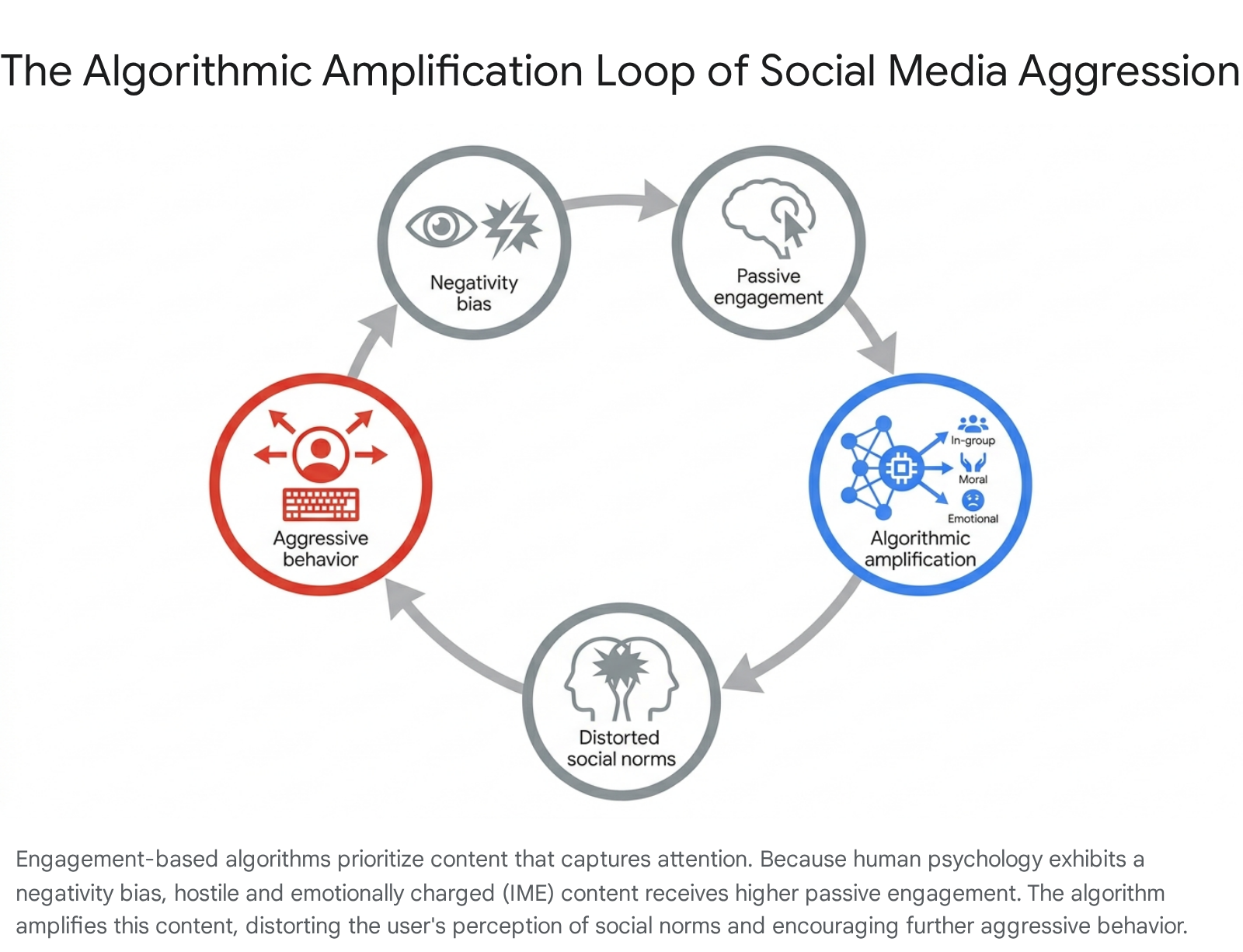
This process of "unreflective endorsing" - where users passively consume hostile content without conscious intent - feeds back into the algorithm, reinforcing structural patterns of hostility 48. The overrepresentation of aggressive IME content disrupts accurate social norm learning, causing users to overperceive societal polarization. Consequently, users alter their own behavior to match these distorted norms, mediating a significant increase in active aggressive output online 4546.
Exposure to Real-World Trauma
The behavioral impact of social media is starkly evident in the dissemination of user-generated war footage. Global conflicts, including the Russian invasion of Ukraine and the Israel-Hamas war, have generated extensive frontline imagery uploaded directly by combatants and civilians 4950. This access provides an immediate, visceral view of human suffering, bypassing the editorial filters and content warnings traditionally applied by news broadcasting agencies 5163.
The behavioral responses to this graphic reality bifurcate sharply. For the general public, relentless exposure to raw violence can induce secondary trauma, anxiety, and profound feelings of helplessness 5163. The continuous influx of graphic imagery normalizes extreme violence in daily digital consumption, fostering emotional desensitization. Observers may lose the capacity for empathy, viewing atrocities merely as standard aspects of a TikTok feed 4963.
Conversely, for populations directly enduring the conflict, social media can inadvertently function as a coping mechanism. Research assessing behavior during collective trauma observes that affected populations often utilize platforms to build psychological resilience through dark humor, self-deprecating memes, and shared documentation, using the medium as a therapeutic space to regain a modicum of control amidst profound instability 5052.
Social Media Addiction and Behavioral Outcomes
Independent of the specific violent content viewed, the structural dependence on social media applications is emerging as a robust predictor of real-world aggressive behavior. Longitudinal research (2024 - 2025) demonstrates a statistically significant correlation between Social Media Addiction (SMA) and both overt physical aggression and relational aggression (such as cyberbullying and social exclusion) among adolescents and young adults 45354.
Studies indicate that individuals suffering from high SMA frequently exhibit lower frustration tolerance, deficits in social competencies, and diminished mental well-being 455. As digital dependence deepens, individuals lacking the nuanced social skills required for face-to-face conflict resolution are more likely to resort to aggressive behaviors when confronted with interpersonal disputes 45568. Notably, the physical aspect of addiction to these platforms (e.g., withdrawal symptoms, compulsive checking) demonstrates the most significant positive association with aggressive conduct (r = 0.468), proving that the architectural nature of digital consumption is intrinsically linked to real-world hostility, transcending socioeconomic demographics 68.
Conclusion
The scientific inquiry into the behavioral effects of media violence over the past four decades reveals a highly complex reality that defies simple binary classification. The consensus among psychological researchers acknowledges that exposure to violent media - whether via traditional television, interactive video games, or virtual reality - exerts a reliable, yet structurally small, causal relationship with short-term physiological arousal, aggressive cognitions, and minor aggressive behaviors. Furthermore, the persistent public myth that violent media provides a cathartic release is definitively rejected by neuroscience; simulated violence serves to prime aggressive schemas rather than expel them.
However, the prevailing cultural narrative that attempts to directly link interactive media violence to severe criminal behavior, such as mass shootings, lacks empirical foundation. When subjected to rigorous multivariate analysis, severe real-world violence is overwhelmingly predicted by profound environmental, familial, and socioeconomic traumas - such as child abuse, domestic violence, and peer delinquency. Cross-cultural data unequivocally demonstrates that high per capita consumption of violent media does not dictate a nation's rate of lethal violence, emphasizing that systemic legislative and cultural realities govern severe crime.
As technological paradigms shift, the focus of behavioral science must transition from fictionalized interactive violence toward the structural mechanics of algorithmic social media. The unchecked amplification of emotionally hostile content, the psychological toll of unfiltered real-world trauma, and the rising prevalence of social media addiction represent novel and pervasive threats to social norm learning and psychological well-being. Mitigating these modern behavioral risks requires moving beyond simplistic content restrictions, advocating instead for comprehensive digital literacy, algorithmic transparency, and holistic societal support.