
Asymptotic Safety in Quantum Gravity
The formulation of a mathematically consistent and phenomenologically viable quantum theory of gravity stands as one of the most formidable challenges in theoretical physics. While general relativity serves as a robust effective field theory (EFT) at macroscopic scales, it is perturbatively non-renormalizable when treated under the standard paradigm of quantum field theory (QFT). The standard perturbative expansion of the Einstein-Hilbert action requires an infinite number of counter-terms to cancel ultraviolet (UV) divergences, which strips the theory of predictive power at trans-Planckian energy scales 11.
Historically, this structural impasse led to the development of two dominant paradigms: String Theory, which posits extended fundamental objects and additional spatial dimensions, and Loop Quantum Gravity (LQG), which proposes a fundamentally discrete, background-independent quantization of spacetime geometry 32. However, a third paradigm, initially proposed by Steven Weinberg in 1976 and 1979, suggests that general relativity may already be a well-defined quantum field theory if it exhibits a non-trivial ultraviolet fixed point 34. This framework, known as Asymptotic Safety, hypothesizes that the dimensionless couplings of the gravitational interaction approach finite constant values as the energy scale approaches infinity. If the critical surface associated with this fixed point is finite-dimensional, the theory is shielded from divergences and retains predictive power using only a finite number of physical parameters 35.
Over the past three decades, the asymptotic safety program has matured from a conceptual hypothesis into a rigorous computational framework, heavily leveraging non-perturbative mathematical tools. It is currently being tested against cosmological observables, Standard Model constraints, and foundational consistency conjectures 69.
Theoretical Foundations of Asymptotic Safety
The viability of asymptotic safety fundamentally relies on the behavior of the renormalization group (RG) flow at extreme energies. In asymptotically free theories, such as Quantum Chromodynamics (QCD), the interaction couplings diminish at high energies, ultimately converging to a free, Gaussian Fixed Point (GFP) where interactions vanish and classical scale invariance is recovered 7118. Conversely, asymptotic safety envisions a regime governed by a non-Gaussian Fixed Point (NGFP). At this point, couplings remain non-zero but constant, exhibiting quantum scale invariance rather than classical scale invariance 8.
The Functional Renormalization Group and Phase Space
The primary mathematical vehicle for investigating the asymptotic safety scenario is the Functional Renormalization Group (FRG), operationalized via the Wetterich equation, which was adapted for gravity by Martin Reuter in 1998 613. The central mathematical object in this formalism is the effective average action, $\Gamma_k$. This action acts as a scale-dependent analogue to the standard quantum effective action, encompassing all quantum fluctuations with momenta higher than a sliding momentum cutoff scale $k$ 14.
The exact flow of $\Gamma_k$ is governed by the Wetterich equation: $$\partial_k \Gamma_k = \frac{1}{2} \text{Tr} \left[ \left(\Gamma_k^{(2)} + \mathcal{R}_k\right)^{-1} \partial_k \mathcal{R}_k \right]$$ In this equation, $\Gamma_k^{(2)}$ is the second functional derivative of the action with respect to the fluctuating metric fields, and $\mathcal{R}_k$ is an infrared regulator that suppresses fluctuations with momenta below $k$ 14. By integrating this equation from a high-energy UV scale down to $k=0$, one recovers the full quantum effective action containing all macroscopic physical observables 159.
Within the parameter space of this theory, defined by the dimensionless Newton coupling ($g_k$) and the dimensionless cosmological constant ($\lambda_k$), the theoretical phase diagram reveals distinct flow trajectories. Theoretical models show that RG trajectories move away from the Gaussian Fixed Point at the origin and flow into the non-Gaussian Reuter fixed point at trans-Planckian scales. The trajectories that successfully emanate from the NGFP toward the infrared define the UV critical surface. Any trajectory lying on this surface represents a valid, UV-complete continuum limit for quantum gravity.
Truncation Schemes and the Reuter Fixed Point
Because the space of all possible diffeomorphism-invariant operators is infinite-dimensional, extracting exact solutions from the Wetterich equation is computationally intractable. Researchers therefore rely on "truncation schemes," which project the exact RG flow onto a finite-dimensional subspace of the full theory space 1710.
Early computational work focused almost exclusively on the Einstein-Hilbert truncation, which tracks only the running of the cosmological constant and Newton's constant. Subsequent mathematical advances have extended these truncations to include higher-order curvature operators, such as $R^2$, $R_{\mu\nu}R^{\mu\nu}$, and polynomials of the Ricci scalar up to extreme orders 1011. The persistence of the Reuter fixed point across these increasingly complex polynomial truncations provides the primary evidence that asymptotic safety is not merely a mathematical artifact of an overly simplified projection scheme, but potentially a genuine feature of a quantum gravitational field 10.
Lorentzian Signature and Wick Rotation Dynamics
The vast majority of functional RG calculations in asymptotic safety have been performed in Euclidean spacetime signature to ensure that the gravitational path integral is mathematically well-defined and convergent 1417. To extract physical predictions for the real universe, these results must theoretically be analytically continued back to Lorentzian signature via a Wick rotation.
In quantum gravity, however, the dynamical nature of the metric severely complicates Wick rotations. Critics have long argued that the correspondence between Euclidean and Lorentzian asymptotic safety is unproven, and that fundamental topological obstructions prevent a reliable mapping between the two signatures 14.
Recently, the asymptotic safety community has made significant strides in directly addressing this limitation. Through the use of the Arnowitt-Deser-Misner (ADM) decomposition, whereby the metric is foliated into distinct spatial and temporal components, researchers have investigated the direct analytic continuation of the lapse function 12. Recent explicit calculations by Saueressig and Wang (2025) within the Einstein-Hilbert truncation have demonstrated that the beta functions governing the flow of the graviton two-point function exhibit exact agreement between Euclidean and Lorentzian settings 12. These findings provide compelling preliminary evidence that the UV completions identified in Euclidean spaces are robust and carry over accurately to physical, Lorentzian spacetimes 1221.
Phenomenological Implications for Particle Physics
A fundamental requirement for any quantum gravity candidate is its compatibility with low-energy physics. If general relativity and the Standard Model are to be mutually UV-complete, the gravitational fixed point must accommodate matter fields without generating unphysical divergences 61323.
The "Matter Matters" Paradigm
Led by extensive research from Eichhorn, Schiffer, and collaborators, the "Matter Matters" paradigm systematically evaluates the compatibility of scalar, fermion, and gauge fields with the Reuter fixed point 61323. Investigations indicate that asymptotic safety acts as a highly restrictive boundary condition for low-energy physics, effectively dictating parameters that are otherwise treated as arbitrary free variables in the isolated Standard Model 578.
By calculating the critical trajectory emanating from the trans-Planckian fixed point down to the electroweak scale, the theory can constrain properties of matter. One notable early success was a prediction regarding the mass of the Higgs boson by Shaposhnikov and Wetterich in 2010, which placed constraints on the scalar quartic coupling based on the gravity-induced anomalous dimension 321. Current research also focuses on how quantum gravitational fluctuations at the Planck scale might bound the mass of ultralight scalar dark matter or constrain the Abelian hypercharge coupling 68.
Perturbative Renormalization Group Phases
To map how gauge-Yukawa theories interface with asymptotically safe gravity, researchers analyze different perturbative fixed-point structures. The possible RG phases dictate how a theory behaves from the UV to the IR 8.
| RG Phase Type | UV Behavior | IR Behavior | Scale Invariance Profile |
|---|---|---|---|
| Asymptotically Free | Interacts weakly, approaches Gaussian Fixed Point. | Becomes strongly coupled (e.g., QCD confinement). | Classical scale invariance at the UV fixed point. 8 |
| Asymptotically Safe | Approaches Non-Gaussian Fixed Point (NGFP). | Flows toward physical observable values. | Quantum scale invariance at the UV fixed point. 8 |
| IR-Complete | Diverges or hits a Landau pole in the UV. | Approaches an interactive fixed point in the IR. | Scale invariance in the macroscopic limit. 8 |
| Conformal Region | Exists precisely on a critical trajectory between fixed points. | Remains scale-invariant across all scales. | Exact scale invariance, heavily constrained parameter space. 8 |
Cosmological Signatures of Asymptotically Safe Gravity
The most direct observational window into quantum gravity lies in early-universe cosmology. Under the asymptotic safety paradigm, the energy-scale dependence of the gravitational couplings introduces new physical scales that explicitly break classical time-translation symmetry, manifesting as quantum corrections to the background cosmological expansion 324.
The Refined Starobinsky Inflation Model
Standard Starobinsky inflation, which modifies the Einstein-Hilbert action with an $R^2$ term, successfully describes early-universe accelerated expansion. However, in an asymptotically safe universe, quantum corrections integrated via the FRG result in a resummed effective Lagrangian containing precise logarithmic modifications 1426. The asymptotically safe Starobinsky Lagrangian is modeled as:
$$L_{AS} = \frac{M_p^2}{2}R + \frac{\alpha}{2}\frac{R^2}{1 + \beta \ln(R/\mu^2)}$$
where $\alpha$ and $\beta$ are dimensionless parameters modified by the RG flow, and $\mu$ is the characteristic renormalization energy scale 1426.
When mapping this refined model against the latest cosmic microwave background (CMB) constraints from the Planck collaboration, BICEP, and large-scale structure data from DESI and ACT, researchers find that the quantum deformation parameter $\beta$ heavily influences both the scalar spectral index ($n_s$) and the tensor-to-scalar ratio ($r$) 1426. Current observational constraints firmly require $n_s \simeq 0.965$ and place an upper limit of $r < 0.036$. Marginal deformations inherent to the asymptotically safe model consistently reproduce the observed amplitude of primordial perturbations while elevating $n_s$ and $r$ slightly, alleviating a $\gtrsim 2\sigma$ tension currently seen between exact Starobinsky limits and recent ACT+DESI measurements 1415. This provides a testable and phenomenologically viable mechanism for inflation without the need for arbitrary, ad-hoc scalar inflatons .
Late-Time Cosmic Acceleration and Swiss-Cheese Cosmology
Beyond the early universe, asymptotic safety offers potential resolutions to late-time cosmological phenomena, specifically the nature of dark energy and the cosmic coincidence problem. Rather than postulating a fundamental, static cosmological constant or exotic dark energy fluid, physicists have explored inhomogeneous "Swiss-cheese" models governed by RG-improved local metrics 161731.
In an asymptotically safe Swiss-cheese cosmology, the universe is modeled as a continuous global expansion (the "cheese") populated by localized, spherically symmetric regions (the "holes"), such as galaxies or clusters. These regions are described by RG-improved Schwarzschild-de Sitter metrics 1631. Because the Newton coupling $G_k$ and the cosmological constant $\Lambda_k$ vary as a function of the local energy-momentum cutoff scale $k$, the effective vacuum energy becomes dependent on local astrophysical structure 18.
By enforcing rigorous Israel-Darmois matching conditions between the local patches and the global homogeneous background, the local fluctuations in the quantum-corrected $\Lambda_k$ effectively average out. This structural integration drives the observed global acceleration of the universe at late times 1631. This approach provides a mathematically natural mechanism to address the cosmic coincidence problem - the observation that matter density and dark energy density are currently comparable - without requiring extreme fine-tuning 173133.
Methodological Critiques and Structural Challenges
Despite its theoretical elegance and phenomenological successes, the asymptotic safety program faces severe methodological and foundational critiques. Critics assert that the non-perturbative techniques used to extract the fixed point inadvertently break the symmetries that define general relativity, undermining the validity of the entire framework.
Truncation Convergence and the 35th Order Debate
The integrity of the asymptotic safety claim relies entirely on the assumption that finite-dimensional truncations are accurate approximations of the infinite-dimensional theory space. Extensive numerical tests of higher-order truncations have sparked significant controversy within the theoretical physics community. Calculations extending the polynomial truncation of the Ricci scalar up to the 35th order, conducted by Falls, Knorr, and others, have been scrutinized to argue that the fixed point properties exhibit persistent non-convergence 114.
According to these critiques, rather than homing in on stable critical exponents, the addition of higher-order derivative terms introduces volatile mathematical behaviors. These include the emergence of fictitious zero-crossings and massive Lee-Wick poles (ghost states) in the truncated propagators, which violate non-perturbative unitarity 1935. While proponents of the theory maintain that these artifacts are simply limitations of the specific Taylor-polynomial basis used in the expansion, and that alternative techniques (such as Padé approximants) restore stability, critics assert that this lack of systematic convergence points to a fundamental instability in metric-based quantum field theories 1410.
The Breakdown of BRST Symmetry and General Covariance
A deeper foundational critique involves the fate of diffeomorphism invariance at quantum scales. In standard gauge theories, maintaining gauge invariance during quantization requires the introduction of Faddeev-Popov ghosts and the strict enforcement of Becchi-Rouet-Stora-Tyutin (BRST) symmetry. According to rigorous canonical quantization analyses presented by Chishtie (2026), the asymptotic safety program encounters profound symmetry violations above a gravitational cutoff scale $\Lambda_{grav} \sim 10^{18}$ GeV 414.
Critics assert that the gauge parameter dependence found throughout functional RG calculations in the literature is not merely a technical annoyance or truncation artifact, but a direct manifestation of BRST violation 414. If general covariance breaks down at trans-Planckian scales, the metric tensor ceases to act as a valid, fundamental quantum degree of freedom 4. Under this view, integrating the metric fluctuations over an RG flow up to $k \to \infty$ is physically meaningless, as the path integral is operating over variables that have lost their quantum consistency 414. This critique has led some researchers to suggest that consistent quantum gravity requires recognizing spacetime geometry as emergent, rather than fundamental 14.
Compatibility with the Swampland Conjectures
Recently, researchers have begun investigating whether the predictions of asymptotic safety are compatible with the "Swampland" program. Originally developed within the context of string theory, the Swampland program seeks to identify universal criteria that distinguish consistent low-energy effective field theories (the "landscape") from those that fundamentally cannot be coupled to quantum gravity (the "swampland") 93637.
An extensive conceptual assessment by Basile, Knorr, Platania, and Schiffer (2026) revealed profound tensions between effective field theory principles and strict Asymptotically Safe Quantum Gravity (ASQG) 153839. Two primary areas of conflict have been identified:
Topology Change and Global Symmetries
Standard QFT approaches, including the functional RG utilized in ASQG, implicitly assume a fixed spacetime topology for the background metric in order to define a continuous flow 915. However, Swampland conjectures strongly dictate that a consistent quantum gravity theory must lack global symmetries and must inherently support dynamical topology change (e.g., wormholes and topology fluctuations) to prevent inconsistencies during black hole evaporation 93640. Because strict ASQG enforces a field-theoretic description of gravity at all scales without discrete topology jumps, it struggles to satisfy this Swampland condition 1540.
Black Hole Thermodynamics and Microstates
The Bekenstein-Hawking entropy law indicates that the thermodynamic microstates of a black hole scale with its horizon area. If ASQG does not incorporate topology fluctuations or non-local degrees of freedom at the event horizon, it faces severe difficulties in providing a standard thermodynamic (microstate) interpretation of black hole entropy 915.
These tensions suggest a critical crossroads: if asymptotic safety is to be a fundamental theory of nature, it may need to be generalized beyond the strict bounds of local QFT to incorporate non-local physics. Alternatively, the Swampland conjectures themselves may merely be artifacts of string theory rather than universal laws applicable to all quantum gravity models 91540.
Methodological Comparisons in the Quantum Gravity Landscape
To evaluate the overall viability of asymptotic safety, it is necessary to contextualize it against other leading quantum gravity frameworks. Different paradigms operate on fundamentally incompatible axioms regarding the nature of space, time, and physical symmetries 32.
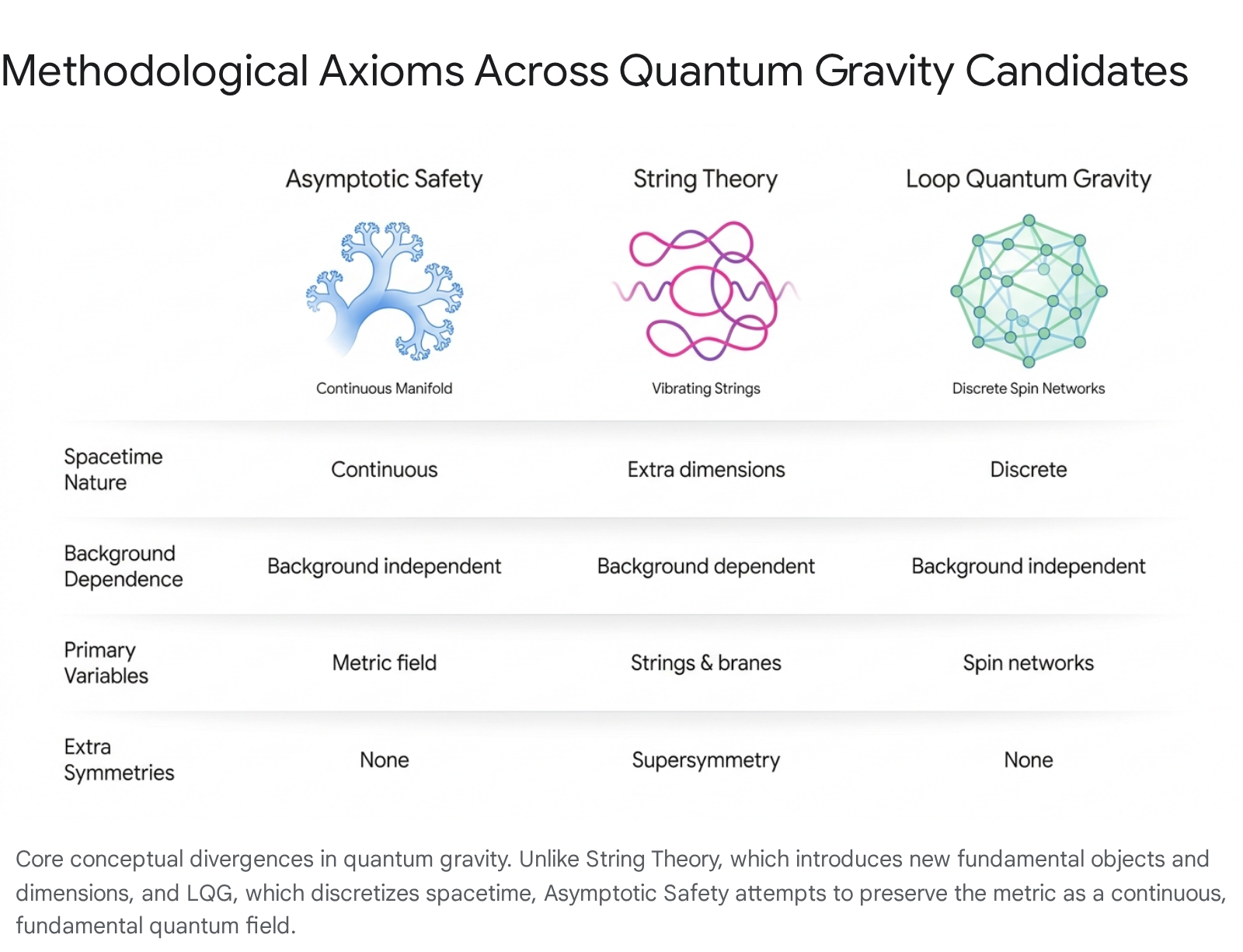
| Feature | Asymptotic Safety | String Theory | Loop Quantum Gravity (LQG) |
|---|---|---|---|
| Nature of Spacetime | Continuous field at all scales 41 | Smooth continuous background (in perturbative limits) 220 | Fundamentally discrete / granular (Spin Networks) 241 |
| Fundamental Variables | Metric tensor fluctuations ($g_{\mu\nu}$) 14 | 1D strings and higher-dimensional branes 3 | Ashtekar-Barbero connection variables / Holonomies 4143 |
| Background Dependence | Background-independent (utilizes background field method, but physical results aim to be background-free) 943 | Highly background-dependent in perturbative formulations 3 | Strictly background-independent 221 |
| Extra Dimensions / Symmetries | None required (operates in 4D, no supersymmetry needed) 41 | Requires 10 or 11 dimensions and supersymmetry 41 | None required (operates in 4D, no supersymmetry needed) 41 |
| Primary Goal | UV-complete quantum field theory of gravity 12 | Unified "Theory of Everything" encompassing all forces 4546 | Quantization of gravitational geometry alone 4145 |
Asymptotic safety distinguishes itself by remaining strictly within the traditional machinery of Quantum Field Theory. It explicitly rejects the necessity of introducing unobserved higher dimensions, extended objects, or fundamental discreteness 41. Instead, it tests the limit of whether the standard field-theoretic toolkit, when upgraded with non-perturbative RG methods, is already sufficient to cure the pathologies of general relativity.
Cross-Pollination with Discrete Lattice Methods
While theoretically distinct from LQG, the asymptotic safety program is actively fostering deep connections with discrete lattice gravity approaches, specifically Causal Dynamical Triangulations (CDT) and Causal Set Theory. By utilizing discrete geometries as a regularization scheme for the gravitational path integral, researchers can search for scale-invariant regimes (second-order phase transitions) that act as the lattice equivalents of the continuum UV fixed point 4347.
This synergistic approach, championed by researchers like Eichhorn and Schiffer, provides independent, cross-methodological verification. If both the continuum functional RG and the discrete lattice simulations converge on identical physical features - such as spectral dimensionality reduction at the Planck scale - the confidence in the physical reality of asymptotic safety is vastly strengthened, proving that the fixed point is not an artifact of the continuous functional formalism 4748.
Recent Advancements in Observable Calculations
To address the limitations of the functional renormalization group and connect the theory to tangible observables, the asymptotic safety community is actively expanding its methodological toolkit toward the calculation of scattering amplitudes and form factors.
As articulated by Knorr and colleagues (2022), the traditional FRG approach relies heavily on off-shell effective actions, which can be plagued by gauge dependencies 49. Transitioning to physical, on-shell scattering amplitudes ensures that theoretical predictions remain independent of arbitrary gauge choices and parameterization schemes 49. By calculating gravity-mediated scattering amplitudes derived directly from the quantum effective action, researchers can interface ASQG with positivity bounds derived for low-energy EFTs. This modern advancement provides a robust bridge to particle physics phenomenology, allowing asymptotic safety to be tested using the rigorous tools of the S-matrix bootstrap program 949.
Conclusion
Asymptotic safety provides a highly conservative yet mathematically radical route to quantum gravity. By rejecting the necessity of extra dimensions, supersymmetry, or fundamental spacetime discreteness, it asks whether the known laws of physics, governed by the principles of quantum scale symmetry, are sufficient to describe the universe up to infinite energies.
The program has demonstrated remarkable successes, particularly in its ability to generate viable, testable models of early-universe inflation, resolve the dark energy coincidence problem via Swiss-cheese metrics, and rigidly constrain the parameter space of the Standard Model. However, it remains ensnared in profound methodological debates. The apparent non-convergence of higher-order polynomial truncations, theoretical conflicts regarding BRST symmetry violations, and foundational tensions with the Swampland conjectures cast legitimate doubt on whether the metric tensor can survive as a fundamental quantum degree of freedom at trans-Planckian scales.
Ultimately, whether asymptotic safety is recognized as the definitive theory of quantum gravity, or merely as a highly effective model of an intermediate physical regime before geometry itself breaks down, depends on its ability to produce unambiguous, gauge-invariant observables. As the framework evolves to incorporate on-shell scattering amplitudes and intersects with lattice methodologies, it continues to serve as one of the most rigorous and physically constrained laboratories for exploring the ultimate limits of quantum field theory.