
Analysis of meritocracy and economic outcomes 2023-2026
The concept of meritocracy - the fundamental proposition that social and economic rewards should be distributed strictly according to individual talent and effort rather than inherited privilege or chance - has served as the defining legitimizing ideology of modern liberal democracies. However, an unprecedented confluence of empirical data emerging between 2023 and 2026 reveals a profound structural crisis within this paradigm. As global economies navigate the complex aftermath of the COVID-19 pandemic, rigidities in labor markets, unprecedented concentrations of intergenerational wealth, and hyper-competitive educational arms races have increasingly exposed meritocracy not as a reliable mechanism of social mobility, but as a sophisticated engine for the intergenerational transmission of advantage.
To understand the long-term trajectory of global inequality, it is necessary to rigorously dismantle the meritocratic myth using contemporary empirical frameworks. This exhaustive analysis evaluates post-pandemic wealth shifts, labor market dynamics, and social mobility metrics. By synthesizing projections on the impending "Great Wealth Transfer," institutional data from the Organisation for Economic Co-operation and Development (OECD) and the World Economic Forum (WEF), alongside working papers from the National Bureau of Economic Research (NBER) and the Centre for Economic Policy Research (CEPR), the analysis targets the precise mechanisms through which extreme inequality is reproduced. Ultimately, the data suggests that while the principle of meritocracy remains vastly superior to historical alternatives such as aristocracy and nepotism, its current systemic iteration functions as a "Meritocracy Trap," disproportionately rewarding heavily subsidized early-life advantages while misattributing the compounding effects of pure chance to individual virtue.
Deconstructing the Meritocratic Myth: Effort, Talent, and the Multiplier of Luck
In contemporary cultural narratives, meritocracy posits that effort and talent are the primary, if not sole, determinants of economic destiny. This ideological framework has been subjected to foundational critiques by political philosopher Michael Sandel in The Tyranny of Merit and legal scholar Daniel Markovits in The Meritocracy Trap 1. Sandel argues that the system fosters a toxic hubris among the successful, who view their standing as entirely self-generated, and a corresponding deep humiliation among the marginalized, who internalize their systemic disadvantages as personal failures 1. Markovits specifically identifies that meritocracy has transformed over the past half-century from a tool of egalitarian leveling into a mechanism of exclusion, wherein elite parents invest unprecedented capital into their children's human capital, effectively monopolizing access to elite institutions .
Effort as a Baseline Qualifier, Luck as the Determinant of Extreme Success
The assertion that individuals are the sole architects of their fate is empirically and mathematically flawed. As outlined by Cornell University economist Robert Frank in Success and Luck: Good Fortune and the Myth of Meritocracy, effort and talent are not absolute guarantors of success; rather, they are merely baseline qualifiers - entry tickets into highly competitive arenas 342. In modern "winner-take-all" economies, which are increasingly driven by network effects, algorithmic visibility, and globalized markets, the gap between the premier performer and the second-best is often marginal in terms of raw skill, but exponential in terms of economic reward 237.
Frank's analysis demonstrates that chance events - ranging from genetic inheritance, the zip code of one's birth, and the historical timing of one's career, to serendipitous professional encounters - act as extreme multipliers of success 37. In massive, highly saturated candidate pools, the individual who emerges victorious is rarely the absolute most talented, but rather the most talented among the extraordinarily lucky 237. For instance, trivial events often determine the outcomes of entire industries, heavily magnified by the structure of modern markets where relative performance is rewarded exponentially over absolute performance 37.
Yet, profound cognitive biases obscure this reality. The psychological phenomenon known as the "availability heuristic" ensures that successful individuals vividly recall their own late nights, sacrifices, and hard work, while the invisible tailwinds of fortunate timing or systemic advantage remain cognitively unavailable to them 43. This cognitive blindness carries severe macroeconomic consequences: successful individuals who view their wealth as entirely self-made become highly resistant to progressive taxation 237. According to Frank, recognizing the role of luck is vital for social cohesion; individuals primed to acknowledge the role of external chance in their success demonstrated a 25% higher propensity to donate to charity and support the public infrastructure required to facilitate mobility for the next generation 33. To combat systemic under-investment in public goods, Frank proposes a progressive consumption tax - taxing the gap between income and savings - which would dampen the ruinous positional arms races among the wealthy without fundamentally altering their relative societal standing 323.
Quantifying Serendipity: The Pluchino et al. "Talent vs. Luck" Model
The theoretical critique of meritocracy has been robustly quantified by an agent-based computational model developed by physicists Alessandro Pluchino and Andrea Rapisarda, and economist Alessio Biondo, research that notably earned the Ig Nobel Prize in Economics 89. The researchers sought to reconcile a fundamental statistical paradox that underpins human societies: while human traits such as intelligence, talent, and effort are normally distributed (following a Gaussian bell curve), the distribution of wealth and success follows a scale-invariant power law (the Pareto distribution), where a microscopic fraction of the population controls the vast majority of resources 84. If talent alone dictated success, the wealth distribution should mirror the talent distribution.
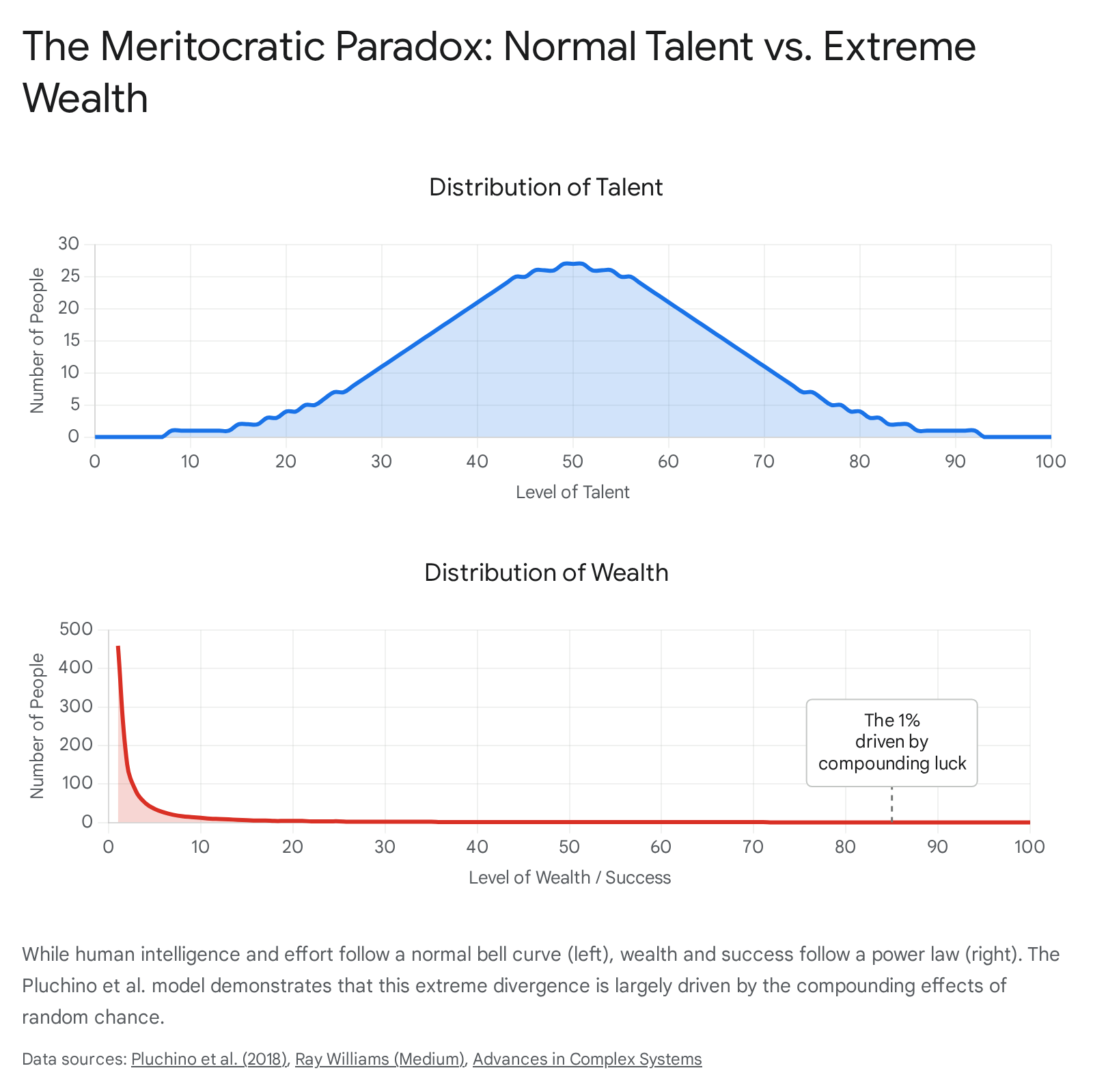
To isolate the variables of success, the Pluchino model simulated the careers of 1,000 agents over a 40-year working life. Agents were endowed with varying degrees of talent and subjected to random positive ("lucky") and negative ("unlucky") events 911. The simulation yielded a highly counterintuitive, yet empirically profound conclusion: the most successful agents were almost never the most talented. Instead, they were consistently individuals of average or moderate talent who experienced an anomalous sequence of lucky events 8911.
Table 1: Parameters and Outcomes of the Pluchino et al. "Talent vs. Luck" Model
| Model Component | Parameter / Distribution | Operational Mechanism & Finding |
|---|---|---|
| Agent Population | $N = 1000$ individuals | Represents a closed system of interacting professionals evaluated over a standard career lifecycle. |
| Talent ($T_i$) | Gaussian (Normal) Distribution | Talent is bounded $[0,1]$ with a mean $m_T = 0.6$ and standard deviation $\sigma_T = 0.1$. Represents IQ, grit, and baseline skill 1112. |
| Capital/Success ($C_i$) | Power-Law (Pareto) Distribution | All agents begin with $C_i = 10$ units. Final capital distribution perfectly mimics real-world extreme wealth inequality 412. |
| Lucky Events | Random Spatial Intersections | If a lucky event hits an agent, their capital doubles, provided their talent allows them to exploit it ($C \rightarrow C \times 2 \times T_i$) 1112. |
| Unlucky Events | Random Spatial Intersections | If an unlucky event hits an agent, their capital is halved ($C \rightarrow C / 2$), regardless of their talent level 1112. |
| Career Duration | $t = 40$ years (80 iterations) | Represents a standard professional lifespan from age 25 to 65 911. |
| Primary Finding | Non-Correlation at the Apex | Maximum success was achieved by an agent with a talent score slightly above average ($T = 0.61$), while the highest-talent agents often achieved mediocre results due to misfortune 912. |
| Policy Application | Research Funding Simulation | An egalitarian funding strategy (distributing equal funds to all) vastly outperformed meritocratic "elite" funding strategies in generating overall societal innovation 811. |
The Pluchino findings carry devastating implications for meritocratic resource allocation. If peak success is primarily a function of serendipity capitalizing on moderate competence, then systems that disproportionately reward the "winners" - such as highly concentrated scientific research funding, exorbitant executive compensation, or winner-take-all educational tracking - are fundamentally inefficient 8411. They allocate capital based on the illusion of superlative merit, rather than optimizing for broad-based innovation and risk mitigation. In the simulations, distributing research grants equally among all researchers consistently resulted in higher overall scientific advancement than directing funds solely to past "winners," because the latter strategy merely amplified past luck rather than future potential 811.
The Great Wealth Transfer and the Entrenchment of Inequality (2023 - 2026)
If extreme success in a single generation is heavily contingent on chance, the direct intergenerational transfer of that success represents the ultimate structural subversion of meritocracy. Between 2023 and 2026, global economies decisively entered the acceleration phase of what major financial institutions and researchers term the "Great Wealth Transfer." Evolving demographic transitions are triggering the largest movement of capital in human history, with profound macroeconomic and sociological implications for the trajectory of global inequality 56157.
Macroeconomic Concentration and Demographic Projections
Empirical projections by financial consulting groups like Cerulli Associates estimate that the Baby Boomer and Silent Generations in the United States alone will bequeath approximately $\$84.4$ trillion in assets through 2045, with roughly $\$72.6$ trillion passing directly to heirs and the remainder directed to philanthropy 57. When the horizon is expanded globally to 2048, factoring in the United Kingdom, continental Europe, Japan, and the rapidly aging ultra-high-net-worth populations in the Asia-Pacific (APAC) region, total transfer figures reach an astounding $\$124$ trillion 615178. This transfer breaks down generationally, with an estimated $\$39$ trillion flowing to Generation X, $\$46$ trillion to Millennials, and $\$15$ trillion to Generation Z 17.
However, this transfer emphatically does not represent a democratization of capital; rather, it serves as a mechanism of profound dynastic consolidation. By 2021, bequeathable wealth had surged to an unprecedented $424\%$ of Gross Domestic Product (GDP) in the US, up from $256\%$ in 1997, with $97\%$ of that increase concentrated in households headed by individuals 55 or older 920. This immense pool of capital is highly skewed: the wealthiest $1.5\%$ of households constitute $42\%$ of expected transfers, and the top $10\%$ of earners are projected to receive $55\%$ of all aggregate inheritances 59. Conversely, the bottom two quintiles of the income distribution will receive less than $10\%$ of this transferred wealth 9.
As highlighted by Brookings Institution researchers and analyses from the National Bureau of Economic Research (NBER), wealth transfers contribute directly to rising inequality because aggregate transfers are massive, are given predominantly by the most affluent households, and are received by heirs who are already situated in the upper echelons of the income distribution 910. The data confirms that inheritances are largely flowing to heirs who are already wealthy, thereby maintaining family dynasties and calcifying the wealth gap indefinitely 91011. Furthermore, there is a pronounced gender shift underway; approximately $\$9$ trillion will pass "sideways" to surviving spouses, overwhelmingly women who statistically outlive their husbands, fundamentally altering the landscape of wealth management toward longer-term, ESG-focused (Environmental, Social, and Governance) stewardship before the capital ultimately trickles down to younger generations 6157.
The "Hollowing Out" of the Middle Class via Eldercare
A critical, often overlooked mechanism operating within the 2024 - 2026 economic data is the bifurcated nature of wealth preservation across class lines. While the ultra-wealthy seamlessly pass assets intact through tax-efficient trusts and family offices, the middle class faces the systemic erosion of inheritable wealth due to the exorbitant, privatized costs of aging. As noted in a landmark 2026 report by the Roosevelt Institute, the structure of long-term care in nations like the US is systematically "hollowing out" generational wealth, puncturing the narrative of the Great Wealth Transfer for ordinary families 2023.
In 2025, the median annual cost of in-home long-term care was approximately $\$80,000$, while a private room in a nursing home exceeded $\$115,000$ to $\$129,000$ annually 23. Concurrently, the median household income for Americans aged 65 and older stood at approximately $\$57,000$ 23. Because public safety nets like Medicare do not cover long-term custodial care, and Medicaid only engages after a patient has spent down their assets to near-poverty levels (with asset ceilings hovering around a mere $\$2,000$ in most states), the anticipated inheritances of middle-class Millennials and Generation Z are routinely liquidated to finance end-of-life care 23.
This dynamic yields a stark second-order effect on social mobility: the Great Wealth Transfer will ultimately bifurcate the younger generations into two distinct cohorts. The first is an inherited-wealth rentier class whose familial assets survived the healthcare gauntlet due to sufficient scale, and the second is an asset-poor working class who must rely entirely on wage labor in an increasingly automated economy 201123. The failure to recognize eldercare as a systemic policy issue rather than a private responsibility directly perpetuates cycles of wealth inequality 23.
The Great Gatsby Curve and the Mathematics of Structural Immobility
The empirical relationship between the concentration of wealth in one generation and the collapse of meritocratic mobility in the next is formalized in labor economics through the "Great Gatsby Curve" (GGC) 121314. Recognized early by economists and popularized in 2012 by Alan Krueger, then-Chairman of the US Council of Economic Advisers, the curve plots cross-sectional income inequality (typically measured by the Gini coefficient) on the horizontal axis, against intergenerational persistence on the vertical axis 1214. The empirical regularity is robust and stark: countries with high economic inequality systematically exhibit lower rates of intergenerational mobility 12131528.
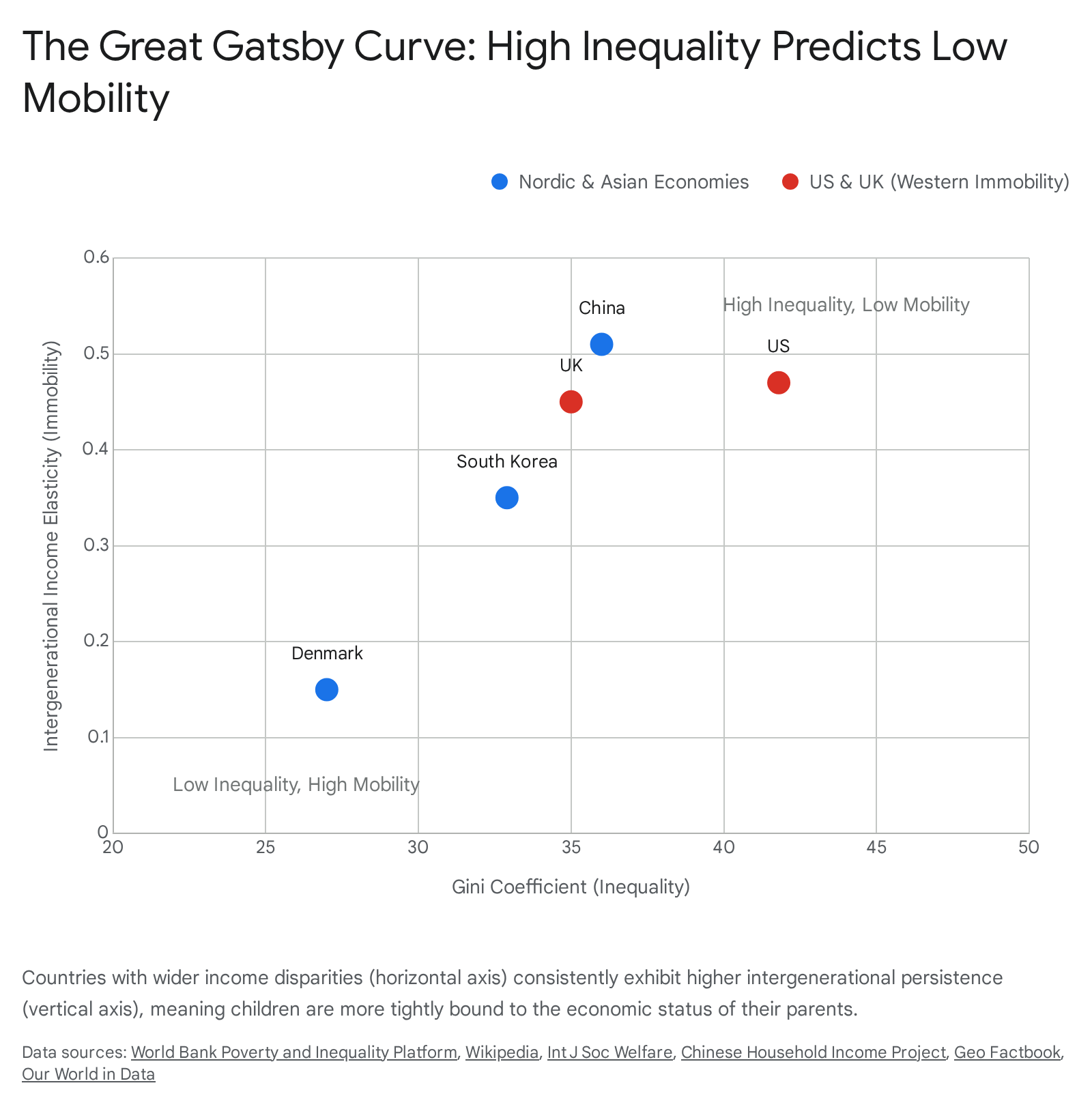
When the rungs of the economic ladder are pulled wider apart by extreme wealth concentration, climbing the ladder becomes structurally improbable 15.
Deconstructing Intergenerational Income Elasticity (IGE)
The primary metric used to establish the vertical axis of the Great Gatsby Curve is Intergenerational Income Elasticity (IGE). IGE is derived mathematically by regressing the logarithm of a child's adult income against the logarithm of their parent's income, typically represented by an autoregressive AR(1) model 14163017. An IGE of $0.0$ implies perfect mobility (a child's income is entirely independent of their parents' status), whereas an IGE of $1.0$ implies absolute immobility (the child's economic rank is entirely predetermined by parental income).
However, advanced econometric research published in 2024 and 2025 has highlighted the nuanced complexities and potential pitfalls of relying solely on IGE for cross-country comparisons. While IGE captures the speed of regression to the mean, it is highly sensitive to the distribution of wealth at the extreme tails (both poverty and extreme wealth) 1630. Furthermore, a low IGE does not automatically dictate that all sub-groups in a population converge to the same wealth level; it merely reflects an average convergence rate, potentially masking deep racial or regional disparities 1617. Because of this sensitivity - formally explained by Yitzhaki's theorem regarding the weighting schemes of linear regressions - contemporary analyses increasingly supplement IGE with "Rank-Rank" mobility metrics (which assess the correlation of parent-child percentiles) and measures of absolute mobility 301819. Absolute mobility, defined as the percentage of children who achieve a higher standard of living than their parents in real terms, has fallen dramatically in the US since the mid-twentieth century 1419.
Despite methodological refinements, recent expansions of the World Bank's Global Database on Intergenerational Mobility (GDIM), which now covers 87 economies representing 84% of the global population, definitively confirm that the Great Gatsby Curve holds true across both high-income and developing nations 1320.
Comparative Social Mobility Metrics
To illustrate the geographic variance of meritocratic failure and success, Table 2 synthesizes recent 2023 - 2026 data on inequality and mobility across diverse socioeconomic models, moving beyond the traditional US/UK paradigm to include East Asian and Nordic frameworks.
Table 2: Comparative Social Mobility and Inequality Metrics (2023 - 2026 Estimates)
| Nation | Gini Coefficient (2023-2025) | IGE Score (Persistence) | Socioeconomic Model & Mobility Profile |
|---|---|---|---|
| Denmark | Low (~27.0) | Very Low (~0.15) | Nordic Egalitarian: High progressive taxation, universal healthcare, and free higher education effectively decouple a child's life chances from parental wealth, driving high absolute and relative mobility 2122. |
| South Korea | Moderate (32.90) | Moderate (~0.20 - 0.45) | East Asian Rapid Industrialization: Gini ticked up to 32.90 in 2025. Severe reliance on shadow education creates an illusion of meritocracy while deeply entrenching class advantage. IGE estimates vary based on cohort 233839. |
| China | Moderate-High (~36.0) | High (~0.51) | Transitional Economy: Extremely high IGE (0.51) indicating deep persistence. A pronounced urban-rural divide driven by the hukou system severely limits upward mobility for rural populations 184041. |
| United Kingdom | High (~35.0) | High (~0.40 - 0.50) | Stalled Mobility: A highly stratified education system and deep geographic disparities have led to a U-shaped curve of immobility, with "sticky" endpoints at both the top and bottom of the distribution 1524. |
| United States | Very High (41.8) | Very High (~0.47) | The Gatsby Extreme: Despite the cultural mythos of the "American Dream," the US exhibits some of the lowest absolute and relative mobility among advanced OECD nations 12281940. |
(Note: Gini coefficients are drawn from the World Bank Poverty and Inequality Platform and Geo Factbook; IGE scores represent consensus estimates from recent econometric working papers and the GDIM.) 121820383940
The comparative cross-national data reveals that relative income mobility is highly responsive to deliberate state intervention. Egalitarian nations like Denmark achieve profound mobility not merely by equalizing educational access, but by maintaining compressed wage structures, effective collective bargaining, and high redistributive taxes that lower the ultimate economic premium placed on extreme success 21. Conversely, in highly unequal societies like the US and the UK, the education system has largely failed to act as the "great social leveler" promised by meritocratic theory; instead, it increasingly functions as a sophisticated sorting mechanism that authenticates and legitimizes inherited advantage 1521.
Geographic Divergence: Education, Exams, and the East Asian Experience
While Western critiques of meritocracy frequently center on legacy admissions, alumni networks, and the hoarding of opportunities at elite Ivy League or Oxbridge institutions, examining East Asian models - specifically China and South Korea - provides a vivid demonstration of how fiercely hyper-meritocratic, exam-based systems paradoxically reinforce rigid class stratifications. These nations possess deeply ingrained cultural commitments to education as the absolute determinant of social worth, an ethos historically rooted in centuries of Confucian imperial civil service examinations 254426.
China's Gaokao: The High-Stakes Gateway and the Hukou Divide
In China, the gaokao (National College Entrance Examination) determines university placements and subsequent career trajectories for approximately 13.42 million students annually 46. On its surface, relying on a single, standardized, anonymized examination appears to be the purest, most objective distillation of meritocracy possible. Indeed, achieving admission to an elite Chinese university can drastically alter a student's economic trajectory, raising their eventual rank in the national income distribution by nearly 20 percentiles 27.
However, recent studies tracking social mobility from the 1990s through 2024 reveal that China's IGE is remarkably high at 0.51, indicating severe intergenerational stickiness and a high dependence of a child's income on parental wealth 18. This profound immobility is heavily driven by deeply embedded spatial and institutional inequities. The hukou (household registration) system enforces a rigid de jure urban-rural divide 41. Urban children possess exponential advantages in accessing high-quality secondary schools, advanced pedagogy, and extensive private tutoring. This dynamic results in an "elephant curve" of mobility, where urban elites secure the vast majority of intergenerational income growth while rural populations face systemic stagnation 184146.
When the stakes of a single exam dictate lifelong outcomes, wealthy families inevitably deploy massive capital to ensure victory, converting raw economic power directly into academic "merit." Furthermore, as domestic competition breeds intense anxiety, wealthy Chinese families are increasingly bypassing the gaokao entirely by financing international education, effectively buying an exit from the hyper-competitive pressure cooker to secure places in Western universities 26.
South Korea's Kyoyukyeol and the Commodification of Childhood
The trajectory of South Korea provides a stark cautionary tale of meritocracy taken to its logical extreme. Following rapid democratization and industrialization in the late 20th century, the massive expansion of higher education drove immense social mobility and national economic growth 254428. This historical success cultivated an intense national "education fever" (kyoyukyeol), where parents view extreme educational investment as the sole guarantor of class security and upward mobility 232528.
By the mid-2020s, this system had evolved into a hyper-commodified private education market (shadow education), largely neutralizing the equalizing power of the public schooling system. The structural advantage of intergenerational wealth is starkly visible in escalating phenomena like the chil-se-ko-si - highly competitive, grueling entrance exams for elite English-language kindergartens taken by children as young as six or seven years old 29. Originating in wealthy enclaves like Seoul's Daechi-dong district, these exams demonstrate how early, purchased advantage is codified as inherent "talent." By age seven, a child from a high-net-worth family has already accrued thousands of hours of specialized instruction, utilizing English proficiency as symbolic capital and a mechanism of social distinction 29.
Within this framework, a teenager's eventual success on the national university entrance exam (Suneung) is rarely an objective measure of innate merit, but rather the delayed manifestation of their parents' financial capacity to sustain years of elite private tutoring 2329. As new pedagogical trends attempt to move away from rote memorization to emphasize "creativity" and "experiential learning," the barrier to entry only rises. Wealthy parents now fund global language camps, specialized excursions, and bespoke portfolio building, systematically deepening the structural inequalities in childhood experiences while maintaining the facade of a meritocratic assessment 23.
Post-Pandemic Labor Market Dynamics (2025 - 2026)
The systemic inequalities generated by educational sorting and wealth transfers are presently colliding with a profoundly transforming post-pandemic global labor market. Data compiled by the OECD, the International Labour Organization (ILO), and the WEF in late 2025 and early 2026 reveals a labor landscape characterized by a severe paradox: historically tight macroeconomic labor markets juxtaposed against rapidly evaporating pathways for upward mobility for new entrants 3031523254.
The Tight Market and the Skills Paradox
In the first quarter of 2026, the OECD recorded an average unemployment rate stabilized at an extraordinarily low 4.9%, marking three consecutive years at or below 5% 303132. Employment and labor force participation rates hit record highs of 72.1% and 76.6%, respectively, across the OECD 3132. Concurrently, demographic realities are fundamentally reshaping the workforce; the progressive exit of the Baby Boomer generation has driven the old-age dependency ratio dramatically upward from 19% in 1980 to 31% in 2023, severely constraining the supply of working-age labor 31.
Logically, a chronic labor shortage should empower workers, drive broad-based real wage growth, and flatten corporate hierarchies. Yet, the data indicates highly uneven geographic wage patterns and persistently low employee engagement 305254. Gallup and ADP Research from 2025 note that merely one in five global workers feels truly engaged at work, citing a lack of clarity regarding career progression and systemic mistrust in corporate leadership 52. In high-income countries, real wage growth has frequently failed to keep pace with labor productivity growth 54.
The primary driver of this friction is the rapid integration of Artificial Intelligence (AI) and digitalization. The WEF Future of Jobs Report 2025 highlights a severe structural transition underway: while 41% of organizations are actively planning to reduce headcounts in roles vulnerable to AI-induced skills obsolescence, 70% are simultaneously struggling to hire personnel with advanced AI competencies 30. Consequently, the labor market is aggressively bifurcating. Workers with existing capital, access to elite education, or the resources to self-fund upskilling are capturing the massive wage premiums associated with human-centric and analytical tech roles 3052.
The Collapse of the Entry-Level and the Rise of the Nepotistic Hire
Perhaps the most alarming metric for the future of social mobility is the collapse of the traditional entry-level job. According to Randstad data from late 2025, analyzing 126 million postings worldwide, entry-level job opportunities plummeted by 29% since January 2024 30.
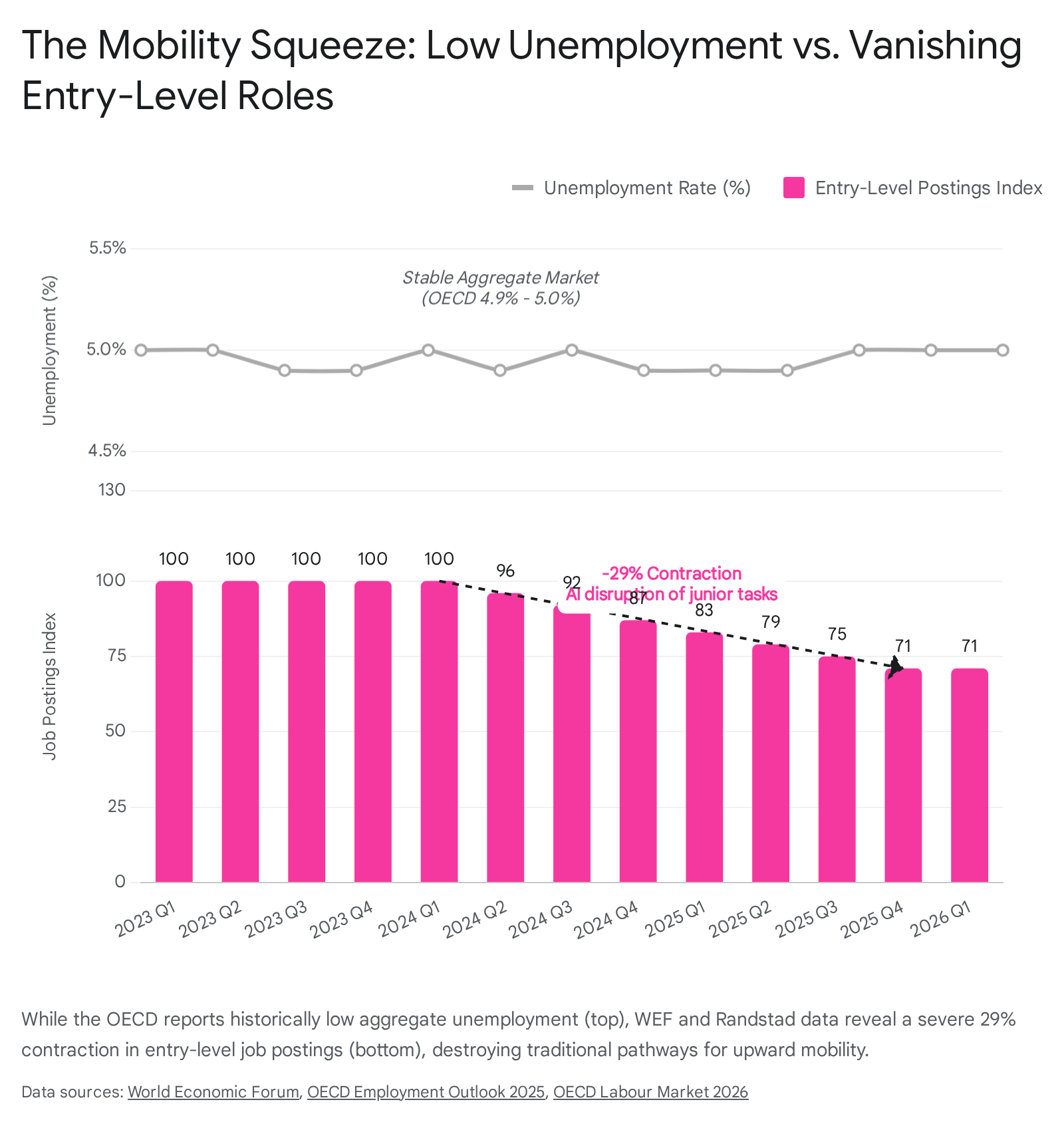
As AI increasingly absorbs routine administrative, clerical, and junior-level analytical tasks, the traditional corporate ladder is missing its bottom rungs 3052.
Young workers entering the labor market without elite credentials or pre-existing professional networks find it increasingly difficult to secure the initial professional foothold required to accumulate human capital. This dynamic inherently privileges the "nepotistic hire" - young adults who can leverage their parents' social capital to secure unadvertised roles, secure high-status internships, or bypass automated resume screening entirely. Recent research from Harvard's Opportunity Insights illustrates the staggering power of these networks: nearly one-third of Americans will work at the same firm as a parent before turning 30, and in those jobs, they earn almost 20% more than they would on the open market 33. This intergenerational "stickiness" in the labor market ensures that even as the nature of work changes, access to the most lucrative roles remains gatekept by inherited social capital rather than objective merit.
In Defense of Meritocracy: Efficiency, Impartiality, and the Alternative of Nepotism
Given the overwhelming sociological and economic evidence that meritocracy serves to launder inherited privilege and validate the extreme disparities generated by pure luck, it is intellectually tempting to discard the concept entirely. However, robust institutional history and modern econometric literature provide a vital, necessary corrective: meritocracy must be evaluated not against an unattainable utopian ideal of perfect equality, but against its historical and practical alternatives - namely aristocracy, patronage, and nepotism.
The Historical Imperative: The Northcote-Trevelyan Reforms
The historical baseline for meritocratic governance is encapsulated in the United Kingdom's landmark Northcote-Trevelyan Report of 1854. Commissioned by Prime Minister William Gladstone to address a British Civil Service suffering from profound "internal efficiency and in public estimation," the report identified the root cause of systemic dysfunction: the pervasive system of aristocratic patronage 34355836. Prior to the reforms, government departments operated as isolated bureaucratic fiefdoms where employment and promotion were granted based on bloodlines, political loyalty, and the direct financial purchase of commissions 355836.
Influenced by the historical efficiency of the Chinese Imperial examination models, Stafford H. Northcote and C.E. Trevelyan proposed a radical solution: recruitment based entirely on merit through open, competitive examinations, leading to a unified, non-partisan administrative body 34355836. Though it took decades to fully implement against the resistance of entrenched elites, the shift from patronage to meritocracy was the critical catalyst that allowed the modern state to function effectively. It substituted systemic corruption with the core civil service values of integrity, objectivity, and political impartiality, allowing the government to manage complex modern crises, including navigating two World Wars 343536.
Empirical Evidence on Nepotism vs. Competence in Modern Governance
Modern cross-national empirical analyses validate the foundational Northcote-Trevelyan premise. Extensive research leveraging massive mediation analysis across 52 countries and 14 years of data confirms that meritocratic recruitment (MR) in public administration is directly and positively correlated with higher economic growth, superior tax revenue mobilization, and substantially reduced corruption 6037.
Meritocracy achieves these superior developmental outcomes through two distinct pathways. The first is the competence mechanism, which enhances the epistemic quality of bureaucratic personnel by prioritizing technical skill over political expedience or familial ties 60. The second is the impartiality mechanism. A professional bureaucracy creates an intentional incentive misalignment between career civil servants and transient elected politicians. Because merit-recruited bureaucrats do not owe their jobs to political patrons, they are empowered to resist corrupt mandates, blow the whistle on malfeasance, and prioritize long-term public interests over short-term electoral gains 603738. Conversely, studies tracking historical administrative data - such as analyses of 200 years of Swedish public administration - demonstrate that when nepotism thrives, institutional efficiency invariably rots, even if the transition away from nepotism allows the old elite to maintain some advantage through superior access to education 38.
The Destructive Psychology of Private Sector Nepotism
The destructive impacts of nepotism are equally glaring in the private sector. A comprehensive 2024 analysis of organizational behavior demonstrated that nepotistic hiring - the practice of promoting individuals based on family ties rather than objective performance - triggers a cascade of institutional failures 6339.
Applying Social Comparison Theory, researchers found that when employees witness less competent individuals receiving unearned promotions or rewards, it induces profound cognitive dissonance and shatters perceptions of organizational justice 3940. This dynamic leads to plummeted motivation, deep job dissatisfaction, the rapid attrition of highly talented personnel, and an overall degradation of firm productivity and innovation 633940. In controlled psychological studies examining recruitment preferences, individuals exhibited significant private and public backlash against nepotistic hires, validating the deeply ingrained human preference for fairness 66. Theoretical models in labor economics further highlight a "displacement effect," where highly capable individuals actively avoid organizations or activities dominated by the "rich" or connected, driving them toward sectors with lower incentives for effort, thereby harming macroeconomic output 40.
Therefore, while the execution of modern meritocracy is demonstrably skewed by inherited wealth, systemic unequal access, and the undeniable multiplier of luck, the core principle of selecting for competence remains an indispensable bulwark. Without a commitment to merit, systems inevitably regress into overt oligarchy, where neither effort nor talent matters, and bloodline dictates all.
Conclusion
The empirical landscape of the global economy from 2023 to 2026 paints a highly complex, often contradictory portrait of social mobility and wealth distribution. The foundational promise of meritocracy - that an individual's ability and effort will objectively dictate their station in life - has been severely compromised by the realities of modern capitalism. As mathematically modeled by Pluchino et al., extreme success is vastly more reliant on the geometry of pure chance than the baseline distribution of human talent 894. This serendipitous wealth is then crystallized into permanent structural advantage via the unprecedented $124 trillion Great Wealth Transfer, ensuring that inequality compounds across generations 61517.
Furthermore, this entrenched wealth is systematically weaponized in the hyper-competitive educational arms races of East Asia and the West, where access to elite credentials is fundamentally commodified from early childhood, effectively masquerading inherited privilege as objective academic merit 15232629. Simultaneously, as artificial intelligence fundamentally reshapes the labor market and erases the entry-level stepping stones that historically facilitated upward mobility, the rungs of the economic ladder are pulling further apart, trapping those without inherited social or financial capital at the bottom of the Great Gatsby Curve 12133052.
Yet, as history and organizational science definitively demonstrate, the total abandonment of merit-based selection would invite the disastrous return of overt nepotism, patronage, and institutional decay 3436606339. The policy imperative, therefore, is not to destroy the concept of meritocracy, but to strip it of its moral hubris and structural rigidities. If success is acknowledged as being heavily reliant on robust public infrastructure, the genetic lottery, and sheer systemic luck, the moral justification for winner-take-all inequality completely dissolves 323.
Addressing this crisis requires profound macroeconomic shifts modeled on the successes of Nordic egalitarian states. Policymakers must focus on decoupling baseline human dignity, healthcare access, and economic security from elite educational attainment and extreme wealth accumulation. Solutions proposed by contemporary economists - such as implementing steeply progressive consumption taxes to curb the ruinous positional arms races of the ultra-wealthy, aggressively closing the tax loopholes that facilitate dynastic intergenerational wealth transfers, and democratizing access to high-quality early childhood education - are critical first steps 3291121. Only by recognizing the persistent illusion of the perfectly level playing field can modern societies begin to construct an economic reality where luck is significantly less vital to survival, and human talent - in all its varied, normal distributions - is genuinely valued and cultivated.