
AI in competitive intelligence and market monitoring in 2026
Market Environment and Investment Trends
In 2026, the intersection of artificial intelligence and corporate strategy has fundamentally redefined the discipline of competitive intelligence (CI). Historically characterized by periodic reporting, manual data aggregation, and lagging indicators, competitive intelligence has transitioned into an autonomous, predictive, and agent-driven operational engine. As global organizational spending on artificial intelligence reaches a projected $2.52 trillion in 2026 11, the allocation of capital toward AI-optimized infrastructure and software reflects a structural shift in how enterprises monitor their competitive environments. Analysts project that the market for dedicated competitive intelligence platforms will reach $1.46 billion by 2030, driven by an annual growth rate nearing 20% 2.
The impetus for this rapid adoption is rooted in tangible revenue implications and competitive parity. In B2B sales environments, approximately 68% of deals now involve at least one direct competitor; however, average sales teams rate their competitive preparedness at a mere 3.8 out of 10 2. This preparedness gap results in an estimated $2 million to $10 million in lost annual revenue per enterprise due to missed winnable deals 2. To mitigate these losses, organizations are rapidly abandoning legacy manual tracking methods in favor of autonomous agentic systems. By 2026, AI adoption among competitive intelligence teams surged by 76% year-over-year, with 60% of practitioners utilizing AI continuously in their daily workflows 23. Furthermore, 40% of technology and service providers now employ commercial CI platforms, representing a fourfold increase from baseline adoption levels just a few years prior 2.
Evolution of Intelligence Workflows
Automated Data Collection and Signal Processing
The operational mechanics of competitive intelligence have undergone a structural paradigm shift between 2023 and 2026. In the pre-AI paradigm, competitive intelligence was a highly reactive, labor-intensive function. Product marketers and CI analysts spent an estimated 30 to 40 hours per quarter manually updating static competitor "battlecards," while individual B2B sales representatives spent 8 to 12 hours monthly conducting their own ad-hoc competitor research 4. This manual dependency created severe latency issues; by the time a competitor's strategic maneuver was identified, analyzed, and distributed to frontline teams, the intelligence was often four to eight weeks out of date, rendering it tactically useless in fast-moving sales cycles 45.
Artificial intelligence automation has systematically dismantled these latency barriers. In 2026, the integration of large language models (LLMs) and advanced machine learning techniques has reduced manual CI research time by 85% to 95%, while accelerating evidence synthesis by over 50% 346. The modern intelligence framework operates on a continuous loop, monitoring hundreds of data sources per competitor simultaneously. Autonomous agents continuously crawl digital footprints, categorize changes by strategic relevance, filter out routine noise, and escalate material shifts directly to decision-makers 37.
The volume of unstructured data generated by modern enterprises exceeds human processing capacity. AI-driven platforms address this via sophisticated four-layer technology stacks: Collection, Processing, Analysis, and Distribution 3.
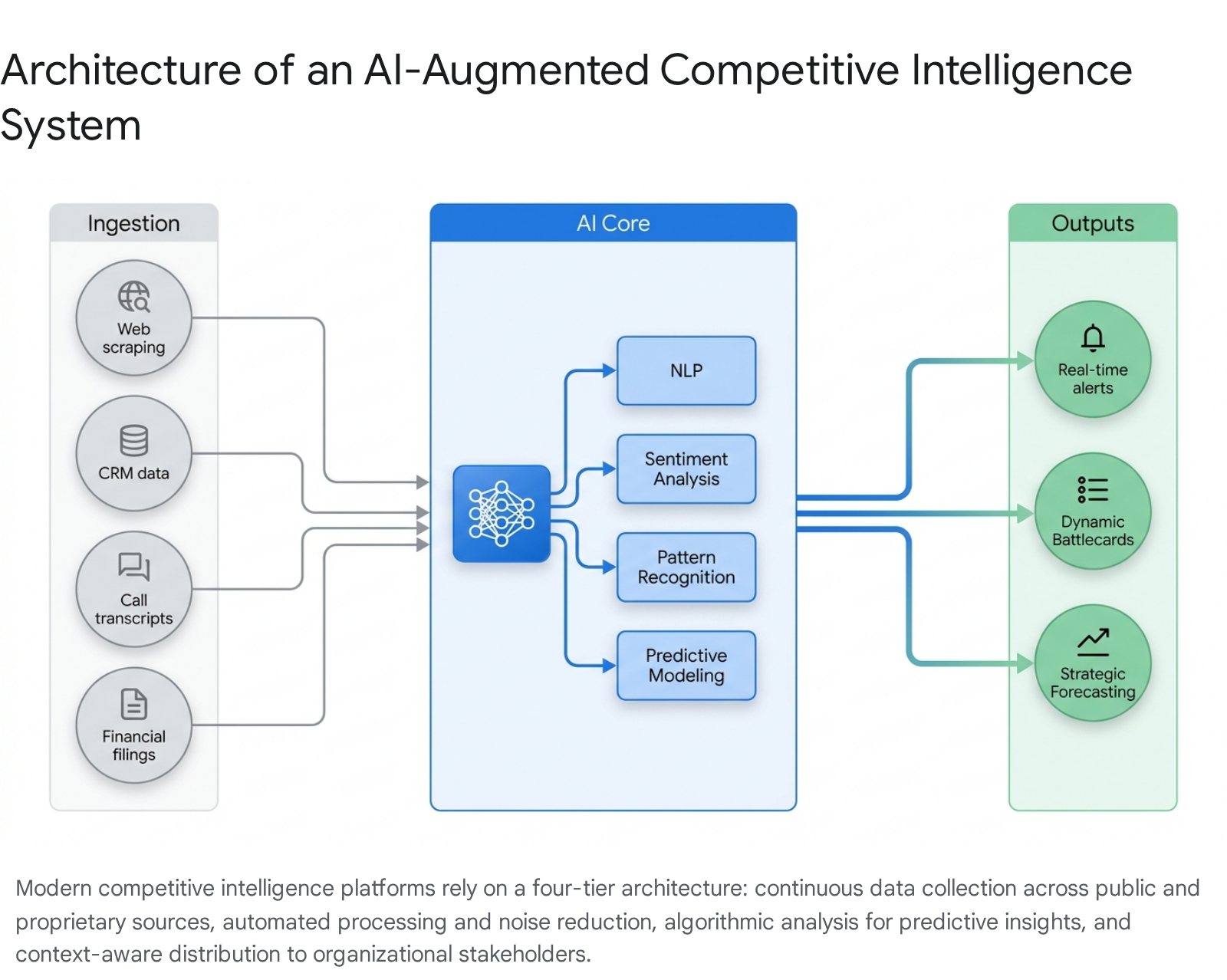
During the collection phase, web scrapers and API integrations ingest multi-modal data. This includes public digital exhaust - such as website updates, software reviews on platforms like G2 or Capterra, regulatory filings, and social media sentiment - as well as proprietary internal data, including Gong or Chorus sales call transcripts, win/loss interview notes, and Salesforce CRM records 258911.
Shift to Predictive Intelligence
Crucially, the 2026 landscape is defined by the transition from descriptive intelligence - reporting what a competitor has already done - to predictive and prescriptive intelligence, which anticipates future actions and recommends preemptive countermeasures 412.
In the processing and analysis phases, algorithms classify the ingested signals. By utilizing semantic analysis, the AI distinguishes between a routine, non-material press release and a critical pivot in competitor messaging 46. The system establishes factual grounding, attributes sources, and applies confidence scoring to flag uncertain claims for human review 4.
The distribution phase delivers this context-aware intelligence dynamically. Rather than forcing sales representatives to search a centralized database, agentic AI actively pushes deal-specific insights into the platforms where sellers operate. If a sales representative is scheduled for a call involving a specific competitor, the system autonomously detects the competitor mention in the deal notes, extracts relevant recent buyer quotes, and delivers a customized objection-handling briefing moments before the engagement 58. Market leaders utilize predictive models to detect weak signals. For instance, an AI platform might analyze an abrupt surge in a competitor's engineering job postings specific to a certain geographic region, correlating this data with recent patent filings to forecast an unannounced product feature launch with a three-to-six-month lead time 410.
Technical Mechanisms in Market Analysis
The underlying computational mechanisms driving competitive intelligence in 2026 rely on sophisticated machine learning models tailored for specific analytical functions.
Natural Language Processing and Sentiment Analysis
Natural Language Processing (NLP) functions as the core mechanism for extracting subjective meaning and qualitative value signals from vast text corpora. In financial and market research, NLP transforms unstructured documents - such as earnings call transcripts, broker research, and SEC filings - into quantified, analyzable metrics 1112.
Advanced sentiment analysis algorithms evaluate texts to classify sentiment polarity (positive, negative, neutral) and measure subjectivity 131415. Modern AI tools employ deep learning architectures, such as transformer models and Recurrent Neural Networks (RNNs), to parse nuanced semantic relationships, contextual tone, and bipolar terminology within corporate discourse 131416. Tools like the Harvard Psychosociological Dictionary (Harvard IV-4) or the TextBlob Python library are frequently utilized to establish programmatic sentiment baselines 1517.
A prominent application of this technology is the psycholinguistic profiling of corporate executives during earnings calls. Analysts utilize NLP to cross-reference executive statements against historical baselines, tracking shifts in rhetorical complexity, evasiveness (such as an increased use of weak modal verbs), and urgency 111718. If a Chief Financial Officer abruptly transitions from confident, definitive phrasing to hesitant language regarding future demand, NLP tools flag this micro-shift. By extracting readability scores, tracking sentiment across specific call sections, and mapping these features against subsequent stock performance, investors and competitors can model the true dynamics of a company's strategic vision 111718.
Predictive Algorithmic Pricing
In dynamic sectors such as consumer goods, travel, software-as-a-service (SaaS), and digital advertising, algorithmic pricing models dictate competitive strategy. Predictive analytics algorithms analyze historical data and current market conditions to forecast demand fluctuations and identify optimal pricing parameters 1920.
| Algorithm Type | Primary Function in Competitive Intelligence | Application Example |
|---|---|---|
| Linear / Logistic Regression | Quantifies relationships between variables and predicts binary outcomes. | Estimating the probability of a customer churning to a specific competitor based on historical price increases 2021. |
| Random Forest | An ensemble classification and regression algorithm using multiple decision trees. | Categorizing competitor pricing strategies into aggressive or passive tiers based on multi-variable inputs 20. |
| Temporal Fusion Transformer (TFT) | Deep learning architecture designed specifically for multi-horizon time-series forecasting. | Predicting long-term pricing shifts and volatility over sequential financial quarters 1120. |
| K-Means Clustering | Unsupervised learning method that groups similar data points. | Segmenting the competitive landscape based on observed pricing behaviors and market positioning 2022. |
Predictive pricing algorithms continuously ingest competitor pricing data, market demand signals, and seasonal fluctuations to optimize a firm's own pricing architecture 1922. By employing regression analysis to determine price elasticity, firms can dynamically adjust their rates to maximize margins while undercutting rivals 1922. In digital advertising, AI tools such as Ryze AI monitor competitor bid adjustments, creative ad fatigue, and cross-platform budget arbitrage. If a competitor aggressively increases their cost-per-click bids on target keywords, the AI autonomously enacts defensive countermeasures within hours, ensuring market share retention 26.
Feature Forecasting and Synthetic Benchmarking
Predictive modeling is critical for anticipating competitor feature launches and strategic pivots. By deploying pattern recognition across non-traditional datasets - such as tracking the specific engineering skill sets requested in a competitor's job postings or parsing the technical specifics of their recent patent filings - AI models forecast R&D trajectories 1021. This allows the monitoring organization to preemptively adjust its own marketing narratives, launch counter-campaigns, or accelerate internal product development to neutralize the competitor's upcoming advantage 10.
At the highest levels of enterprise strategy, competitive intelligence incorporates simulation and scenario modeling. Utilizing deep learning and Markov decision processes, organizations simulate competitor behavior over time to wargame various strategic permutations 2123. This technique, often referred to as "synthetic benchmarking," leverages generative AI to create detailed competitor personas based on firmographics, past acquisition history, and leadership behavioral profiles. When a company contemplates a price increase or a new product launch, they input these variables into the model to simulate the competitor's most probable counter-maneuvers, dramatically reducing strategic risk 212429.
Competitive Intelligence Software Architecture
The maturation of the AI competitive intelligence market has led to a distinct fragmentation of the software ecosystem. By 2026, the market has segmented into distinct architectural archetypes, each serving discrete organizational functions.
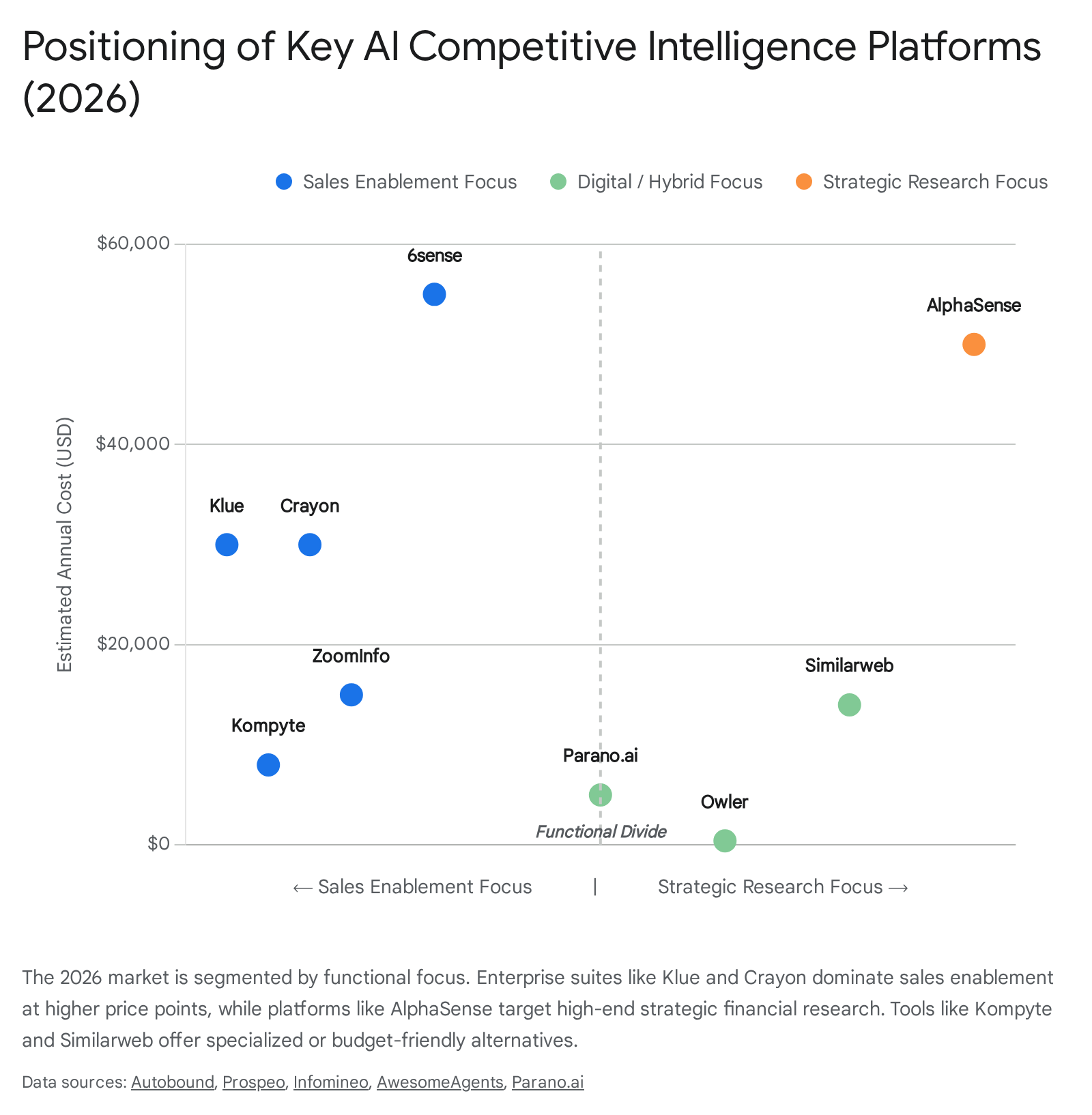
Buyers no longer seek a singular, monolithic platform; instead, they architect integrated intelligence "stacks" based on their specific maturity levels and departmental objectives 7925.
Platform Archetypes and Capabilities
The 2026 market recognizes five primary archetypes of competitive intelligence platforms:
- Dedicated Enterprise CI Suites (Sales Enablement Focus): Platforms such as Klue and Crayon dominate the enterprise tier, specifically tailored for B2B product marketing and sales enablement teams. These tools excel at transforming raw competitive data into structured, automated battlecards, win/loss analytics, and direct CRM integrations 2826.
- Market Data Aggregation and Financial Intelligence: Platforms like AlphaSense and Contify serve corporate strategy and financial analysis teams. Rather than focusing on sales battlecards, these tools function as AI-powered search engines and semantic aggregators. They index millions of premium documents, including broker research, regulatory filings, and paywalled news, utilizing domain-specific LLMs to conduct deep financial and industry research 27122627.
- Digital and Traffic Intelligence: Tools such as Similarweb and Semrush specialize in benchmarking digital footprints. These platforms provide unparalleled visibility into competitor web traffic, audience demographics, SEO performance, and digital market share - metrics that are largely absent from traditional CI suites 79252627.
- Modern Continuous CI Platforms: Emerging challengers like Parano.ai and Red Brick Labs represent the 2026 wave of "AI-native" architecture. Built explicitly around continuous monitoring and LLM-generated intelligence briefs, these tools focus on autonomous research agents that synthesize insights without the heavy administrative overhead required by older enterprise platforms 252628.
Comparison of Leading Platforms
The following table provides a comparative breakdown of the leading platforms defining the 2026 competitive intelligence technology stack:
| Platform | Core Archetype & Strength | Estimated Annual Cost | Key AI Features & Capabilities |
|---|---|---|---|
| Klue | Enterprise CI / Sales Enablement. Best for driving rep adoption and dynamic battlecards. | $20,000 - $40,000+ 2 | Compete Agent (agentic AI), Auto Insights from CRM/Gong, automated win/loss analysis, unlimited competitor tracking 28911. |
| Crayon | Enterprise CI / Broad Monitoring. Best for deep AI-driven signal detection and alerts. | $20,000 - $40,000+ 2 | Real-time tracking of 100+ data types, AI "Sparks" synthesis, Crayon Answers (generative Q&A), Call Clips integration 281226. |
| AlphaSense | Market & Financial Intelligence. Best for institutional strategy and M&A forecasting. | ~$24,000/user (scales to $50K+) 28 | Domain-specific LLMs, semantic search across SEC filings and broker research, Smart Summaries, Generative Search 2111227. |
| Kompyte | Budget CI / Marketing Integration. Best for teams leveraging the Semrush ecosystem. | From $300 (Essentials) to ~$15,000 28 | Automated website change detection, Kompyte GPT for generative analysis, AI battlecard generation 2826. |
| Similarweb | Digital & Traffic Intelligence. Best for web benchmarking and audience demographics. | $1,500 - $14,000+ 2927 | Unrivaled digital market share estimation, traffic source analysis, predictive audience benchmarking 272627. |
| Parano.ai | Modern Continuous CI. Best for lean teams needing highly synthesized, automated briefs. | Variable / Mid-Market 2526 | AI-native architecture, automated intelligence briefs and strategic summaries (minimizes raw data dumps) 2526. |
When establishing a CI architecture, organizations rarely rely on a single vendor. Over 70% of businesses deploy multiple AI platforms simultaneously to address different operational facets 34. For example, a mature enterprise stack might combine Crayon for broad market monitoring with AlphaSense for deep financial research, while utilizing Similarweb for granular SEO and digital traffic analysis 29.
Evolution of the Human Analyst Role
Shift to Strategic Synthesis
The aggressive deployment of automated intelligence platforms has catalyzed widespread speculation regarding the obsolescence of the human CI analyst. However, industry data from 2026 indicates that rather than replacing analysts, AI is profoundly augmenting and elevating their function 293630. Artificial intelligence currently automates 30% to 40% of the repetitive tasks historically associated with CI, including web scraping, preliminary data cleansing, report formatting, and basic pattern detection 2931.
By eliminating computational labor, organizations are pivoting toward lean, highly specialized intelligence units. While overall analyst headcount may decrease in some enterprises - resulting in significant cost efficiencies - the remaining professionals are transitioned into higher-value roles, frequently retitled as "AI-Augmented Analysts," "Analytics Intelligence Specialists," or "AI Orchestrators" 363031.
The primary mandate of the 2026 analyst is "strategic synthesis." While an AI model can identify that a competitor has dropped their pricing by 15% and aggressively hired channel partners, the AI lacks the nuanced business context to definitively explain why this is happening or how it fundamentally impacts the host organization's unique vulnerability profile 2936. Human analysts provide this critical context. They operate as the interface between algorithmic output and executive action, validating AI-generated hypotheses, assessing ethical considerations, and applying Explainable AI (XAI) frameworks to ensure recommendations are interpretable and justifiable to stakeholders 293631.
Organizational Restructuring and Market Foresight
As AI tools become ubiquitous, the competitive advantage shifts from merely acquiring data to interpreting it with superior strategic velocity. Elite analysts leverage their deep domain expertise to refine the prompts directed at AI systems, orchestrate complex automated workflows, and interpret geopolitical, regulatory, and market shifts that algorithms cannot independently contextualize 303139.
The expectations for these roles have shifted drastically. Leading technology organizations in 2026 seek CI managers capable of building web-scraping fleets, utilizing LLM-driven sentiment analysis continuously, and engaging in synthetic benchmarking to simulate market futures 242940. A key responsibility is developing proprietary "Human-to-Agent" ratios - quantifying how competitor shifts in labor and AI augmentation strategies directly affect competitive advantage 2440. Analysts are required to translate massive external data yields, such as earnings calls and labor reports, into a clear leadership narrative, acting as the enterprise radar for market disruptions 24.
Legal and Regulatory Constraints
As competitive intelligence relies increasingly on autonomous agents, large language models, and vast data ingestion, the discipline faces profound legal and operational risks. In 2026, the parameters of acceptable intelligence gathering are constrained by three primary vectors: the legal boundaries of automated data scraping, the liability of generative output, and the fracturing of global data sovereignty frameworks.
Legal Parameters of Automated Web Scraping
AI-powered competitive intelligence is dependent on the continuous ingestion of external data, a process driven by automated web scraping. However, the legality of deploying bots to harvest competitor data remains a complex and heavily litigated domain 3242. In the United States, the primary statute governing digital access is the Computer Fraud and Abuse Act (CFAA) 3242. Following years of ambiguity, a consensus framework has emerged in 2026, heavily influenced by landmark rulings.
| Landmark Legal Case | Core Legal Issue | Prevailing Ruling & Implication for CI Web Scraping |
|---|---|---|
| LinkedIn v. hiQ Labs (2019/2022) | Application of CFAA to public data scraping. | Permissible: Scraping data that is visible to any anonymous user on the public internet without breaking technical barriers does not violate the CFAA 3242434445. |
| Meta v. Bright Data (2024) | Breach of Terms of Service (ToS) via public scraping. | Partial Restriction: The court ruled public scraping does not violate CFAA, but upheld that it can constitute a breach of contract if the scraping entity has an active, binding ToS agreement with the host 324345. |
| Ryanair v. PR Aviation (2015) | EU regulations and automated price comparison. | Restriction: European courts upheld that website owners can restrict automated data harvesting through terms of use 3245. |
| Reddit v. Perplexity (Pending 2025/2026) | AI training data collection and DMCA circumvention. | Under Review: Testing legal theories regarding the circumvention of rate limits and anti-bot systems specifically deployed to block AI data harvesting 4243. |
The prevailing legal standard establishes a clear demarcation. The scraping of publicly accessible data (e.g., public pricing pages, unprotected job listings) is generally recognized as lawful 4445. Conversely, accessing data secured behind a login wall, paywall, or technical authentication requirement using automated scripts without explicit permission constitutes unauthorized access 424445. Circumventing technical blocks or CAPTCHAs severely escalates legal exposure 424445. Ethical and legally compliant CI programs enforce strict guidelines: respecting robots.txt files, avoiding the scraping of Personally Identifiable Information (PII) to prevent privacy law violations, and transparently attributing data sources 3242.
Risk of Algorithmic Hallucinations
The probabilistic nature of LLMs introduces a critical failure mode known as "AI hallucination" - the generation of coherent, confident, yet entirely fabricated information 463334. In the context of competitive intelligence, an autonomous system might falsely predict an upcoming competitor acquisition, misinterpret a benign regulatory filing as a compliance violation, or invent non-existent financial metrics 46.
The reliance on unverified AI output creates substantial corporate exposure. Courts and regulatory bodies have established clear precedents holding organizations strictly liable for the outputs of their AI tools 3335. If a company utilizes an AI agent to draft competitive positioning collateral that falsely claims a rival product violates federal cybersecurity standards, the company faces severe exposure under deceptive trade practices and false advertising laws 33. Regulators such as the Federal Trade Commission (FTC) emphasize that the source of the statement is legally irrelevant; liability rests solely on the publication of unsubstantiated claims 33.
In legal and highly regulated research environments, the manifestation of "phantom citations" - where AI invents nonexistent court cases or regulatory statutes - has already resulted in sanctions, fines, and reputational damage for practitioners who failed to verify their algorithmic outputs, as evidenced in cases like Mata v. Avianca and Shahid v. Esaam 3435. Gartner predicts that by the end of 2026, over 2,000 "death by AI" legal claims will be filed globally due to insufficient risk guardrails 3637. To mitigate this, robust CI frameworks mandate "human-in-the-loop" validation protocols and prioritize platforms bounded by verifiable databases 313435.
The European Union Artificial Intelligence Act
The global regulatory environment for artificial intelligence has grown increasingly fragmented. The most consequential development in this sphere is the European Union's Artificial Intelligence Act (EU AI Act), which entered into full phased applicability between 2025 and 2026 383940.
As the world's first comprehensive legal framework governing AI, the EU AI Act utilizes a tiered, risk-based classification system. It explicitly prohibits "unacceptable risk" applications (e.g., social scoring or manipulative behavioral algorithms) and imposes stringent transparency, data governance, and human oversight requirements on "high-risk" and general-purpose AI systems 3839554142. The regulation operates with extraterritorial reach; it applies to any AI system whose outputs affect individuals within the EU, regardless of where the developer or server is geographically located 384344.
For competitive intelligence vendors and their enterprise clients, the Act significantly elevates the cost of compliance. Organizations face formidable penalties for non-compliance, amounting to the higher of €35 million or 7% of global annual revenue 3855. The Act restricts the indiscriminate scraping of biometric data and mandates clear labeling of AI-generated content 404144. While the regulation provides legal certainty and seeks to establish a global standard (the "Brussels effect"), analysts warn that its stringent requirements may inadvertently chill innovation, increase market entry barriers for smaller CI startups, and potentially compel some foreign tech providers to withhold their latest AI models from the European market 384143. Concurrently, the United States relies on a fragmented patchwork of state-level privacy laws, while comprehensive federal frameworks like the proposed SECURE Data Act remain subjects of intense legislative debate 45464748.
Data Sovereignty and Geopolitical Risk
Beyond statutory compliance, the concept of data sovereignty - the principle that digital data is subject to the laws of the country in which it is collected or processed - has evolved into a matter of national security and critical corporate risk 495066.
The global AI landscape is fracturing into regional ecosystems. Analysts project that by 2027, 35% of nations will mandate the use of region-specific AI platforms, forcing global enterprises to maintain separate, localized infrastructures to comply with divergent cross-border data transfer restrictions 363750. This "localization" stifles the seamless pooling of global data sets required to train massive AI models, adding significant operational friction 4966.
This friction is acutely pronounced in the geopolitical context of China. The rapid emergence of highly capable Chinese AI models - such as those developed by DeepSeek and Kimi Moonshot - has triggered alarms within Western corporate cybersecurity and intelligence communities 51686970. While these tools offer formidable processing speeds and multilingual capabilities, their usage by corporate employees (often as "Shadow AI" to bypass internal procurement delays) introduces severe jurisdictional risks 68.
Routing sensitive corporate data, legal contracts, or proprietary source code through AI platforms headquartered in jurisdictions with expansive state intelligence mandates exposes organizations to espionage, intellectual property theft, and non-compliance with domestic export controls 51686970. The threat landscape in 2026 involves advanced threat actors specifically targeting third-party SaaS and AI supply chains for competitive intelligence gathering 5169. Consequently, corporate IT departments are forced to implement robust AI governance tools to detect and restrict localized "Shadow AI" usage, ensuring that strategic competitive intelligence data is confined to vetted, sovereign infrastructure 685253.