
Adult Friendships and Time Scarcity
The infrastructure of adult socialization has undergone profound structural shifts over the past two decades. Friendship, often viewed as a spontaneous and organic human phenomenon, is intrinsically bound by cognitive constraints, temporal availability, and financial resources. Recent sociological, economic, and time-use data indicates that the fundamental "price" of maintaining close adult relationships has risen significantly. This rising cost is measured not only in the literal inflationary pressures applied to commercial spaces where socialization traditionally occurs, but also in the figurative opportunity costs associated with time scarcity, shifting demographics, and the changing geography of modern work.
To understand why adult friendships are becoming increasingly difficult to form and sustain, it is necessary to analyze the cognitive mechanics of relationship maintenance, the macroeconomic variables constraining discretionary spending, the collapse of incidental workplace socialization, and the broader demographic trends in time allocation.
Cognitive Capacity and Relationship Maintenance
The foundation of human socialization operates on strict cognitive and temporal budgets. Anthropological and psychological research models consistently demonstrate that maintaining social ties requires a measurable, ongoing investment of resources.
The most prominent framework for understanding the capacity of human social networks is Dunbar's number, first proposed by British anthropologist Robin Dunbar in 1992 112. Extrapolating from the correlation between primate neocortex volume and average social group size, Dunbar posited that humans possess a cognitive limit of approximately 150 stable social relationships 113. A "stable relationship" in this context is defined not as mere recognition, but as a dynamic bond where an individual knows the other person, understands their shared history, and tracks how they connect to others within a broader network 11. The social brain hypothesis argues that the key selection pressure driving the evolution of large brains in primates was the complexity of managing these long-term relationships within a stable social group 4.
These 150 relationships are not distributed equally; rather, they are structured in concentric circles of decreasing intimacy and increasing size, typically scaling by multiples of three: 1.5 (intimate partners), 5 (close support clique), 15 (sympathy group), 50 (affinity group), and 150 (active network) 57.
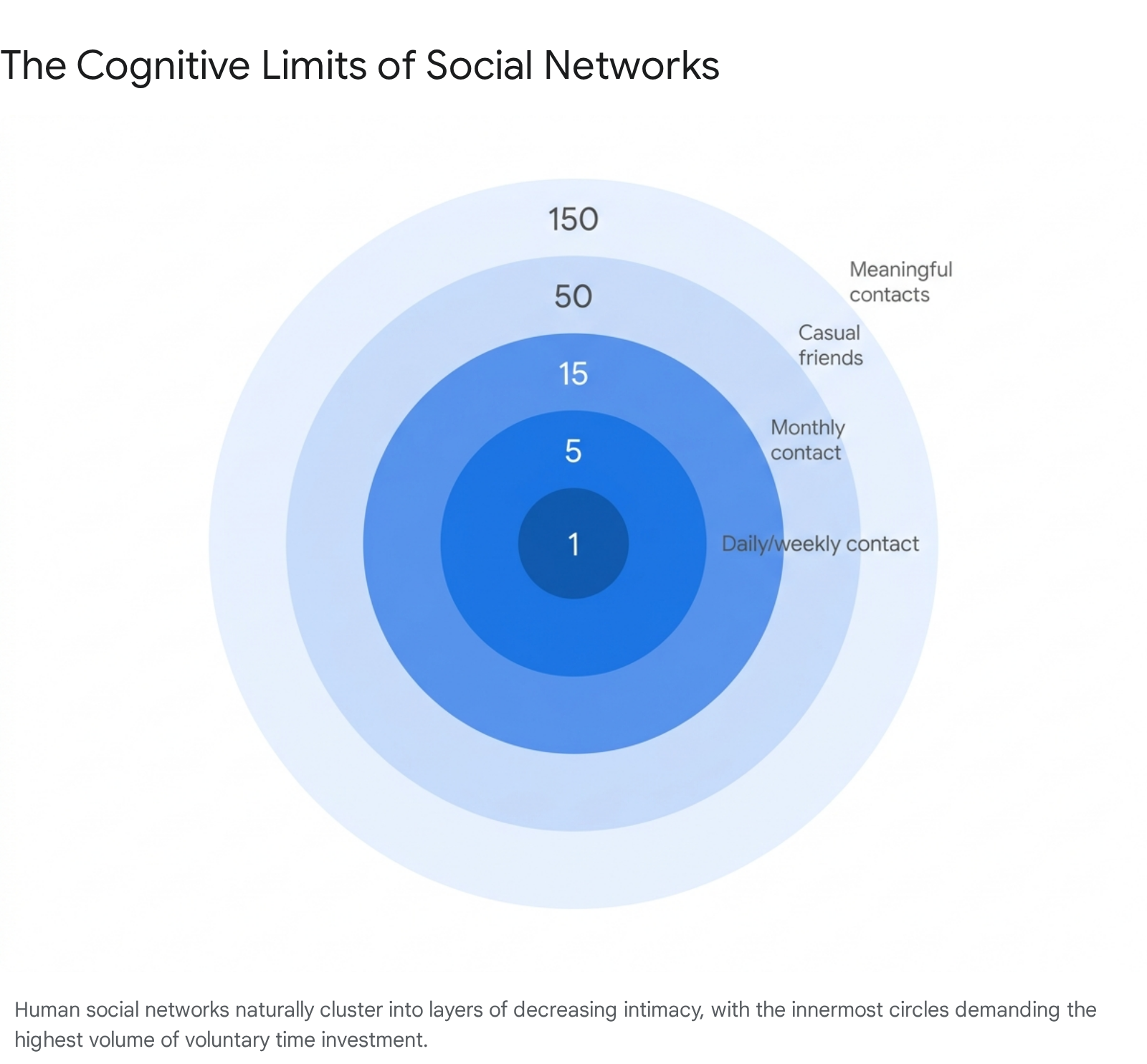
Each outward layer represents a lower level of emotional closeness and, crucially, a proportionately lower time commitment 1. The maintenance of these relationships requires active cognitive and temporal effort. The innermost layer - the core support clique of roughly five individuals - demands daily or weekly contact, mutual vulnerability, and a significant portion of an individual's discretionary social time 189. The subsequent layer of 15 close friends requires one to two meaningful interactions per month to remain stable 1. Anthropological findings emphasize that social relationships possess a literal "maintenance cost" 576. Because the cognitive limit of ~150 individuals remains relatively fixed regardless of technological advancements, adding new relationships inevitably dilutes the intimacy and time available for older ones 57.
While some researchers dispute the exact rigidity of Dunbar's number - with a 2021 study by Lindenfors et al. challenging the original statistical methods and suggesting wider confidence intervals ranging from 16 to 520 based on updated phylogenetic models - the underlying premise of a cognitive and temporal ceiling remains a cornerstone of sociological network analysis 17. Digital connections and social media do not expand this cognitive limit; they merely make maintaining "weak ties" (the 150-500 layer) cheaper 1.
Friendships cannot be expedited; they require a high volume of unstructured, voluntary time. Research into friendship formation quantifies the specific hourly investments required to escalate relational intimacy. It takes approximately 50 hours of interaction to transition an acquaintance into a casual friend, 90 hours to elevate a casual friend to a standard friend, and upward of 200 hours of investment within the space of a few months to forge a close friend 1812. The context of this time is equally critical. Time spent in structured, task-oriented environments - such as executing a project alongside a coworker - does not generate the same relational depth as voluntary, leisure-based interactions where both parties actively choose each other's company 12.
| Social Layer | Average Capacity | Maintenance Frequency | Relational Definition |
|---|---|---|---|
| Support Clique | ~5 individuals | Daily to weekly | Intimates; the core emotional support system. Requires the highest density of unstructured time. |
| Sympathy Group | ~15 individuals | Bi-weekly to monthly | Close friends; main social companions and highly trusted peers. Often provides the context for exchange of care. |
| Affinity Group | ~50 individuals | Periodic | Casual friends; the ambient social network, frequently context-dependent (e.g., large gatherings). |
| Active Network | ~150 individuals | At least annual | Meaningful contacts; stable relationships with known shared histories and reciprocal recognition. |
Table 1: The standard distribution of human social layers based on cognitive limits, demonstrating the relationship between network size and maintenance frequency 1589.
The Financial Cost of Socialization
While cognitive and temporal limits represent the biological constraints on friendship, the macroeconomic environment dictates the logistical constraints. Socializing in adulthood is heavily reliant on commercial "third places" - spaces distinct from the home and the workplace that facilitate informal gathering 8. Over the past decade, the financial barriers to accessing these spaces have risen dramatically, outpacing wage growth and creating a literal price tag for maintaining friendships.
The cost of achieving a basic but secure standard of living has diverged from headline inflation metrics. According to the Ludwig Institute for Shared Economic Prosperity (LISEP), the Minimal Quality of Life (MQL) Index - which accounts for the costs necessary for well-being, modest leisure, and upward mobility - increased by 30.9% between 2019 and 2024 alone 14. In 2024, the cost of essential needs and upward mobility rose by 4.4%, outpacing the 3.9% growth in median weekly earnings for full-time workers and resulting in an erosion of purchasing power for the average household 14.
This erosion is acutely visible in the hospitality and food service sectors, which serve as the primary venues for adult socialization. Data tracking fast-food and casual dining prices reveals inflation rates that vastly exceed the broader Consumer Price Index (CPI). Between 2014 and 2024, the average cost of eating at ten major fast-food chains increased by 63% 9. Specific brands implemented even more aggressive pricing strategies; prices at McDonald's increased by 100%, Popeyes by 86%, and Taco Bell by 81% over the decade 9.
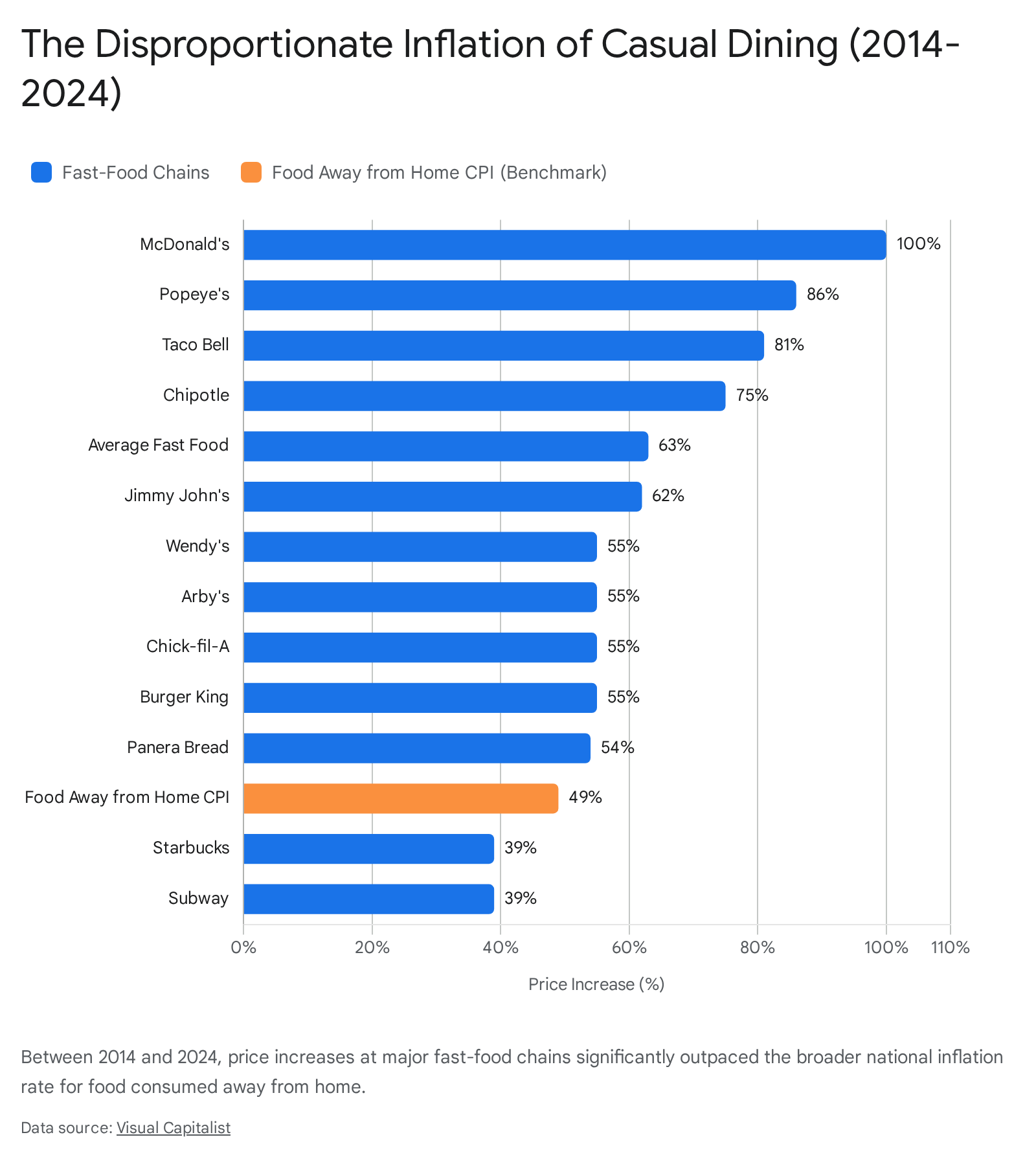
During the same period, the overall CPI for "food away from home" rose by 49% 9.
The inflation of casual beverages - long the cheapest pretext for social gathering - mirrors this trend. Coffee prices have surged globally, driven by both corporate markups and supply chain vulnerabilities, including weather-related harvest failures in major producing countries like Brazil, Vietnam, and Colombia 16. In April 2024, import prices for unroasted coffee beans were up approximately 53% year-over-year 16. Retail data reflects this volatility: between 2014 and 2024, the price of a tall mocha frappuccino at Starbucks increased by 32%, a bagel by 80%, and a cake pop by 97% 17. Industry monitoring by Toast in late 2025 indicated that the median price for a regular cup of coffee rose an additional 3.4% year-over-year to $3.61, outpacing other menu categories, while cold brew climbed 4.3% annually to a median of $5.55 18.
Alcoholic beverages, another staple of adult social ritual, present a bifurcated pricing landscape. The cost of alcohol purchased in retail environments for at-home consumption rose by only 16% between 2015 and 2025 - a rate roughly half the national inflation rate of 35% for that same period 19. However, the price of beer consumed out of the home or purchased in pre-packaged volumes has climbed steeply. The average price of a 12-pack of popular beer brands increased by 41% over the same decade, with budget-friendly staples like Miller High Life and Pabst Blue Ribbon rising by 44%, and premium options like Sam Adams Summer Ale jumping 71% 10. Globally, the price of a pint varies wildly, averaging $3.53 but ranging from $11.60 in Dubai to $7.52 in New York City, further fracturing the utility of the bar or pub as a universally accessible third place 21.
Financial Friction Within Peer Networks
The macroeconomic realities of third-place inflation generate micro-level friction within social networks, particularly for younger demographics facing mounting debt and volatile housing markets. Socializing is increasingly viewed not as a default state, but as a discretionary line item that frequently conflicts with financial stability.
Survey data collected throughout 2024 and 2025 illustrates the severe strain social spending places on adult friendships. On average, young adults spend approximately $250 every month on activities with friends 2211. However, this spending is rarely budgeted securely; only 18% of respondents report having a strict budget for social activities, and 59% admit that their broader financial goals are negatively impacted by peer spending 22. Consequently, 44% of Gen Z and millennials report actively skipping major social events specifically because of the cost, and 65% of those who do participate admit to breaking their budgets to do so 2224.
The financial barriers to friendship extend beyond casual outings to significant relational milestones. A staggering 72.3% of surveyed adults have declined at least one special occasion invitation for financial reasons, including 25.2% who have explicitly declined a wedding invitation due to the associated costs 12. Gen Z and millennials are the most affected demographics, with 75% and 81.5% respectively declining at least one social event each month due to financial constraints 12.
When socialization is heavily tied to consumption, income disparity within peer groups becomes a source of acute interpersonal tension. The data indicates a pervasive anxiety surrounding the financial mechanics of friendship. Nearly four in five respondents (78.8%) admit to feeling financial anxiety when hanging out with friends 12. Furthermore, 26% of consumers feel they are financially incompatible with their friends, leading to profound behavioral modifications: 54.3% admit to lying to their friends about their financial situation, most commonly by downplaying debt or exaggerating wealth 2412.
The friction of unpaid debts, bill-splitting, and lifestyle gaps frequently leads to the termination of friendships. In national surveys, 21% of respondents reported losing a friendship directly over money, and 44.7% have distanced themselves or cut off a friend due to disagreements about finances 2412. Borrowing money is a common catalyst; 57% of adults have borrowed money from friends, primarily to cover utility bills, and 33% cite repeated borrowing without repayment as a top driver of relationship tension 24.
| Financial Friction Metric | Reported Prevalence | Key Demographic Note |
|---|---|---|
| Skipped social events due to cost | 44% | Highly concentrated in Gen Z and Millennials. |
| Declined special occasion (e.g., weddings) | 72.3% | 25.2% specifically declined wedding invitations. |
| Experienced financial anxiety with friends | 78.8% | Widespread across all surveyed adult cohorts. |
| Lied about financial situation to friends | 54.3% | 33.2% specifically claim to be in a better financial position. |
| Lost a friendship directly over money | 21% to 44.7% | Varies by survey strictness; men are slightly more likely to end friendships over finances. |
Table 2: The prevalence of financial friction and anxiety in adult friendships, compiled from 2024-2025 financial wellness surveys 22112412.
Gender dynamics also influence how the financial toll of friendship is processed. Men are generally more comfortable discussing finances with friends (37% vs. 22% of women) and are twice as likely to spend more than $500 a month on social engagements 24. Conversely, women report feeling the strain of social spending more intensely - frequently citing anxiety regarding lifestyle differences and the pressure of events like birthday brunches and bachelorette weekends - but are statistically less likely than men to let finances irreparably damage their friendships 2224.
The Decline of Incidental Proximity
Historically, a vast portion of an adult's social network was generated and maintained through physical proximity. Workplaces, neighborhoods, and community organizations provided the infrastructure for "incidental" or "functional" friendships. These relationships are supported by shared routines, requiring minimal proactive scheduling to achieve the high interaction frequency necessary to sustain the inner layers of Dunbar's model 13. The mass adoption of remote and hybrid work models has severely disrupted this mechanism, forcing a transition from incidental proximity to intentional outreach.
The shift to remote work removed the built-in rituals of the physical office - casual hallway conversations, shared coffee breaks, and spontaneous post-meeting interactions. Without this social scaffolding, forming and maintaining workplace friendships requires proactive initiative that many workers struggle to sustain 13.
The resulting data outlines a concerning deterioration of workplace socialization. According to Gallup, the percentage of workers under the age of 35 who claim to have a "best friend at work" fell from 25% to 20% between 2019 and 2024 27. In a November 2024 survey by Resume Builder, 25% of remote workers reported that their social abilities had actively declined since transitioning to remote work 14. Furthermore, 20% reported feeling more anxious in social situations, and 18% struggled with basic interactions like small talk and eye contact 14. A majority of remote workers report feeling fundamentally disconnected from their company, their co-workers, and their broader local community 14.
This dynamic creates what organizational psychologists term the "Remote Work Paradox." Remote employees often demonstrate high levels of productivity, role satisfaction, and goal completion, yet simultaneously report navigating a crisis of social depletion and psychological fragmentation 13. Gallup data comparing remote-capable employees indicates that fully remote workers fare worse emotionally in their personal lives, reporting higher levels of anger, sadness, and loneliness, despite showing higher employee engagement metrics than their hybrid or on-site counterparts 13. Autonomy without belonging leads to long-term emotional wear.
A common hypothesis regarding remote work is the "social substitution" theory: the belief that the hours reclaimed from commuting and office presence will be reinvested into deeper, local relationships outside of work. Empirical time-use data firmly contradicts this assumption. Research demonstrates that remote workers lose approximately 38 minutes of daily non-household interactions, primarily stemming from the loss of casual office chats 29. Despite gaining significant time from the elimination of commutes, remote workers add only 0 to 5 minutes of extra socializing outside of work per day 29. Instead of joining local clubs or organizing more meetups with friends, these individuals spend an average of 32 extra minutes alone each day, amplifying isolation rather than expanding local ties 29.
This deficit is mirrored in student populations engaged in remote work-integrated learning (WIL). Studies indicate that students are significantly more likely to develop workplace friendships when working in-person rather than remotely 15. The lack of informal socialization opportunities in virtual spaces limits the humanization of co-workers, stunting early-career network development 15.
It is important to note that the academic consensus on remote work and friendship contains nuances. A 2024 study published in the Academy of Management journal found that, counter to prevailing narratives, working from home can occasionally improve specific workplace relationships 16. Through an analysis of thousands of digital communications, researchers found that co-workers can sometimes learn more about each other's authentic lives via virtual interactions (e.g., seeing into a colleague's home via video call) than through the polished facade of the physical office 16. However, achieving this requires a highly intentional, vulnerable communication culture that most organizations fail to implement organically.
Demographic Shifts in Time Allocation
The financial and geographic barriers to friendship are compounded by broader demographic shifts in how adults allocate their time. Longitudinal data from time-use surveys reveals a progressive decline in socialization across multiple cohorts, independent of the acute disruptions caused by the COVID-19 pandemic.
The most precipitous drop in social engagement is occurring among the youngest demographics. Data from the Bureau of Labor Statistics' American Time Use Survey (ATUS) tracking the period between 2003 and 2024 shows a severe decline in socializing among 15- to 24-year-olds 3217. Over two decades, the mean hours spent socializing and communicating for this age group plummeted from approximately 30 hours a month to just 19 hours a month - a decrease of over 33% 32.
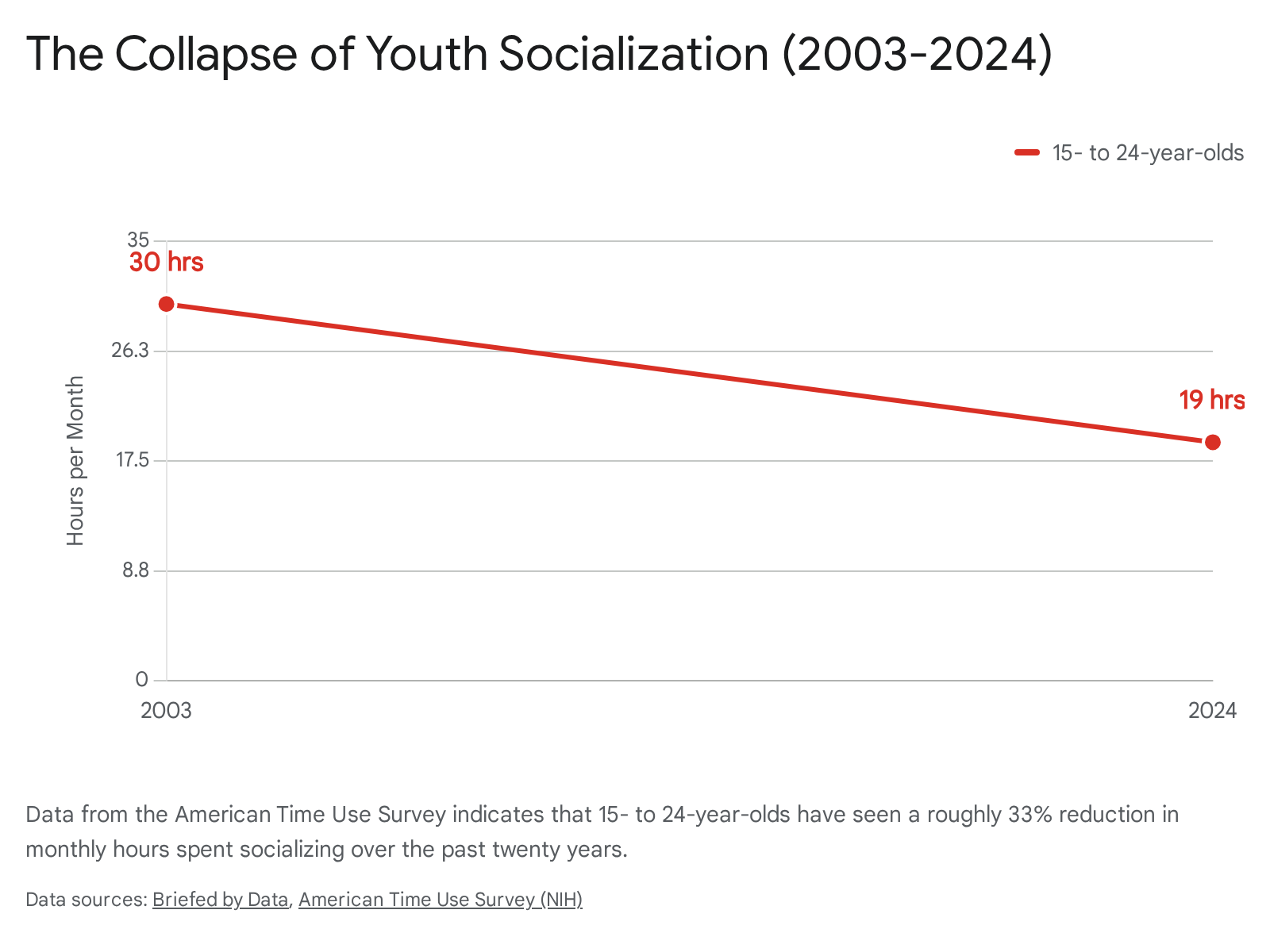
Notably, 15- to 24-year-olds in 2024 socialize less than all other age groups did twenty years ago, indicating a fundamental structural shift in youth behavior 32.
This trend is corroborated by OECD data spanning 21 European countries, which found that between 2015 and 2022, daily in-person contact with friends declined across all population groups 18. While older cohorts offset some of this loss by increasing remote contact via phone or digital platforms, young people aged 16 to 24 were the only age group that did not report a significant increase in remote contact with friends, resulting in an absolute net loss in social connection 18.
As individuals age, their time allocation naturally shifts away from broad friendship networks toward nuclear family units, career obligations, and eventually, solitude. According to an analysis of ATUS and Our World in Data, adolescence is the peak period for time spent with friends 19. By age 25, the average American spends 275 minutes per day alone and 199 minutes with coworkers 19. By age 45, time alone increases to 309 minutes a day, and by age 80, the daily minutes spent entirely alone rises to 477 19.
Parenthood significantly restructures discretionary time. Parents whose youngest child is under the age of six spend an average of 2.5 hours per day engaged in primary caregiving, leaving roughly 3.4 hours for all leisure and sports activities combined 20. Gender disparities in time allocation persist heavily within parenting dynamics. Fathers generally have three more hours per week of total leisure time than mothers, though mothers allocate slightly more of their limited leisure time (8.3 hours per week) specifically to social activities compared to fathers (7.4 hours) 21.
The friction between the demands of parenthood and the maintenance of personal well-being is heavily influenced by state infrastructure and labor policies. Cross-national studies utilizing the European Social Surveys and the International Social Survey Programme reveal a distinct "parenthood gap" in happiness in advanced industrialized societies - meaning parents consistently report lower levels of happiness than non-parents 3839. The United States exhibits the largest disadvantage of parenthood in this regard, driven largely by a lack of institutional support for childcare and leave 3839. Generous family policies, such as paid time off and robust childcare subsidies, are statistically associated with smaller disparities in happiness between parents and non-parents, freeing up the temporal and financial bandwidth necessary for parents to maintain adult friendships outside the home 3839.
Furthermore, macro demographic trends are fundamentally reshaping household compositions and timelines for independence. The Total Fertility Rate (TFR) across the OECD has halved from 3.3 children per woman in 1960 to just 1.5 in 2022, well below the replacement rate 22. Concurrently, economic insecurities and severe housing costs have led to an increase in multi-generational living, with roughly 50% of young adults aged 20 to 29 living with their parents in 2022 across the OECD 22. These delayed transitions into traditional adult independence disrupt the historic timelines of network formation, leaving many young adults structurally hindered from establishing their own distinct routines and hosting capabilities necessary for relationship maintenance.
| Life Stage / Cohort | Primary Time Allocation Shift | Social Implication |
|---|---|---|
| Youth (15-24) | 33% decline in socializing hours since 2003. | Absolute reduction in network building during peak socialization years. |
| Early Adulthood (25) | 275 mins/day alone, 199 mins with coworkers. | Shift toward workplace proximity for friendship, vulnerable to remote work trends. |
| Parenthood (<6yo child) | 2.5 hours/day primary caregiving; 3.4 hours total leisure. | Severe time scarcity; reliance on institutional support to maintain external ties. |
| Late Adulthood (80) | 477 mins/day alone. | High risk of objective isolation as peer networks naturally contract. |
Table 3: The trajectory of time allocation and social availability across the adult lifespan 321920.
The Health Outcomes of Social Isolation
The rising cost of friendship - manifested through financial strain, remote work isolation, and temporal scarcity - has culminated in a profound public health crisis. The reduction of active social networks is not merely a sociological curiosity; it has severe, measurable physiological and psychological consequences that strain healthcare systems globally.
In 2023, the U.S. Surgeon General issued an advisory declaring an "epidemic of loneliness and isolation," noting that approximately half of U.S. adults report experiencing loneliness 23. The biological imperative for connection is deeply rooted in human evolution; living in isolation historically required far more effort to survive, and human neural architecture has adapted to expect proximity to others 23. When the social infrastructure of a community erodes, the health impacts are immediate and severe.
Meta-analyses demonstrate that the mortality impact of being socially disconnected is comparable to smoking up to 15 cigarettes a day, and is twice as harmful to physical and mental health as obesity 2342. Chronic loneliness is associated with a 50% increased risk of depression, a 29% increased risk of heart disease, and a 40% increased risk of dementia in older adults 2324. Longitudinal studies tracking cognitive decline found that older adults who reported loneliness experienced a 20% faster decline in cognitive abilities over a 12-year period compared to socially engaged peers 24. Both objective solitude (e.g., living alone without frequent contact) and subjective loneliness (the perceived lack of meaningful connection) are strongly correlated with higher morbidity and premature mortality across all demographics 44.
Sociological research draws a vital distinction between voluntary solitude and involuntary isolation. Not all reductions in network size yield negative psychological outcomes. Studies testing the well-being of single young adults found that those who perceived their solitary status as voluntary reported significantly lower levels of romantic loneliness and maintained stable mental health metrics compared to those who viewed their isolation as involuntary 254626.
However, social exclusion harms both the victim and the perpetrator when the exclusion is forced by circumstance or lack of resources. Experimental paradigms demonstrating social exclusion reveal that individuals who are forced to exclude others (due to systemic rules, geographic limits, or financial inability to participate) experience a significant reduction in their own "meaning in life" scores, comparable to the victims of the exclusion 27. This suggests that when adults are forced to shrink their social circles due to financial anxiety, time scarcity, or geographic distance, the act of withdrawing inflicts a measurable psychological toll on all parties involved.
The cost of friendship is fundamentally regressive. There is a well-documented, bidirectional relationship between social isolation and poverty: being poor increases the likelihood of social isolation, and being socially isolated restricts the social capital necessary to secure employment or escape poverty 24. Access to free or low-cost third places (such as parks, libraries, and civic organizations) is geographically inequitable. Tract-level data from the National Neighborhood Data Archive indicates that higher poverty rates are associated with significantly fewer third places across all facility types 8. A one percentage point increase in a neighborhood's poverty rate correlates directly with a one percentage point decline in third-place availability 8. Consequently, low-income individuals face compounded cost and transportation barriers simply to access the physical spaces where friendships are traditionally forged and maintained, exacerbating the health impacts of isolation 8.
Ultimately, the scarcity of adult friendship is not a failure of individual sociability or a sudden shift in human nature, but a predictable outcome of an economic and spatial architecture that taxes connection. The time and cognitive bandwidth required to maintain Dunbar's relational layers remain fixed by evolutionary biology, but the modern environment systematically extracts that time or prices it out of reach. Reversing this trend requires viewing accessible social infrastructure, stabilized discretionary time, and localized economic support not as luxuries, but as critical components of public health.