
Adolescent Mental Health and Digital Technology Use
Introduction
Epidemiological surveillance across multiple Western nations indicates a pronounced, population-level decline in adolescent mental health over the past decade. Data from public health institutions point to sharp increases in the prevalence of major depressive episodes, generalized anxiety disorders, self-injurious behaviors, and suicidal ideation among youth. The inflection point for these trends is frequently identified as occurring between 2010 and 2012 1234. The synchronization of this epidemiological shift with the ubiquitous adoption of smartphones and high-speed social media networks has catalyzed a dominant cultural and scientific hypothesis: that digital technology is the primary causal agent driving a global psychological crisis 567.
Proponents of this technological determinism argue that the transition from a "play-based childhood" to a "phone-based childhood" has fundamentally altered adolescent neurological and social development. This framework posits that constant digital connectivity precipitates sleep deprivation, attention fragmentation, pathological social comparison, and the displacement of face-to-face interactions 258. Consequently, robust policy interventions have gained substantial traction, ranging from state-mandated social media bans for minors and age-gating legislation, to calls by public health officials for the integration of tobacco-style warning labels on digital platforms 698.
However, a growing coalition of psychological researchers, data scientists, and sociologists contests this monolithic narrative. Critics assert that the empirical foundation linking aggregate screen time to profound psychological harm is highly contested, characterized by severe methodological flaws, reliance on unverified self-reported data, and a persistent failure to distinguish between correlation and causality 1191310. Furthermore, an emerging sociological critique suggests that the intense focus on smartphones operates as a contemporary moral panic, effectively scapegoating digital devices for systemic, offline social failures 151112. By attributing the youth mental health crisis solely to digital technology, society risks obscuring deeply entrenched structural determinants of health, including rising economic inequality, the erosion of unsupervised physical play spaces, escalating academic pressures, and systemic deficiencies in pediatric psychiatric care 1314151617.
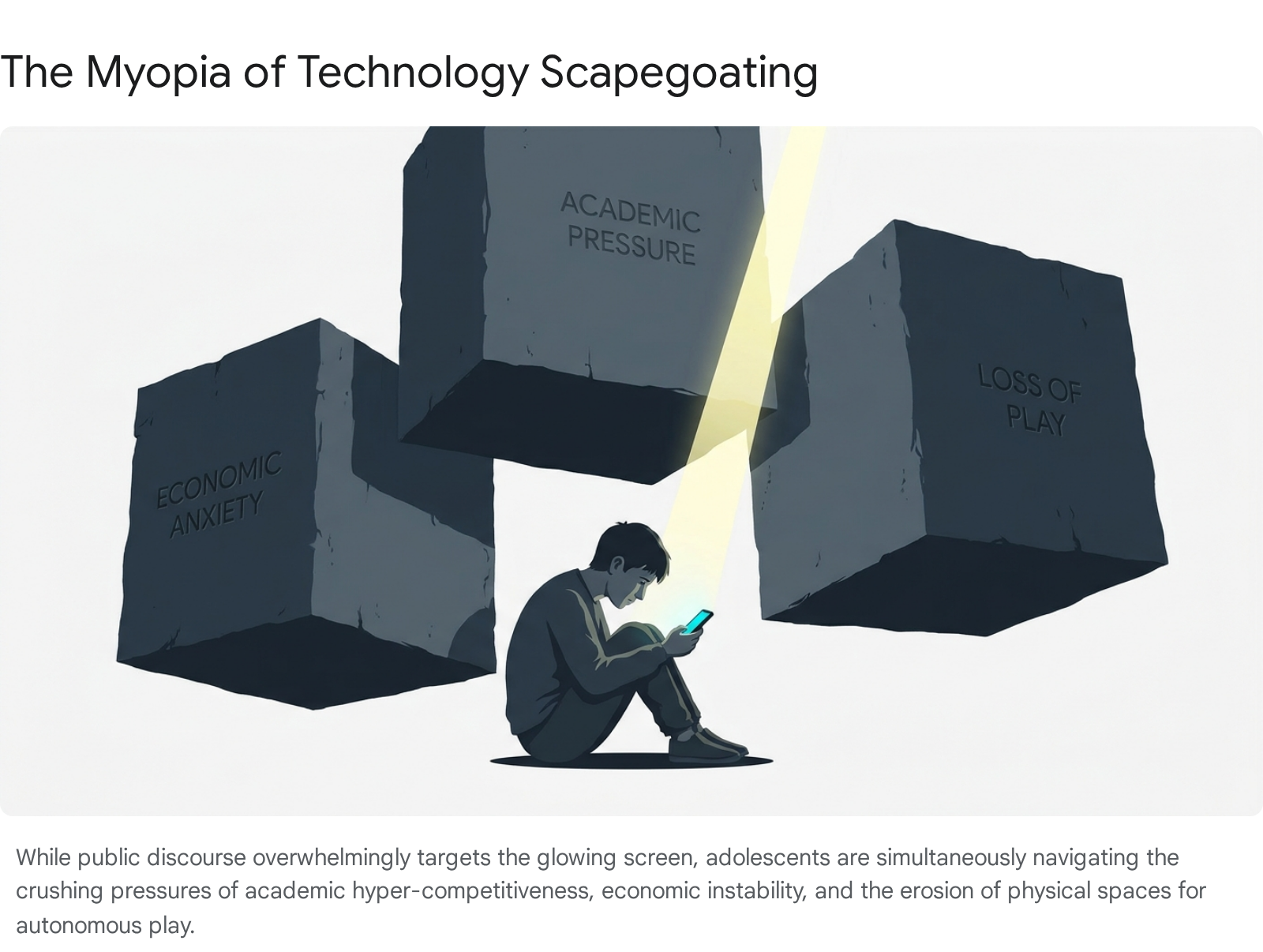
This report provides an exhaustive evaluation of the contemporary literature surrounding adolescent digital technology use and mental well-being. It synthesizes findings on methodological limitations in digital media measurement, platform-specific psychological associations, longitudinal evaluations of causality, and the broader social determinants of adolescent mental health.
The Emergence of the Smartphone Hypothesis
The argument that digital technology is the root cause of the current adolescent mental health crisis relies heavily on the temporal alignment between the proliferation of the smartphone and the rise in youth psychopathology. Understanding the theoretical underpinnings of this hypothesis requires examining the specific mechanisms of harm proposed by its primary advocates.
Theoretical Mechanisms of Digital Harm
Researchers identifying social media as the primary vector for declining mental health typically outline a multi-factorial model of harm. Social psychologist Jonathan Haidt, a prominent voice in this discourse, delineates four foundational mechanisms by which smartphones degrade youth well-being: social deprivation, sleep deprivation, attention fragmentation, and addiction 25.
The social deprivation hypothesis argues that the sheer volume of time adolescents spend engaging with screens inherently displaces high-quality, synchronous, in-person interactions 58. Sleep deprivation is identified as a critical physiological mediator; the presence of mobile devices in bedrooms, coupled with blue light emission and the psychological arousal of late-night digital interactions, significantly curtails total sleep duration and diminishes rapid eye movement (REM) sleep architecture 31819. Attention fragmentation refers to the cognitive toll of constant interruptions and task-switching driven by push notifications, which researchers argue impedes the development of sustained focus and executive function 25. Finally, the addiction model relies on the premise that the algorithmic architecture of social media - utilizing intermittent variable rewards and endless scrolling - hijacks dopaminergic pathways, creating compulsive usage patterns akin to substance use disorders 22021.
Correlational Support and Public Policy
Cross-sectional survey data provides the primary empirical backing for these theories. Large-scale analyses frequently demonstrate a dose-response relationship between hours of self-reported screen time and the incidence of mental distress. For example, a 2022 meta-analysis observed that the odds of depression increased by approximately 13% for every additional hour per day of social media use 2223. Survey data from the United States and the United Kingdom indicates that nearly one-third of adolescents report being online "almost constantly," and a significant percentage of these heavy users self-report that social media harms their confidence, disrupts their sleep, and induces anxiety 71123.
These correlational findings have catalyzed rapid policy responses. Health bodies and political figures rely on this data to advocate for aggressive restrictions, arguing that the harms to individual users are so diverse and vast in scope that they justify classifying social media as a dangerous consumer product operating at a population level 678.
Methodological Limitations in Screen Time Research
Despite the widespread acceptance of the smartphone hypothesis in public discourse, the academic community remains deeply divided. The primary vector of academic skepticism targets the methodological integrity of the foundational studies linking digital media to psychopathology. Methodologists argue that the field is plagued by measurement inaccuracies and analytical flexibility that distort the true magnitude of technology's impact.
Discrepancies Between Self-Reported and Logged Data
A fundamental vulnerability in the psychological literature concerning digital media is the historical reliance on retrospective self-report questionnaires. The vast majority of studies require adolescents or their parents to estimate their daily or weekly technology usage 2425. Recent advancements in passive sensing technologies and the availability of digital trace data have allowed researchers to test the convergent validity of these subjective estimates against objective behavioral logs.
The discrepancies between perceived and actual use are profound. A major systematic review and meta-analysis conducted by Parry et al. (2021) evaluated 106 comparisons across 47 studies, encompassing 50,000 individuals, to determine how closely self-report estimates relate to logs of actual usage 252632. The analysis revealed that self-reported media use is only weakly to moderately correlated with device-logged measurements, and that participants' estimates were accurate in merely 5% of the studies examined 252632.
Adolescents exhibit significant time distortion, routinely overestimating their time spent on social media by a factor of two under normal conditions 2728. Conversely, under conditions of heightened stress or altered routines, such as the COVID-19 lockdowns, researchers observed that individuals systematically underestimated their smartphone screen time (SST) by an average of 71 minutes per day 2930. A study utilizing the "Effortless Assessment of Risk States" (EARS) passive smartphone tracking app among 495 adolescents found that lower cognitive scores (specifically on picture vocabulary tests) were associated with a higher likelihood of inaccurate reporting 24. Because the foundational literature of the past decade relies overwhelmingly on these highly inaccurate self-reports, methodologists caution that the established evidence base regarding the dose-response relationship of screen time is inherently unstable 2526.
Statistical Variance and Specification Curve Analysis
Beyond raw measurement errors, the statistical methodologies utilized to extract meaning from massive public datasets have faced intense scrutiny. Traditional research paradigms often involve researchers making subjective decisions about which variables to control for (e.g., socioeconomic status, pre-existing conditions, family structure). This introduces massive "researcher degrees of freedom," allowing analytical flexibility that can inadvertently generate statistically significant but practically meaningless correlations 11931.
To rigorously test the magnitude of technology's impact while eliminating this analytical bias, researchers Amy Orben and Andrew Przybylski applied Specification Curve Analysis (SCA) to three large-scale, nationally representative datasets comprising 355,358 adolescents in the US and the UK 911. SCA involves running all mathematically possible analytical pathways - in this specific study, over 600 million different model configurations - to determine the true median effect size across all possible control scenarios 911.
The results of the specification curve analysis fundamentally challenged the panic narrative. The data indicated that digital technology use explains less than 0.4% of the variance in adolescent mental well-being 911. To provide a grounded context for this magnitude, the researchers compared the effect of screen time to other mundane activities measured within the same datasets. The negative association between digital screen engagement and well-being was found to be statistically equivalent to the negative association between well-being and regularly eating potatoes, and actually smaller than the psychological effect of wearing corrective eyeglasses 911931.
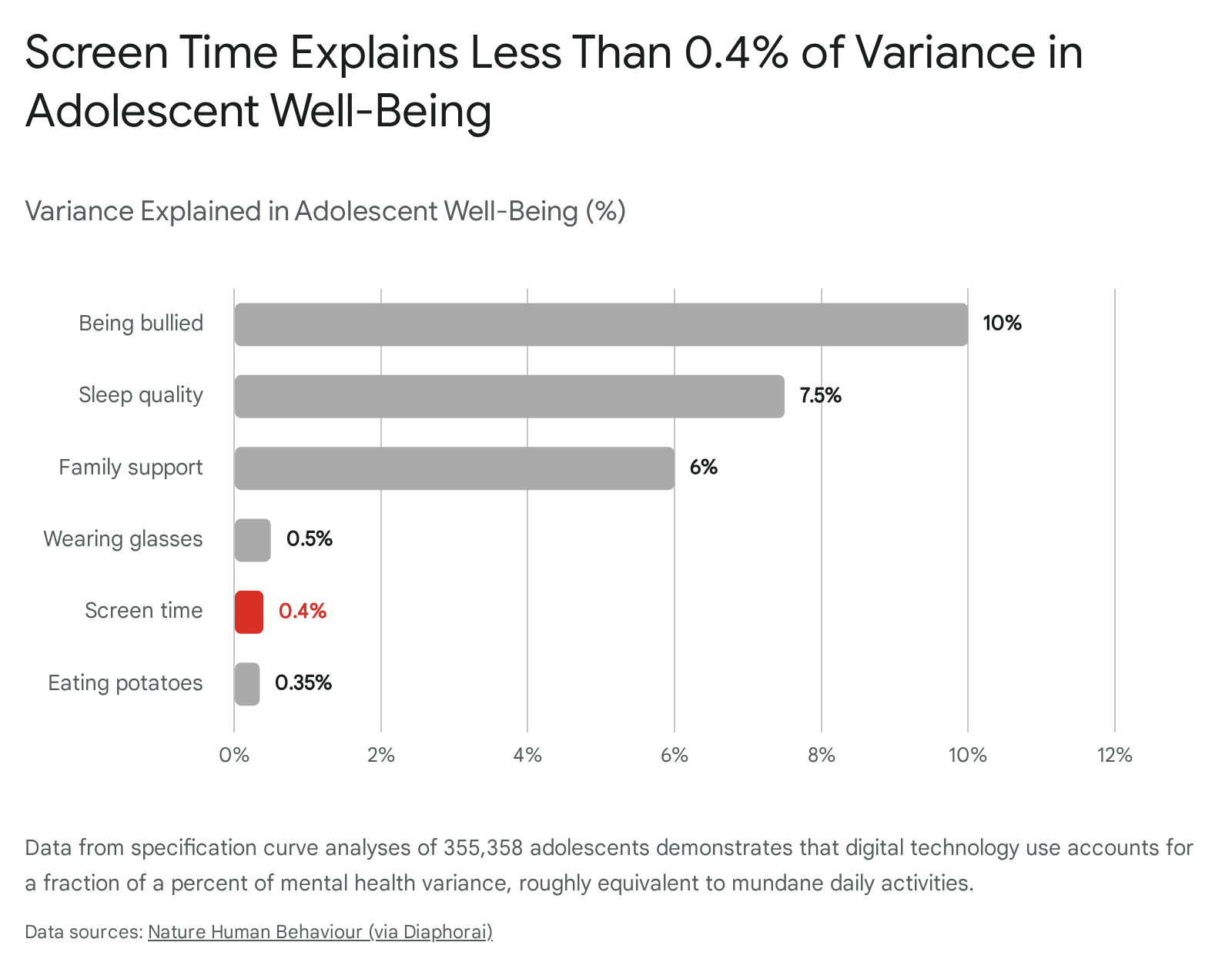
While pooled meta-analyses confirm that the general effects of digital technology on mental health reside slightly on the negative end of the spectrum, the absolute effect sizes are consistently classified as very small to negligible (yielding absolute correlation values of |r| < 0.10) 323334. Methodologists conclude that the minuscule space occupied by digital technology in the statistical models sits in stark contrast to its bloated expanse within public imagination and regulatory initiatives 11.
Typologies of Digital Engagement
Given the negligible utility of aggregate "screen time" as a predictive variable, contemporary psychological research has pivoted toward examining distinct typologies of digital engagement. The impact of a device is heavily contingent upon the specific activities the user performs, the architecture of the platform, and the social context of the interaction.
Active Versus Passive Social Media Use
A critical distinction within digital sociology is the divergence between active and passive social media use. Active use entails direct interaction and content creation - messaging peers, posting original updates, commenting on others' media, and participating in digital communities. Passive use involves the unidirectional, non-reciprocal consumption of content, colloquially referred to as "doomscrolling" 4142.
A 2024 meta-analysis encompassing 141 studies and approximately 145,000 participants evaluated the disparate effects of these engagement styles. The synthesis revealed that passive social media use is consistently linked to negative mental health outcomes, notably elevated depressive symptoms and cognitive fatigue 33414235. The primary psychological mechanism driving this degradation is upward social comparison. Continuous exposure to highly curated, algorithmically optimized, and filtered depictions of peers' lives fosters chronic feelings of inadequacy, body image disturbance, and social isolation 41423637.
Conversely, active engagement is frequently associated with enhanced perceptions of online social support and slight gains in overall eudaimonic well-being. By facilitating the maintenance of interpersonal relationships and allowing adolescents to find niche communities, active use acts as a buffer against loneliness 33413538. However, active use is not entirely benign; it has also been correlated with increased symptoms of anxiety, likely due to the performative pressures of content creation and the stress of managing online social dynamics 83341.
The Role of Platform Architecture in Adolescent Loneliness
The homogenization of all platforms under the umbrella term "social media" obscures vast architectural differences that dictate user behavior. An extensive cohort study of 1,632 young adults in the United Kingdom evaluated feelings of loneliness across different specific digital networks. The study found that while aggregate time spent online correlated with higher loneliness, time spent on major social networking sites (e.g., Facebook, Instagram) did not demonstrate a uniform or significant association 3940.
Instead, feelings of isolation were highly platform-specific. Elevated levels of loneliness were strongly associated with the use of platforms heavily reliant on passive consumption and pseudonymous interaction, such as Reddit, as well as digital dating applications 3940. In stark contrast, the use of WhatsApp - a platform fundamentally designed for private, direct messaging and maintaining existing close relational ties - was associated with lower levels of loneliness 3940. Furthermore, the study noted that individuals who experienced cyber-victimization or reported compulsive technology usage were significantly lonelier, suggesting that the qualitative nature of the digital experience and the specific architectural affordances of a given app are the true determinants of psychological outcomes 3940.
Video Gaming Versus Social Media Engagement
Digital technology consumption is heavily stratified by gender, necessitating distinct evaluations for social media and video gaming. Behavioral data indicates that adolescent boys are significantly more likely to engage in daily video gaming (61% versus 22% for girls), whereas adolescent girls exhibit higher rates of heavy, image-based social media use 341.
The mental health implications of video gaming present a complex dichotomy of risks and benefits. On the positive spectrum, multiplayer gaming serves as a vital conduit for socialization. Nearly half of adolescent gamers report that gaming facilitates the formation of new friendships and strengthens existing real-world bonds, while also improving collaborative problem-solving skills and resilience through overcoming in-game challenges 1941.
However, excessive and compulsive gaming introduces severe psychological risks. A study conducted by the Hanyang University Medical Center analyzed data from 54,809 South Korean teenagers, utilizing propensity score matching to account for confounding variables. The research identified a distinct curvilinear relationship: adolescents gaming for more than four hours daily exhibited a 16% higher propensity for stress perception, a 22% increase in depressive symptoms, and a 20% higher likelihood of suicidal attempts compared to benchmark groups 42. Furthermore, a longitudinal assessment utilizing four years of data from the Adolescent Brain Cognitive Development (ABCD) dataset revealed that high, addictive trajectories of video game use are associated with two to three times higher rates of suicidal ideation and internalizing symptoms compared to low-use trajectories 2143.
| Digital Activity Domain | Primary Engagement Style | Dominant Demographic | Associated Psychological Benefits | Primary Psychological Risks |
|---|---|---|---|---|
| Social Media (Image/Feed-Based) | Passive scrolling, profile viewing, status updating. | Adolescent Females | Identity exploration, connection for marginalized groups, rapid information access 338. | Upward social comparison, body image disturbance, depressive symptoms, cyberbullying 34237. |
| Direct Messaging Apps (e.g., WhatsApp) | Active, private, synchronous and asynchronous text/voice. | Broadly distributed | Maintenance of strong-tie relationships, lower levels of overall loneliness 3940. | Compulsive checking behaviors, anxiety regarding response times. |
| Video Gaming (Multiplayer/Action) | Active, highly interactive, team-based or competitive. | Adolescent Males | Enhanced spatial cognition, teamwork, stress relief, formation of online friendships 1941. | Sleep displacement, hostility/aggression, clinical addiction, increased suicidality in extreme use cases (>4 hrs/day) 214243. |
Evaluating Causality in Longitudinal Studies
A profound limitation of the digital harm narrative is its historical reliance on cross-sectional data - measurements taken at a single point in time. Cross-sectional studies can establish that depressed teenagers spend more time on social media, but they are fundamentally incapable of determining which factor preceded the other 11322. Establishing definitive causality requires longitudinal studies that track specific cohorts over multiple years, applying advanced statistical models to isolate the direction of effect.
Divergent Findings from Multi-Year Cohorts
The results from high-quality longitudinal analyses remain highly fractured, yielding conflicting interpretations of causality. Several robust long-term studies contradict the panic narrative entirely. An extensive eight-year longitudinal study conducted by researchers at Brigham Young University tracked 500 adolescents, examining both between-subject and within-subject changes across their developmental transition. The analysis found no clear causality between increased social media use and subsequent increases in anxiety or depression at the individual level; increasing or decreasing time on social media had no significant impact on the individual teenager's mental health trajectory 44.
Similarly, a comprehensive path analysis using the UK Understanding Society dataset (tracking 3,228 adolescents from age 10 to 15) found a non-significant linear trend linking social media time to poorer mental health two years later. When researchers adjusted the models for confounding variables, they found that any minor observed effects were mediated primarily by baseline self-esteem rather than the technology itself acting as an independent pathogen 45. Furthermore, experimental studies involving digital detoxes - where teens are required to abstain from social media for weeks - often yield null results, with measured effects on life satisfaction and positive affect failing to achieve statistical significance 932.
Conversely, specific longitudinal designs have detected causal harm, particularly concerning gender disparities. A study utilizing fixed-effects instrumental variable (FE-IV) techniques on longitudinal data from South Korean youth concluded that extended smartphone use did cause increased depressive symptoms and higher suicidal ideation - but exclusively among adolescent girls 4647. Additionally, structural analyses of the ABCD dataset within the United States suggest that extreme, compulsive engagement trajectories reliably predict subsequent internalizing disorders 723.
Bidirectional Relationships and Reverse Causality
To reconcile these conflicting data points, clinical researchers increasingly suggest that the relationship between digital technology and mental health is bidirectional. While excessive screen time may exacerbate existing depressive symptoms, pre-existing psychological distress frequently acts as a primary catalyst for problematic internet use.
This phenomenon, termed reverse causality, occurs when youth experiencing offline trauma, social ostracization, academic failure, or emerging psychopathology retreat into digital environments as a maladaptive coping mechanism 17133648. When adolescents suffer from depression, they naturally withdraw from physical activities, sports, and face-to-face interactions, which inevitably increases their passive consumption of digital media. Consequently, observing a high correlation between heavy social media use and mental illness in a dataset may simply reflect the reality that suffering adolescents use technology differently than their healthy peers, rather than proving the technology initiated the suffering 13575849.
Systemic and Environmental Determinants of Mental Health
The intense cultural hyper-focus on digital screens frequently acts as a cognitive blinder, distracting the public and policymakers from the broader, systemic forces shaping modern adolescence. The World Health Organization (WHO) explicitly defines the social determinants of health (SDOH) - the environmental, economic, and cultural conditions in which people are born, grow, live, and age - as the primary drivers of both physical and mental well-being 505152.
The Decline of Unsupervised Free Play
Developmental psychologists, notably Peter Gray, argue that the trajectory of the adolescent mental health crisis predates the invention of the smartphone, tracing its true origins to the systematic elimination of unsupervised free play starting in the 1970s and 1980s 1553. Unsupervised play is not a frivolous luxury; it is an evolutionary necessity for mammals. It serves as the primary mechanism through which youth learn risk negotiation, emotional regulation, conflict resolution, and social cohesion without adult intervention 154953.
Over the past four decades, cultural shifts toward intensive, overprotective parenting, coupled with the privatization of public spaces, heightened academic schedules, and exaggerated fears of crime, have drastically curtailed children's autonomy in the physical world 8155354. As real-world "third spaces" vanished and safety anxieties confined youth indoors, the internet became the only accessible avenue for autonomous socialization. Gray asserts that the spike in youth anxiety, depression, and feelings of helplessness is the direct psychological consequence of play deprivation and micromanagement 1555. In this framework, the smartphone is not the inherent pathogen; rather, it is the lifeline adolescents utilize to achieve the basic social connectivity that modern suburban and urban environments have systematically denied them 104954.
Academic Pressure and Economic Inequality
Concurrently, the material realities and performance expectations placed upon youth have intensified drastically. The 2008 global financial crisis and subsequent periods of economic instability fundamentally altered family economic security, initiating a cascade of parental stress that trickles down to disrupt child development 415.
The intersection of poverty and academic pressure creates a specific, highly destructive mental health environment. As higher education became increasingly framed as the sole mechanism for escaping poverty or maintaining middle-class status in a highly unequal economy, the academic pressure on adolescents skyrocketed 14. For marginalized youth, academic failure is not merely disappointing; it represents a catastrophic foreclosure of future economic survival. Expecting adolescents to endure escalating academic workloads and economic precariousness without experiencing subsequent rises in anxiety and depression ignores fundamental psychological realities 1456. Furthermore, modern adolescents are uniquely exposed to existential stressors that previous generations did not confront with the same immediacy, including pervasive climate anxiety, political polarization, and exposure to global conflicts, further compounding baseline stress levels 41512.
Global Disparities and Cultural Protective Factors
The assertion that digital technology universally and automatically damages youth mental health is further complicated by global health data. A comprehensive 2025/2026 report by Sapien Labs, which analyzed data from nearly one million internet-enabled individuals across 84 countries, revealed striking geographic disparities that challenge Western technological assumptions 6757.
Despite growing internet penetration and the rapid adoption of smartphones, young adults in Sub-Saharan Africa - specifically in nations such as Ghana, Nigeria, Kenya, Zimbabwe, and Tanzania - consistently reported the highest levels of mental well-being globally 6757. Conversely, youth in wealthy, high-income nations including the United States, Canada, Europe, and Australia ranked near the absolute bottom 6757.
While the Sapien Labs report noted that earlier adoption of smartphones during childhood generally correlated with poorer outcomes globally, it highlighted that specific cultural protective factors can powerfully override technological risks. African youth reported significantly stronger family bonds, tighter intergenerational community structures, and profound spiritual connections compared to their Western peers 675758. This geographic disparity strongly suggests that the Western mental health crisis may not be a pure product of the silicon chip. Instead, the crisis may be the result of introducing hyper-individualistic digital technology into Western societies that are already suffering from advanced social atomization, secularization, and the erosion of local community infrastructure.
Sociological Critiques and the Moral Panic Paradigm
By isolating the smartphone as the singular variable responsible for youth unhappiness, society engages in a classic sociological phenomenon: the moral panic. Scholars such as Danah Boyd argue that adults have historically projected their anxieties about complex societal shifts onto the media consumed by youth - a pattern observed previously with comic books, television, and rock music, and now repeating with social media 157071.
Deflection from Structural Failures
The scapegoating of social media serves a deeply exculpatory and politically expedient function for adult society. It is administratively simpler to blame technology conglomerates in Silicon Valley for youth depression than it is to address the intractable, expensive, and politically fraught realities of child poverty, the collapse of affordable housing, systemic racism, the underfunding of public education, and the severe lack of accessible pediatric psychiatric care 15121359.
Furthermore, simplistic policies born of moral panics - such as blanket bans on social media for minors or confiscating devices - carry profound unintended consequences. For marginalized youth, including LGBTQ+ adolescents, racial minorities, and children living in isolated or abusive households, digital networks often serve as the sole lifeline for peer support, identity affirmation, and mental health resources 11123874. Draconian restrictions risk severing these vulnerable populations from vital support systems in the name of a paternalistic protectionism that primarily assuages the anxieties of middle- and upper-class parents 115960.
Attentional Inequalities and Algorithmic Exploitation
Acknowledging that society scapegoats smartphones does not absolve technology companies of their complicity. However, critical sociologists argue the regulatory focus must shift away from arbitrary "screen time" limits and toward the systemic exploitation embedded in algorithmic architecture.
The digital ecosystem is predominantly sustained by surveillance capitalism, utilizing persuasive design, intermittent variable rewards, and limitless scrolling to harvest human attention for advertising revenue 61626364. This architecture generates profound "attentional harms" that degrade cognitive focus and emotional regulation. Crucially, the psychological burden of constant self-regulation required to navigate these platforms does not fall equally across society. This disparity creates "attentional inequalities." Marginalized individuals, who may possess lower digital literacy, lack the financial resources for premium ad-free experiences, or lack the environmental scaffolds to easily disconnect, suffer disproportionately from these predatory designs 616265. Therefore, an effective public health approach requires abandoning the futile attempt to prohibit technology use entirely, and instead demanding structural regulations on algorithmic amplification, data privacy, and the exploitative design mechanics that weaponize human psychology for profit 13576364.
Conclusion
The proposition that the adolescent mental health crisis is exclusively, or even primarily, a technological phenomenon is unsupported by the balance of rigorous empirical evidence. While highly compulsive, passive consumption of algorithmic social media undeniably exacerbates anxiety and depressive symptoms - particularly in susceptible individuals and adolescent girls - aggregate "screen time" explains only a negligible fraction of the population-level variance in youth well-being. The reliance on inaccurate self-reported data and cross-sectional studies has artificially inflated the perceived magnitude of digital harm, obscuring the complex, bidirectional relationship where pre-existing depression frequently drives problematic internet use.
The current epidemiological crisis in youth mental health is a multi-causal phenomenon. It is the culmination of decades of systemic social and environmental erosion: the restriction of unsupervised physical play, escalating academic and economic pressures, the dissolution of community infrastructure, and an overarching environment of global instability. Digital devices have become the modern scapegoat, absorbing the collective blame for a society that has systematically failed to provide its youth with the material security, autonomous physical spaces, and robust psychological support systems requisite for healthy development. Addressing this crisis effectively requires moving beyond the technologically deterministic panic of blanket smartphone bans. A holistic solution must focus on mitigating predatory platform architecture and attentional inequalities, while actively rebuilding the offline social and economic scaffolding that fosters authentic adolescent resilience.