
Account-based marketing mechanics and ROI versus lead generation
The transition from broad, volume-based demand generation to precision-targeted marketing represents one of the most significant structural shifts in modern business-to-business (B2B) commerce. For decades, traditional inbound marketing and lead generation operated on a volume-based paradigm: marketers cast a wide net with search engine optimization, content marketing, and digital advertising, captured as many individual contact details as possible, scored these leads based on engagement, and passed the highest-scoring individuals to sales teams. However, empirical data indicates that this model increasingly yields diminishing returns. Market saturation has resulted in a scenario where a vast majority of inbound content generates negligible traffic - with up to 94% of web pages generating zero organic search traffic - while the proliferation of digital noise has extended sales cycles and reduced conversion rates 1.
Furthermore, modern B2B purchasing is rarely executed by a single individual. The average enterprise software purchase now involves complex buying committees comprising up to 13 distinct stakeholders across multiple departments, including finance, legal, procurement, and end-users 2. Nearly 89% of buying decisions cross multiple departments, meaning that traditional lead generation models that focus on nurturing a single individual routinely stall when internal consensus cannot be reached 2.
Account-based marketing (ABM) emerged as a strategic countermeasure to these inherent inefficiencies. Fundamentally, ABM flips the traditional marketing funnel. Rather than acquiring thousands of disparate leads and filtering them down to a few qualified opportunities, ABM begins with a defined universe of high-value target accounts. Marketing and sales resources are then deployed synchronously to engage these specific organizations, treating each account as an independent market 335. This strategy requires deep personalization, recognizing that a compliance officer and a benefits manager within the same target enterprise require vastly different messaging, financial models, and value propositions to advance a deal 2. This report details the underlying mechanics of ABM, analyzes the empirical data surrounding its return on investment (ROI) compared to traditional lead generation, evaluates the total cost of ownership required to implement these systems, and contextualizes the strategy within the constraints of modern data privacy regulations.
Strategic Frameworks and Execution Models
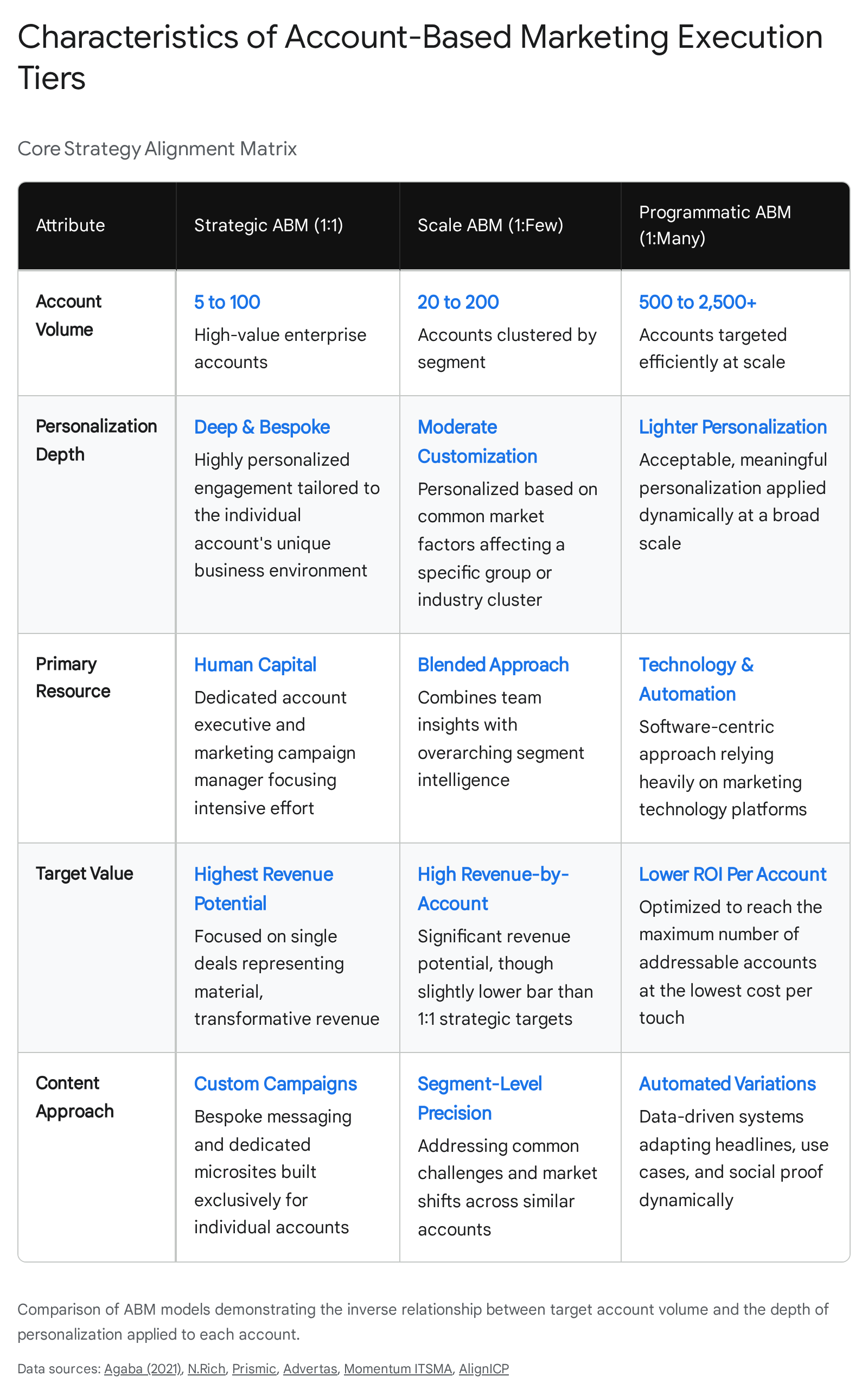
The implementation of account-based marketing is not a monolithic practice. It is stratified into distinct operational models based on the level of personalization, the potential contract value of the target accounts, and the scale of the technology deployed. Academic and practitioner research generally categorizes ABM into three primary execution tiers: Strategic (1:1), Scale (1:Few), and Programmatic (1:Many) 547.
Strategic Engagement
Strategic ABM, or the 1:1 approach, represents the highest level of resource investment and is typically reserved for enterprise accounts capable of generating massive revenue impacts. In this model, marketing teams conduct exhaustive research into a single account's strategic initiatives, recent earnings reports, competitive threats, and internal hierarchy 78. Campaigns are entirely bespoke and highly labor-intensive. Execution may involve creating custom microsites featuring tailored case studies, recording personalized videos from executive to executive, and developing specific return-on-investment models based on the target's public financial data 7. Because of the extreme resources required, an organization may only run 1:1 ABM programs for 5 to 100 accounts simultaneously 5. The objective is to secure long-term partnerships and maximize customer lifetime value (CLV) through highly contextualized relevance 86.
Scale Engagement
Scale ABM, or the 1:Few approach, groups target accounts into micro-segments based on shared characteristics. These clusters might consist of companies within a specific industry sub-vertical facing the exact same regulatory change, or organizations utilizing a specific competitor's technology 57. Personalization in this tier relies on adapting messaging to the shared context of the cluster rather than the unique identity of the individual firm. A typical 1:Few program might target 20 to 200 accounts, allowing for high relevance without the prohibitive unit economics of purely bespoke content 5. This model effectively balances the necessity for targeted messaging with the operational realities of limited marketing personnel 7.
Programmatic Engagement
Programmatic ABM, or the 1:Many approach (sometimes referred to as Growth ABM), leverages advanced technology to extend account-based principles to hundreds or thousands of accounts. This tier relies heavily on marketing automation, customer data platforms (CDPs), and programmatic advertising 47. Content variations are driven dynamically by data inputs; a landing page might automatically swap out its headline, hero image, and case studies based on the incoming visitor's IP address and firmographic profile 7. While personalization is shallower than in the 1:1 tier, it maintains segment-level precision at scale, reaching up to 2,500 target accounts at an acceptable cost per touch 57.
Essential Pillars for Implementation
Successfully implementing any of these frameworks requires mastery of specific operational pillars. Research emphasizes that ABM cannot function as a siloed marketing tactic; it must be treated as a holistic corporate initiative. Agaba (2021) identifies four essential pillars for ABM success: strategy, technology, people, and processes 468. If these structural elements are not aligned, organizations routinely fail to capitalize on the methodology's potential.
The foundational element is the creation of a unified target account list (TAL). If marketing and sales do not agree on which accounts constitute the highest value, the entire apparatus fails 79. Establishing this list requires an ongoing, cross-functional process between marketing and sales to evaluate customer and market trends, surface intelligence, and agree upon ideal customer profiles (ICPs) 7. Furthermore, organizations must invest heavily in aligning omnichannel efforts so that advertising, digital content, and direct sales outreach present a coherent narrative across the entire B2B buying journey 910. Misalignment in these areas is a primary reason why up to 70% of ABM programs fail to achieve their anticipated ROI 11.
Performance Metrics and Return on Investment
The rapid adoption of ABM across B2B sectors is primarily driven by its outsized return on investment compared to traditional demand generation. Because traditional inbound marketing relies on volume, it inherently generates a massive amount of waste; marketing teams spend considerable budget acquiring leads that will never pass qualification standards, while sales teams waste hours attempting to contact individuals who lack purchasing authority 14. By isolating high-propensity targets, ABM structurally eliminates this waste, leading to vastly improved unit economics.
Aggregate Performance Benchmarks
Aggregate benchmarking data consistently positions ABM as the highest-performing initiative in B2B marketing. According to the Momentum ITSMA Global Benchmark Report, 81% of organizations report that ABM delivers a higher return on investment than other marketing initiatives, with 36% classifying the ROI as "significantly higher" 5. Across various studies, the estimated average ROI from mature ABM programs ranges from 137% 12 up to peaks of 200% to 300% when isolated to specific enterprise deployments 13. Consequently, top-performing B2B organizations are increasing their financial commitment to the strategy; 71% of companies increased their ABM spending in 2023, allocating an average of 30% of their total marketing budgets to these programs 518.
| Performance Category | Key ABM Metric | Comparison vs. Traditional Marketing | Sources |
|---|---|---|---|
| Sales Velocity | Sales Cycle Duration | 28% to 30% faster sales cycles on average. | 1314 |
| Win Rates | Deal Close Rate | 35% higher close rates on ABM accounts. | 13 |
| Deal Value | Average Contract Value (ACV) | 75% increase in ACV; mature programs see up to 200% larger deals. | 313 |
| Pipeline Generation | Conversion to Pipeline | 3x higher conversion rate to active sales pipeline. | 13 |
| Revenue Growth | Annual Revenue Impact | Aligned teams achieve 24% faster revenue growth. | 20 |
The financial superiority of ABM manifests through three primary mechanisms: increased deal velocity, higher win rates, and expanded average contract value (ACV). Because ABM preemptively targets the entire buying committee rather than a single mid-level employee, the internal consensus-building required for an enterprise purchase occurs more smoothly. Organizations utilizing ABM report a 28% to 30% acceleration in the average sales cycle 1314.
Furthermore, win rates on ABM-targeted accounts are demonstrably higher. Data indicates that ABM accounts exhibit a 35% higher deal close rate 13, and marketing-sourced leads specifically funneled through ABM workflows convert to pipeline at three times the standard rate 13. Deal sizes also expand under this model. By positioning the vendor as a strategic partner addressing specific corporate pain points - rather than a commodity software provider - best-in-class ABM programs report 75% increases in average contract value, with highly mature programs sometimes seeing deal sizes double compared to non-ABM cohorts 313.
Independent Economic Impact Assessments
To quantify these assertions, major technology vendors frequently commission independent analysis firms, such as Forrester Consulting, to conduct Total Economic Impact (TEI) studies. These studies aggregate data from multiple enterprise implementations to model the financial outcome for a standardized "composite organization." While these studies are vendor-commissioned - necessitating a degree of analytical calibration - Forrester's strict methodological framework requires independent customer interviews, financial modeling, and risk-adjusted discounting, providing the most detailed view of ABM software economics available 15.
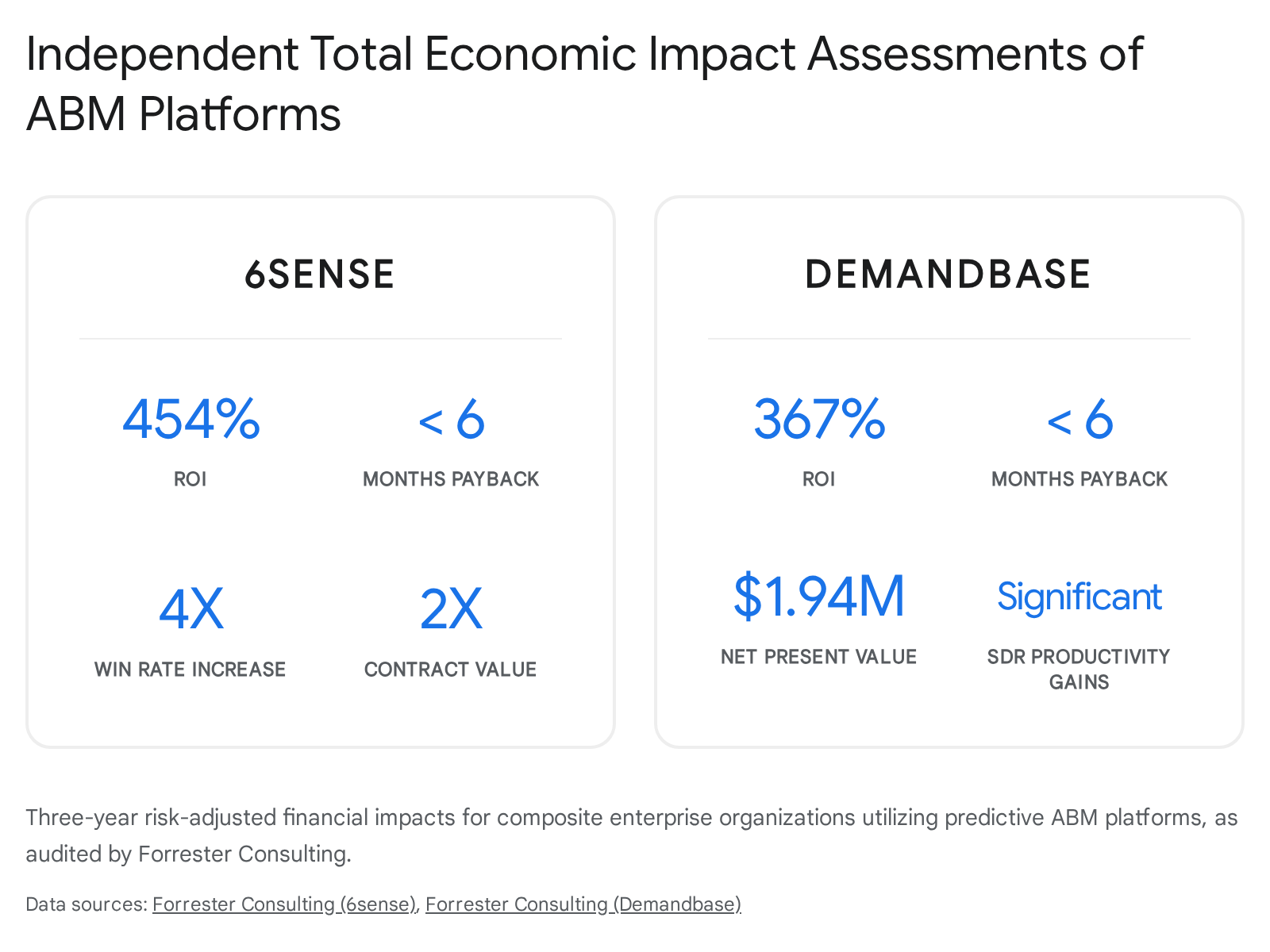
A Forrester TEI study analyzing the deployment of the 6sense Revenue AI platform modeled a composite organization and found a 454% return on investment over a three-year period 1617. The study attributed this profound return to several factors. First, the platform's predictive capabilities allowed organizations to identify accounts that were actively in-market, leading to a four-fold (4X) increase in win rates and a two-fold (2X) increase in average contract value 1617. Simultaneously, the platform drove operational efficiencies, yielding a 40% reduction in the aggregate costs required to qualify opportunities and a 20% to 40% reduction in the time required to close deals 16. The payback period for the initial software and implementation investment was achieved in less than six months 16.
A parallel TEI study conducted for Demandbase, another leading ABM orchestration platform, modeled a composite enterprise with $200 million in revenue and 650 employees. Forrester concluded that deploying Demandbase yielded a 367% ROI over three years, delivering a net present value of $1.94 million 1819. The benefits were heavily weighted toward productivity gains; marketing teams saved entire days previously spent attempting to manually determine which accounts were most likely to buy, while sales development representatives (SDRs) achieved higher connect rates by utilizing accurate, platform-provided account intelligence 18.
Technological Infrastructure and Intent Data Analytics
The modern iteration of ABM - frequently referred to as ABM 2.0 or 3.0 - is defined by the integration of predictive analytics and behavioral intent data. While early ABM strategies relied on static lists of ideal customer profiles, contemporary platforms dynamicize this process by identifying not just who is a good structural fit, but who is actively looking to make a purchase at any given moment 2620.
The Mechanics of Buying Intent
Intent data tracks the digital footprints left by buying committees as they conduct research across the internet. Because up to 70% of the B2B buyer's journey is conducted anonymously before a prospect ever interacts with a vendor's website or fills out a form, organizations utilizing static targeting are operating at a severe disadvantage 26. By the time a prospect formally requests a demonstration, they have often already formed strong vendor preferences.
Intent signals are aggregated through both first-party and third-party networks. First-party intent involves deanonymizing traffic on a company's own digital properties. By cross-referencing visitor IP addresses against massive commercial databases, ABM platforms can identify that employees from a specific target account are currently evaluating a pricing page or reading technical documentation, even if no individual has submitted an email address 2122. Third-party intent data is gathered from vast networks of publishers, content syndication platforms, and B2B forums 22. If multiple employees from a target enterprise begin heavily researching topics like "enterprise cybersecurity compliance" across external tech blogs, the ABM platform detects a surge in topic interest and flags the account as being in-market.
Applying this data to target account selection eliminates the massive inefficiency of marketing to cold accounts. Research indicates that ABM programs activated by intent data generate 2.5 times higher deal close rates compared to programs relying solely on static ICP targeting 26. Furthermore, intent-driven engagement rates are generally 50% higher, as outreach occurs precisely when the account is attempting to solve a specific business problem 26.
Artificial Intelligence and Predictive Scoring
Artificial Intelligence (AI) serves as the core orchestration layer that makes programmatic ABM possible at scale. Predictive analytics models utilize machine learning algorithms to ingest millions of data points - including historical win/loss ratios, current CRM firmographics, and real-time intent surges - to calculate a dynamic propensity-to-buy score for every account in the total addressable market 2623.
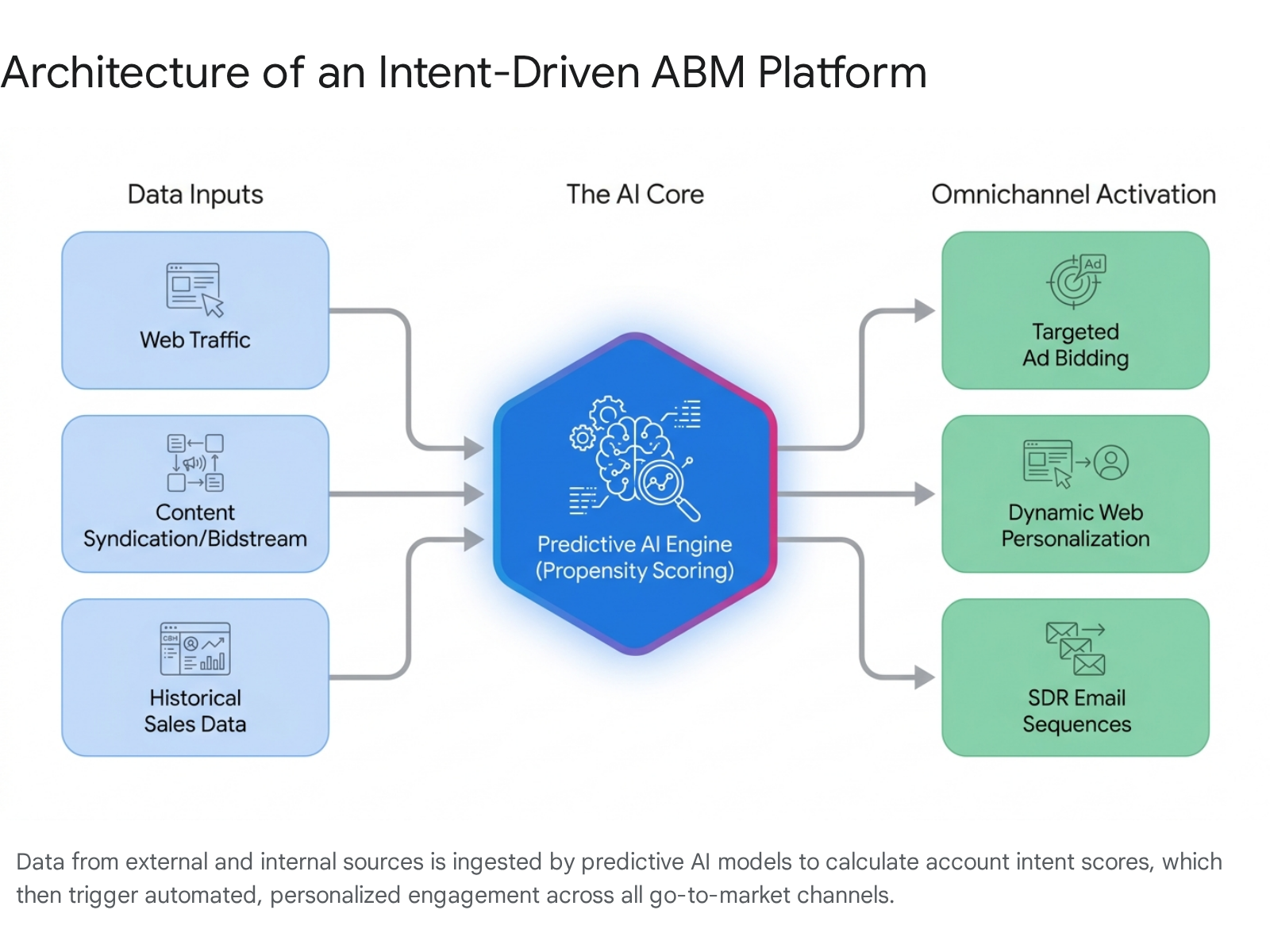
These models can achieve 85% to 90% accuracy in predicting purchase readiness, allowing marketing teams to automatically shift advertising budgets away from dormant accounts and push resources toward those showing late-stage buying behavior 26.
Generative AI is also increasingly solving the content production bottleneck inherent in ABM. Historically, creating personalized landing pages and digital experiences for hundreds of target accounts was a prohibitive manual task 7. Today, AI systems can dynamically adjust the copy, imagery, and case studies presented on a website in real-time based on the incoming visitor's company size, industry, and known intent signals 726. This automated orchestration ensures a continuous, personalized narrative across digital advertising, email outreach, and web experiences, yielding conversion rate increases of up to 30% for AI-powered campaigns 2623.
Total Cost of Ownership and Operational Complexities
While the return on investment for successful ABM initiatives is remarkably high, the absolute costs required to achieve these returns are substantial. The transition to ABM is not merely a change in marketing philosophy; it is a fundamental rearchitecting of the go-to-market technology stack and personnel alignment. Consequently, failure rates are significant. Research indicates that a notable percentage of ABM programs fail to hit their initial ROI targets, largely due to systemic misalignment, poor data quality, and underestimating the true total cost of ownership (TCO) 11.
Software Licensing and Base Infrastructure Costs
At the programmatic and enterprise levels, ABM requires sophisticated orchestration engines. Platforms such as 6sense, Demandbase, and ZoomInfo provide the core infrastructure for identifying accounts, resolving IP addresses to company names, and serving targeted advertising 2432. However, these platforms carry premium enterprise pricing. Standard platform licensing typically ranges from $65,000 to over $145,000 annually, with high-end enterprise contracts exceeding $200,000 3225. For organizations seeking a native solution without massive standalone platform fees, tools like HubSpot Marketing Hub offer introductory ABM capabilities, scaling from roughly $9,600 to $43,200 annually, though they lack the specialized intent modeling of dedicated enterprise systems 32.
The platform fee represents only the foundational layer of the software stack. To function effectively, ABM engines require vast amounts of high-fidelity data. Organizations must invest in data enrichment services to ensure contact records are accurate, visitor identification software (averaging $60,000 annually), and separate marketing automation systems ($20,000 to $60,000 annually) 25. The efficacy of an ABM platform is entirely dependent on the quality of the data feeding into it. Poor contact data results in wasted sales outreach, damaged domain reputation from high email bounce rates, and missed opportunities 26.
Hidden Expenses in Data Enrichment and Implementation
The most frequently underestimated cost in ABM deployment is human capital. Operating an enterprise ABM platform is not a part-time responsibility that can be appended to an existing marketing manager's workload. Systems like 6sense and Demandbase are highly complex and effectively mandate dedicated administrative headcount, representing an additional $60,000 to $120,000 in annual labor costs per operator 32. Furthermore, organizations often over-engineer their technology stacks, creating fragile workflows that require exhaustive standard operating procedures to function. If a key administrator departs the organization, automated workflows and personalization triggers can rapidly collapse 10.
Implementation itself presents a formidable barrier. Platform integration with existing Customer Relationship Management (CRM) databases and marketing automation tools requires significant IT resources and timeline flexibility. Implementation fees charged by vendors or agencies typically range from $5,000 to $50,000, and the technical onboarding process usually demands four to eight weeks before a single campaign can be launched reliably 32. Modeling the true three-year TCO for a 15-seat revenue team utilizing a comprehensive ABM stack typically ranges from $165,000 to $424,000 across all line items 20.
Implementation Barriers and Time-to-Value Constraints
Because ABM targets complex enterprise sales cycles and prioritizes deep relationships, the time-to-value is inherently delayed compared to traditional lead generation, which can produce immediate (albeit low-quality) form fills. The average ABM program requires an incubation period of six to twelve months of consistent execution before generating measurable ROI 13.
Managing Expectations During the Incubation Period
This delayed realization of returns requires immense patience and executive buy-in. When corporate leadership expects immediate quarterly pipeline generation from a newly implemented ABM tool, the resulting pressure often forces marketing teams to abandon strategic personalization. They frequently revert to volume-based, generic tactics to inflate vanity metrics, effectively neutralizing the expensive platform's true value 27. Short-term thinking is repeatedly cited as a primary barrier to ABM success; organizations must embrace the methodology as a continuous, long-term process of nurturing relationships for sustained success 27.
Measurement Challenges and Attribution Models
Proving the efficacy of ABM internally is complicated by the nature of B2B revenue attribution. In traditional marketing, a lead downloads a whitepaper and is tracked through the funnel to a closed deal. In ABM, the buying committee engages with multiple touchpoints - targeted advertisements, personalized microsites, and outbound SDR emails - often simultaneously and anonymously 28.
Establishing multi-touch attribution models that accurately credit marketing for pipeline influence is notoriously difficult. According to Forrester's 2024 State of ABM Survey, 20% of respondents cited an inability to measure performance as a primary challenge, and only half of organizations successfully measure the marketing lift generated by ABM programs 29. Without robust, integrated data spanning marketing automation, web analytics, and the CRM, analysts struggle to prove the ROI of ABM initiatives, risking future budget allocations 28.
Organizational Misalignment and Skill Gaps
Regardless of the technology deployed, the most profound point of failure for ABM initiatives remains organizational misalignment. Traditional corporate structures inherently pit sales and marketing against one another through disparate incentive models: marketing is compensated for generating a high volume of Marketing Qualified Leads (MQLs), while sales is compensated purely on closed revenue.
ABM explicitly requires the dismantling of this division. Because ABM targets a narrow universe of accounts, the sheer volume of leads will decrease, inevitably causing friction if marketing continues to be judged on traditional volume metrics. The success of ABM relies on establishing a joint revenue team operating under a shared set of key performance indicators (KPIs), such as pipeline velocity, account engagement depth, and influenced revenue 71328. When this alignment is successfully engineered, the results compound rapidly; organizations with tightly aligned sales and marketing teams experience average annual revenue growth 24% faster than their misaligned counterparts 2030.
Regulatory Compliance and Data Privacy Advantages
The pivot toward Account-Based Marketing has been drastically accelerated by the implementation of stringent global data privacy frameworks. Over the past decade, the regulatory landscape governing digital marketing has been completely rewritten by the European Union's General Data Protection Regulation (GDPR), the California Consumer Privacy Act (CCPA) alongside its amendment the California Privacy Rights Act (CPRA), and Brazil's Lei Geral de Proteção de Dados (LGPD) 314041. These frameworks have systematically dismantled the mechanisms that previously powered high-volume outbound and inbound lead generation, making the targeted nature of ABM a compliance necessity as much as a strategic advantage.
The Decline of Traditional Lead Generation Under GDPR
Traditional volume-based marketing relies heavily on the mass acquisition of contact data, the aggressive use of third-party tracking cookies, and the bulk purchasing of prospect lists from data brokers. Privacy regulations have rendered these practices highly perilous. The GDPR, enforced across the EU and applicable to any company targeting EU residents regardless of corporate location, establishes severe penalties for non-compliance, reaching up to €20 million or 4% of global annual revenue 3142.
Under the GDPR's core principles of data minimization and purpose limitation, marketers are legally required to collect only the personal data strictly necessary for a specified, legitimate purpose 3143. Gathering vast databases of "potential" leads without explicit consent or a documented legitimate interest is a direct violation. The legislation restricts the processing of unnecessary data, fundamentally starving the traditional, wide-net sales funnel 43.
Navigating the CPRA and LGPD Data Minimization Trends
Similarly, the CCPA and CPRA in California have introduced stringent rights allowing consumers to opt out of the sale or sharing of their personal information and demand the deletion of their data 4044. Crucially for B2B marketers, the CPRA ended the temporary exemption for B2B and employee data, meaning business contacts now enjoy the same rigorous privacy protections as individual consumers 4032. The law also eliminated the 30-day "cure period" for violations and established the California Privacy Protection Agency for strict enforcement 4033.
Brazil's LGPD mirrors these concepts, demanding explicit consent and transparency in data handling 4134. The LGPD enforces strict territoriality regarding processing but applies to any organization handling the data of Brazilian residents, imposing fines of up to 2% of a company's Brazilian revenue for violations 3435. These frameworks force traditional marketers to face a severe dilemma: obtaining granular consent at scale drastically reduces the total volume of leads generated. Furthermore, third-party data providers and lead generation syndicates are under intense scrutiny, as organizations utilizing purchased lists are held legally liable if the vendor did not obtain compliant consent initially 3336.
| Privacy Regulation | Primary Jurisdiction | Impact on Traditional Lead Generation | Advantage of Account-Based Marketing |
|---|---|---|---|
| GDPR (General Data Protection Regulation) | European Union (Extraterritorial) | Mandates strict data minimization and explicit consent. Heavy fines for unwarranted mass email outreach or unauthorized data hoarding 3142. | Highly researched, personalized 1:1 outreach provides a defensible "legitimate interest" basis. Focus is inherently on data minimization 3150. |
| CCPA / CPRA (California Privacy Rights Act) | California, USA | Grants broad rights to opt-out of data sharing and demand deletion. Complicates the use of third-party data brokers and purchased lists. B2B exemption removed 404432. | Reduces reliance on purchased third-party lists by utilizing first-party intent signals and targeted account research 4432. |
| LGPD (Lei Geral de Proteção de Dados) | Brazil (Extraterritorial) | Requires explicit transparency in collection and usage. Empowers consumers to revoke consent and audit data handling 413435. | Tailored ABM content drives organic, high-intent form conversions, ensuring clear, documented consent pipelines without excessive data harvesting 4134. |
The Compliance Superiority of the Account-Based Model
Account-Based Marketing inherently aligns with the core tenets of these privacy frameworks. By design, ABM rejects the mass collection of arbitrary consumer data in favor of hyper-targeted research on a select group of high-value targets.
ABM's focus on relevance and personalization provides a stronger legal foundation for outreach. Under GDPR, for example, "legitimate interest" can serve as a lawful basis for processing B2B data if the marketer can demonstrate a clear, logical connection between the vendor's offering and the target prospect's professional responsibilities, provided it does not override the individual's fundamental privacy rights 31. Because ABM targets specific decision-makers with highly customized proposals designed to solve their documented corporate challenges, the case for legitimate interest is substantially more robust than sending generic marketing emails to a purchased list of 10,000 unknown contacts.
Furthermore, the ABM methodology champions quality over quantity. Industry data indicates that privacy-conscious buyers overwhelmingly prefer relevant, targeted communications. Companies that utilize privacy-compliant ABM strategies report 36% higher customer lifetime value and 28% better engagement rates than those using generic outreach 51. Rather than fighting against privacy laws to maintain an inefficient high-volume funnel, ABM embraces data minimization as a strategic filter, allowing teams to allocate resources safely and effectively 5051.
Conclusions and Future Outlook
The empirical evidence overwhelmingly supports Account-Based Marketing as the premier growth strategy for modern B2B enterprises. By shifting the operational focus from high-volume lead generation to high-value account engagement, organizations routinely experience outsized returns on investment. This is characterized by larger contract values, accelerated sales cycles, and significantly higher win rates against traditional benchmarks 131617. Furthermore, as global data privacy regulations aggressively penalize the indiscriminate collection and processing of personal data, ABM offers a compliant, highly defensible methodology rooted in targeted research and legitimate business interest 3141.
However, the financial success of ABM is profoundly counterbalanced by the reality of its implementation. Achieving returns in excess of 300% or 400% requires substantial upfront capital to license complex software orchestration engines, acquire predictive intent data, and fund dedicated administrative personnel 17183225. It also demands sustained executive patience, as the time-to-value for enterprise sales cycles routinely spans six to twelve months before pipeline impact becomes apparent 13. Ultimately, Account-Based Marketing is not merely a tactical marketing maneuver or an isolated software purchase; it is a fundamental restructuring of the go-to-market operational engine. For organizations willing to commit the necessary financial resources and force rigid structural alignment between their sales and marketing units, ABM provides a durable, data-driven framework capable of dominating complex B2B markets.