
2026 Hantavirus mRNA and DNA Vaccine Candidates and Clinical Barriers
Epidemiological Context and the 2026 Outbreak
Orthohantaviruses, belonging to the order Bunyavirales, are emerging zoonotic pathogens transmitted primarily through the aerosolized excreta of infected rodents. Globally, these pathogens are responsible for two distinct and severe clinical syndromes. In Eurasia, infections typically manifest as Hemorrhagic Fever with Renal Syndrome (HFRS), caused predominantly by the Hantaan (HTNV), Puumala (PUUV), Seoul (SEOV), and Dobrava (DOBV) viruses 1. In the Americas, viral spillover results in Hantavirus Cardiopulmonary Syndrome (HCPS or HPS), an aggressive respiratory disease driven by the Andes (ANDV) and Sin Nombre (SNV) viruses 1. Mortality rates vary significantly by viral strain and geography, ranging from approximately 0.1% for mild PUUV infections to a staggering 35% to 40% for ANDV and SNV infections 123.
The strategic vulnerability of global health systems regarding hantavirus preparedness became acutely visible in the second quarter of 2026. In April 2026, an outbreak of the Andes virus occurred aboard the MV Hondius, an expedition cruise ship that departed from Ushuaia, Argentina, and traveled across the South Atlantic Ocean toward the Canary Islands 45. The outbreak resulted in eight confirmed and suspected cases, including three fatalities, yielding a case fatality ratio of 38% among the affected cluster 45. Because the Andes strain is the only hantavirus documented to exhibit efficient human-to-human transmission - facilitated by close, prolonged contact - the incident triggered international contact tracing and biocontainment protocols 678.
Despite the high mortality rate and the capacity for limited secondary transmission chains, the therapeutic and prophylactic arsenal against hantaviruses remains severely limited. As of mid-2026, there are no hantavirus vaccines approved by the United States Food and Drug Administration (FDA) or the European Medicines Agency (EMA) 49. Furthermore, antiviral therapies and targeted monoclonal antibodies remain stalled in preclinical or defunded phases 10.
Limitations of Legacy Inactivated Vaccines
Historically, vaccine development against hantaviruses has relied on inactivated viral platforms. The most widely utilized legacy product is Hantavax, a formalin-inactivated vaccine derived from rodent brain tissue that was licensed in the Republic of Korea in 1990 to protect against HFRS 910. In China, where HFRS is endemic, cell-culture-derived bivalent inactivated vaccines targeting HTNV and SEOV have been integrated into expanded immunization programs, with an estimated two million doses administered annually 110.
While these legacy vaccines correlate with a decline in regional HFRS incidence, their protective efficacy is hampered by waning immunogenicity. Clinical evaluations of Hantavax utilizing a multi-dose schedule demonstrate that while initial seroconversion rates are high, neutralizing antibody titers drop significantly within a year, necessitating frequent boosters to maintain systemic protection 911. Furthermore, manufacturing rodent-brain-derived vaccines presents scalability and biosafety challenges. Consequently, modern biodefense and public health research has pivoted entirely toward molecular platforms, specifically recombinant DNA, messenger RNA (mRNA), and viral vector systems designed to express key hantavirus antigens.
Landscape of Molecular Vaccine Candidates
The contemporary hantavirus vaccine pipeline is defined by programmable genetic platforms targeting the viral M segment, which encodes the envelope glycoproteins Gn and Gc 1215. These glycoproteins form the hetero-tetrameric spike on the virion surface, facilitating host cell attachment and entry, making them the primary targets for neutralizing antibodies 413.
| Candidate Designation | Platform Technology | Target Strain(s) | Lead Developer / Institution | 2026 Clinical Status |
|---|---|---|---|---|
| pWRG/HTN-M(co) | Plasmid DNA | Hantaan (HTNV) | USAMRIID | Phase 2 completed |
| pWRG/PUU-M(s2) | Plasmid DNA | Puumala (PUUV) | USAMRIID | Phase 2 completed |
| pWRG/AND-M | Plasmid DNA | Andes (ANDV) | USAMRIID | Phase 1 completed |
| Moderna VIC-K | mRNA-LNP | HFRS strains | Moderna & Korea Univ. (VIC-K) | Preclinical |
| UTMB GPC | Linear mRNA-LNP | Andes (ANDV) | Univ. of Texas Medical Branch | Preclinical |
| EnsiliTech HTNV | Ensilicated mRNA | Hantaan (HTNV) | EnsiliTech | Preclinical |
| MVA-Hanta | Viral Vector | HTNV / PUUV | UK Consortium (ISRCTN17868912) | Phase 1 Enrolling |
DNA Vaccine Development and Clinical Efficacy
Deoxyribonucleic acid (DNA) vaccines currently represent the most clinically advanced molecular platforms for hantavirus prevention. These vaccines utilize an engineered plasmid backbone (e.g., pWRG7077) to deliver codon-optimized synthetic sequences of the hantavirus M gene directly into host cells 1214. The United States Army Medical Research Institute of Infectious Diseases (USAMRIID) has been the primary architect of this pipeline, developing candidates against HTNV, PUUV, ANDV, and SNV 111415.
Phase 1 and 2 Trial Outcomes
USAMRIID's clinical program progressed significantly through a rigorous Phase 1/2 double-blind, randomized clinical trial (NCT02776761) evaluating the HTNV DNA vaccine (pWRG/HTN-M) and the PUUV DNA vaccine (pWRG/PUU-M) 1216. The trial assessed the safety and immunogenicity of monovalent delivery versus a combined 1:1 bivalent mixture. Healthy adult subjects received 2 mg doses of the respective plasmids via intramuscular injection on Days 0, 28, 56, and 168 1216.
The immunogenicity results revealed a stark contrast between monovalent and multivalent administration. In the monovalent cohorts, the vaccines demonstrated highly robust efficacy: 100% of participants receiving the HTNV DNA vaccine alone (Cohort 1) and 100% of participants receiving the PUUV DNA vaccine alone (Cohort 2) achieved seroconversion, generating high titers of targeted neutralizing antibodies 1617. Peak geometric mean titers (GMT) for the PUUV cohort reached 641 by Day 196, confirming a durable humoral response extending well past the final booster dose 17.
The Barrier of Immune Interference
However, the trial identified a significant biological barrier for comprehensive hantavirus vaccine design. In Cohort 3, which received the combined HTNV/PUUV vaccine mixture, the overall seroconversion rate fell precipitously to 44% against both viruses 1617.
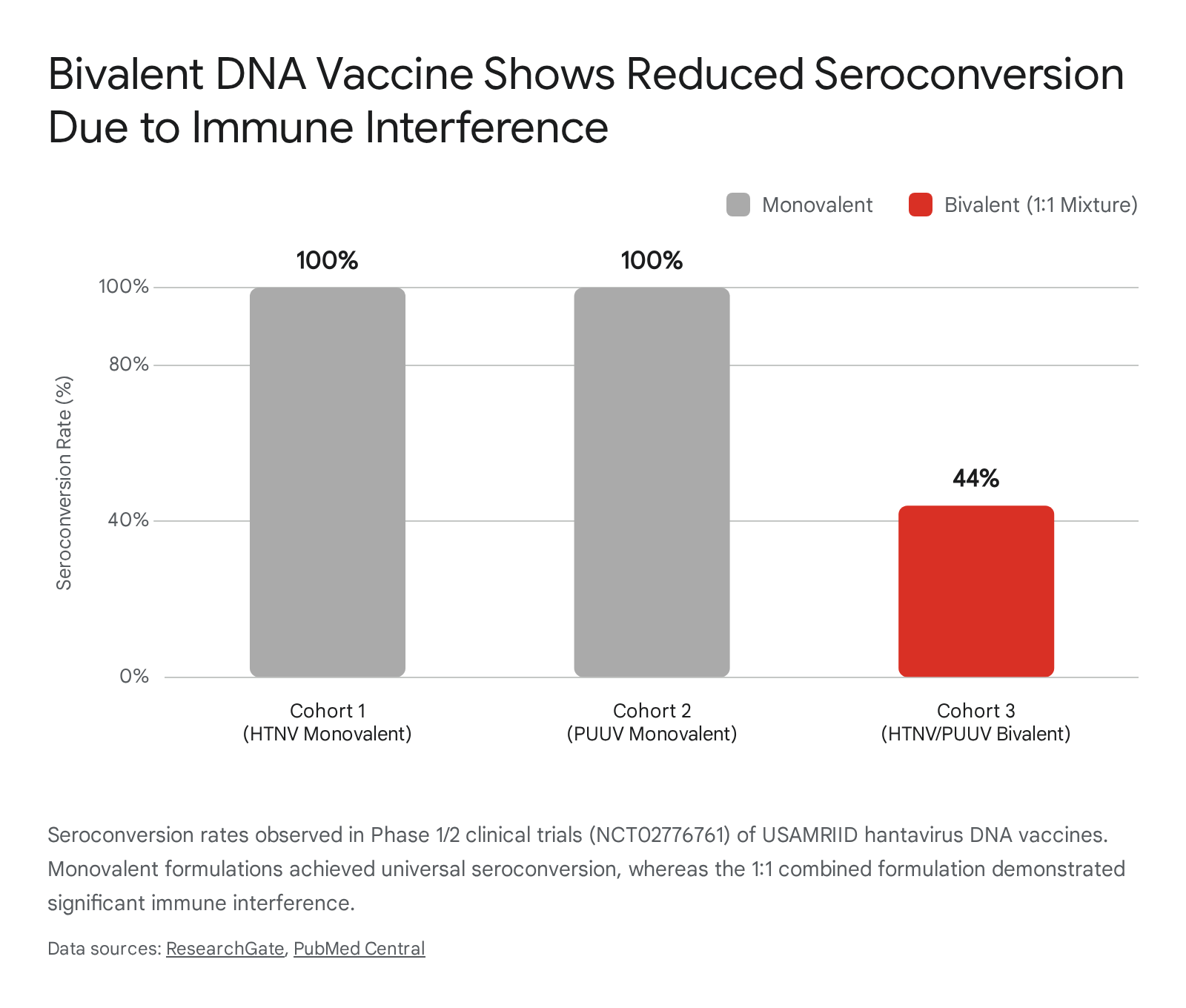
This phenomenon of immune interference indicates that co-administration of related hantaviral antigens suppresses the optimal immunological processing required for robust antibody generation. Because Dobson-Belgrade and Puumala viruses co-circulate in specific geographic regions of Europe, a comprehensive prophylactic countermeasure for HFRS would ideally require multivalent capability 18. The observed interference severely complicates the timeline for formulating a universal pan-hantavirus vaccine.
Advanced Delivery Mechanisms for DNA Vectors
A foundational limitation of plasmid DNA vaccines is inefficient cellular uptake when administered via standard needle and syringe. The DNA construct must cross both the cellular plasma membrane and the nuclear envelope to be transcribed, an inherently inefficient process without mechanical or chemical adjuvants 15. To bypass this limitation, hantavirus clinical trials have predominantly relied on specialized delivery mechanisms.
Early clinical trials utilized intramuscular electroporation, which involves delivering localized electrical pulses to temporarily increase cell membrane permeability 1115. While electroporation significantly increased neutralizing antibody titers (achieving seroconversion in 78% of subjects in some cohorts), the hardware is cumbersome, and the procedure causes localized pain, limiting widespread prophylactic utility 11.
More recent advancements have focused on needle-free jet injection systems, such as the PharmaJet Stratis and Tropis devices 121622. Jet injectors utilize a high-pressure, spring-powered fluid stream to deposit the vaccine deep into the dermis or muscle tissue, mechanically dispersing the payload over a wider cellular surface area. Preclinical evaluation in Syrian hamsters demonstrated that delivering the ANDV DNA vaccine (pWRG/AND-M) via the Tropis jet injection device substantially enhanced immunogenicity compared to needle delivery, achieving sterile protection against lethal viral challenge 22. The successful transition of this delivery method into human Phase 1 trials represents a vital optimization step for DNA-based medical countermeasures 10.
mRNA Vaccine Technologies and Industry Involvement
The accelerated maturation of messenger RNA (mRNA) encased in lipid nanoparticles (LNPs) during the COVID-19 pandemic catalyzed immediate shifts in hantavirus research. Unlike DNA vaccines, mRNA constructs do not need to enter the cell nucleus to be expressed; translation occurs directly in the cytoplasm, generally resulting in faster and more potent antigen expression 1920. Furthermore, mRNA platforms excel at properly folding heavily glycosylated viral envelope proteins like the hantavirus Gn and Gc spikes 13.
The Moderna and VIC-K Partnership
In September 2023, the Cambridge-based biotechnology firm Moderna entered into a collaborative research agreement with the Vaccine Innovation Center at Korea University College of Medicine (VIC-K) 252627. The partnership falls under Moderna's mRNA Access initiative, a program designed to support external academic research on neglected and emerging infectious diseases by supplying proprietary mRNA-LNP technology 2621.
The mechanism of collaboration involves VIC-K researchers providing specific genomic sequences of Old World HFRS-causing strains, while Moderna translates these sequences into preclinical mRNA vaccine candidates 26. Research led by Professor Park Man-sung at Korea University confirmed in early animal studies that the experimental doses successfully prevented hantavirus infection in mice 27. As of May 2026, the candidate remains entirely in the preclinical phase; no human trials have been initiated 2621.
Despite its early stage, the Moderna hantavirus program garnered significant financial market attention in May 2026. The MV Hondius outbreak coincided with the publication of positive Phase 3 clinical data for Moderna's seasonal influenza vaccine (mRNA-1010) in the New England Journal of Medicine 622. The dual catalysts generated an acute, sentiment-driven stock surge, reflecting investor optimism regarding the agility of the mRNA platform to pivot toward rare diseases 2324. However, pharmaceutical analysts noted that hantavirus represents a structurally small commercial market, and that the long-term profitability of the hantavirus program remains uncertain absent massive government procurement contracts 1524.
Academic and International mRNA Consortiums
Beyond corporate pipelines, academic and national consortiums are aggressively advancing mRNA candidates. A leading group at the University of Texas Medical Branch (UTMB), led by researchers specializing in emerging viral hemorrhagic fevers, published preclinical data in 2024 detailing a monocistronic linear mRNA platform 15. The UTMB construct encodes the ANDV glycoprotein precursor (GPC), which is proteolytically cleaved into the functional Gn and Gc glycoproteins inside the host cell 3. This mRNA vaccine demonstrated comprehensive protection in the highly lethal Syrian hamster HCPS model 310.
Similarly, researchers at the Chinese Air Force Medical University have established robust preclinical programs focusing on prefusion-stabilized Hantaan virus mRNA-LNP constructs 15. The aggressive pursuit of mRNA platforms in China aligns with a broader national strategy viewing mRNA not merely as a temporary pandemic measure, but as vital sovereign biomedical infrastructure spanning oncology, respiratory viruses, and emerging hemorrhagic fevers 25.
Thermostabilization via Ensilication
A critical logistical barrier impeding the widespread deployment of mRNA-LNP vaccines and certain advanced biologics is their strict requirement for an unbroken ultra-cold chain 192627. Lipid nanoparticles are highly susceptible to thermal degradation, necessitating storage at -70°C to -80°C to prevent the mRNA payload from degrading via hydrolysis 2628. The World Health Organization estimates that approximately 50% of global vaccine stocks are wasted due to cold chain infrastructure failures, a dynamic that acutely impacts low-resource, rural regions where hantavirus exposures frequently occur 2627.
To circumvent this logistical vulnerability, EnsiliTech, a 2022 spinout from the University of Bath, is developing a thermostable hantavirus mRNA vaccine utilizing a patented preservation technology known as "ensilication" 152729. Ensilication involves synthesizing an inorganic silica (SiO2) nanoshell directly around the biological material. Using silica precursors, the process initiates a sol-gel reaction that intricately deposits protective layers around the vaccine's active ingredients 262730.
| Storage Modality | Target Biomolecule | Maximal Maintained Temperature | Verified Duration | Structural Integrity Output |
|---|---|---|---|---|
| Ultra-Cold Chain | mRNA-LNP / Live Viral | -70°C to -80°C | Months to Years | Complete preservation |
| Standard Refrigeration | Inactivated / DNA | 2°C to 8°C | Months | Gradual thermal degradation |
| Ensilication (Silica Cage) | mRNA / Protein / DNA | Up to 50°C (100°C acute) | Up to 3 Years | Complete preservation upon chemical release |
Extensive structural validation utilizing dynamic light scattering and circular dichroism indicates that the silica cage prevents the internal biomolecules from unfolding, effectively arresting thermal degradation without requiring lyophilization (freeze-drying) 3031. The ensilicated powder can be stored at ambient temperatures up to 50°C for at least three years, and can withstand acute thermal stress of 100°C for brief periods 273031.
When the vaccine is required for administration, an optimized buffer is introduced to chemically etch the silica cage, releasing the fully functional, structurally intact vaccine components 272832. Following a £4.5 million seed funding round in August 2025 and an ongoing £1.7 million UK government contract, EnsiliTech is optimizing this platform for a Hantaan virus mRNA vaccine 1927. While preclinical data is highly promising, the EnsiliTech candidate is still years away from regulatory approval, with human trials projected for 2029 or 2030 4133.
Alternative Viral Vector Approaches
While nucleic acid approaches dominate the late-stage pipeline, recombinant viral vectors offer a compelling alternative. A notable 2026 clinical advancement is the "MVA-Hanta" vaccine trial (ISRCTN17868912) 34. This candidate utilizes Modified Vaccinia Ankara (MVA), a highly attenuated poxvirus historically proven safe and efficacious in smallpox and mpox eradication efforts 34.
The MVA-Hanta vector is genetically engineered to express parts of the hantaviruses responsible for HFRS. The Phase 1, open-label dose-escalation trial is structured to enroll 24 healthy volunteers aged 18 to 50 34. Participants will receive two sequential vaccinations spaced 28 days apart, progressing through three escalating dose levels up to 2x10^8 plaque-forming units (pfu) 34. The primary endpoints measure reactogenicity and the systemic induction of neutralizing antibodies over a six-month monitoring period 34.
Previous attempts to develop viral-vectored hantavirus vaccines - including those utilizing replication-competent vesicular stomatitis virus (VSV) pseudotypes and non-replicating adenovirus type 5 vectors - encountered significant clinical hurdles 11. While these platforms induced robust cytotoxic T-lymphocyte (CTL) responses and survival benefits in hamsters, pre-existing human immunity to the vector backbones blunted the targeted immune response in clinical evaluations 1120. The MVA-Hanta trial aims to establish whether the uniquely attenuated profile of the MVA platform can bypass these historical limitations.
Clinical and Regulatory Barriers to Licensure
The translation of efficacious preclinical and Phase 1 hantavirus candidates into commercially licensed prophylactics is severely obstructed by a combination of epidemiological reality and regulatory architecture. The intersection of low disease incidence and rigid clinical trial requirements creates a near-insurmountable barrier for conventional approval pathways.
Orphan Market Dynamics
In financial prediction markets tracked in May 2026, traders assigned a probability of merely 7.5% that an FDA-approved hantavirus vaccine would be licensed by December 31, 2026 44. This pricing accurately reflects the clinical pipeline: no candidate has advanced to or completed a Phase 3 efficacy trial 44.
Hantavirus infections are rare in North America and Western Europe, squarely categorizing the infection as an orphan disease 35. Because an FDA or EMA Phase 3 trial traditionally requires vaccinating tens of thousands of individuals and monitoring them for natural viral exposure, conducting such a trial for a geographically dispersed, low-incidence pathogen is epidemiologically implausible and commercially unviable 333. Large pharmaceutical entities have virtually zero commercial incentive to fund multi-million dollar late-stage trials for a disease that infects fewer than 300 Americans annually 1524. Progress relies wholly on public biodefense funding - such as the Biomedical Advanced Research and Development Authority (BARDA) - or military research ecosystems 1535.
Surrogate Endpoints and Immune Correlates
When traditional Phase 3 field efficacy trials are not feasible, regulatory agencies like the FDA can grant accelerated approval based on a "surrogate endpoint" - a validated laboratory measurement, such as a precise neutralizing antibody titer, that reliably predicts clinical protection 33637. For example, neutralizing antibody titers greater than 120 mIU/mL serve as an accepted surrogate endpoint for measles vaccines 36.
However, as of 2026, the FDA has no established surrogate endpoint for hantavirus immunity because the exact immunological correlates of protection remain incompletely mapped 1337. Recent longitudinal analysis of PUUV-infected patients hospitalized in Europe indicates that the human humoral response to hantaviruses is highly complex 23839. While robust strain-specific neutralizing antibodies appear quickly, broadly cross-reactive antibodies capable of binding to highly conserved epitopes across multiple New and Old World strains only emerge months into the late convalescent period 23839. This delayed cross-reactivity suggests prolonged antigen persistence driving extensive somatic hypermutation 39. Defining specific protective thresholds for these complex antibody responses remains a crucial regulatory hurdle before any DNA or mRNA candidate can achieve accelerated licensure.
The FDA Animal Rule and Model Limitations
An alternative regulatory mechanism is the FDA's "Animal Rule," which allows for the approval of medical countermeasures based solely on efficacy data derived from well-characterized, predictive animal models when human trials are unethical or impossible 40. Unfortunately, hantavirus researchers face stark limitations in animal modeling.
Of the known human pathogenic hantaviruses, only the Andes virus (ANDV) produces a lethal, frank illness in an accessible laboratory species - the Syrian hamster - that closely mimics the human pathogenesis of HCPS 161822. Conversely, the Old World strains (HTNV, PUUV, SEOV) and the North American Sin Nombre virus (SNV) do not cause discernible clinical illness in standard rodents or nonhuman primates 1118. When evaluating vaccines against these non-lethal strains, researchers can only assess "sterile protection" (the absence of viral replication) rather than survival efficacy, making it exceedingly difficult to assemble the comprehensive efficacy data packages required to satisfy the stringent criteria of the Animal Rule 11.
Global Policy: Pathogen Family R&D Roadmaps
Recognizing the systemic failures inherent in developing medical countermeasures for rare outbreak pathogens, global health institutions initiated a massive strategic realignment in early 2026. In April 2026, during the One Health Summit in Lyon, France, the World Health Organization (WHO), the Coalition for Epidemic Preparedness Innovations (CEPI), and the French research agency ANRS-MIE unveiled global R&D roadmaps targeting 10 priority viral families 414253.
This framework formally abandons the reactive, single-disease approach in favor of comprehensive "Pathogen Family" strategies 4153. To operationalize this, the WHO launched Collaborative Open Research Consortia (CORCs). The roadmap for the Bunyavirales order - which encapsulates the Hantaviridae sub-family - is led by the UK Health Security Agency (UKHSA) in conjunction with the Institut Pasteur de Dakar and Japan's SCARDA 41.
The primary objective of the CORC framework is to definitively map viral biology, ecology, and immune mechanisms across entire families of pathogens before the next spillover event occurs 4243. By pre-establishing the immunological correlates of protection and standardizing clinical trial protocols globally, the roadmap directly supports CEPI's "100 Days Mission" - an ambitious mandate to develop, test, and deploy safe and effective vaccines within 100 days of identifying a novel viral threat 414253.
Conclusions
The 2026 status of hantavirus vaccine development represents a paradigm of scientific capability obstructed by regulatory and economic architecture. Molecular vaccine platforms have proven their biological viability. Plasmids delivered via advanced jet injection devices and cutting-edge mRNA-LNP constructs have both demonstrated the capacity to elicit robust, durable neutralizing antibody responses in preclinical models and early human trials. Concurrently, material science innovations like ensilication provide credible pathways to bypass the ultra-cold chain logistics that currently limit the global distribution of genetic vaccines.
However, clinical translation remains paralyzed by the unique challenges of the Orthohantavirus genus. Multi-strain formulations suffer from significant immune interference, frustrating efforts to develop universal vaccines. More critically, the low global incidence of hantavirus disease eradicates commercial incentives and makes traditional Phase 3 field efficacy trials impossible. Until global health consortia, guided by the newly established WHO Pathogen Family R&D Roadmaps, can definitively establish immunological surrogate endpoints and fully leverage accelerated regulatory pathways like the FDA's Animal Rule, advanced mRNA and DNA hantavirus candidates will remain trapped in early-stage clinical development, available only as experimental biodefense reserves.